WendelseShort breaks, reconsidered
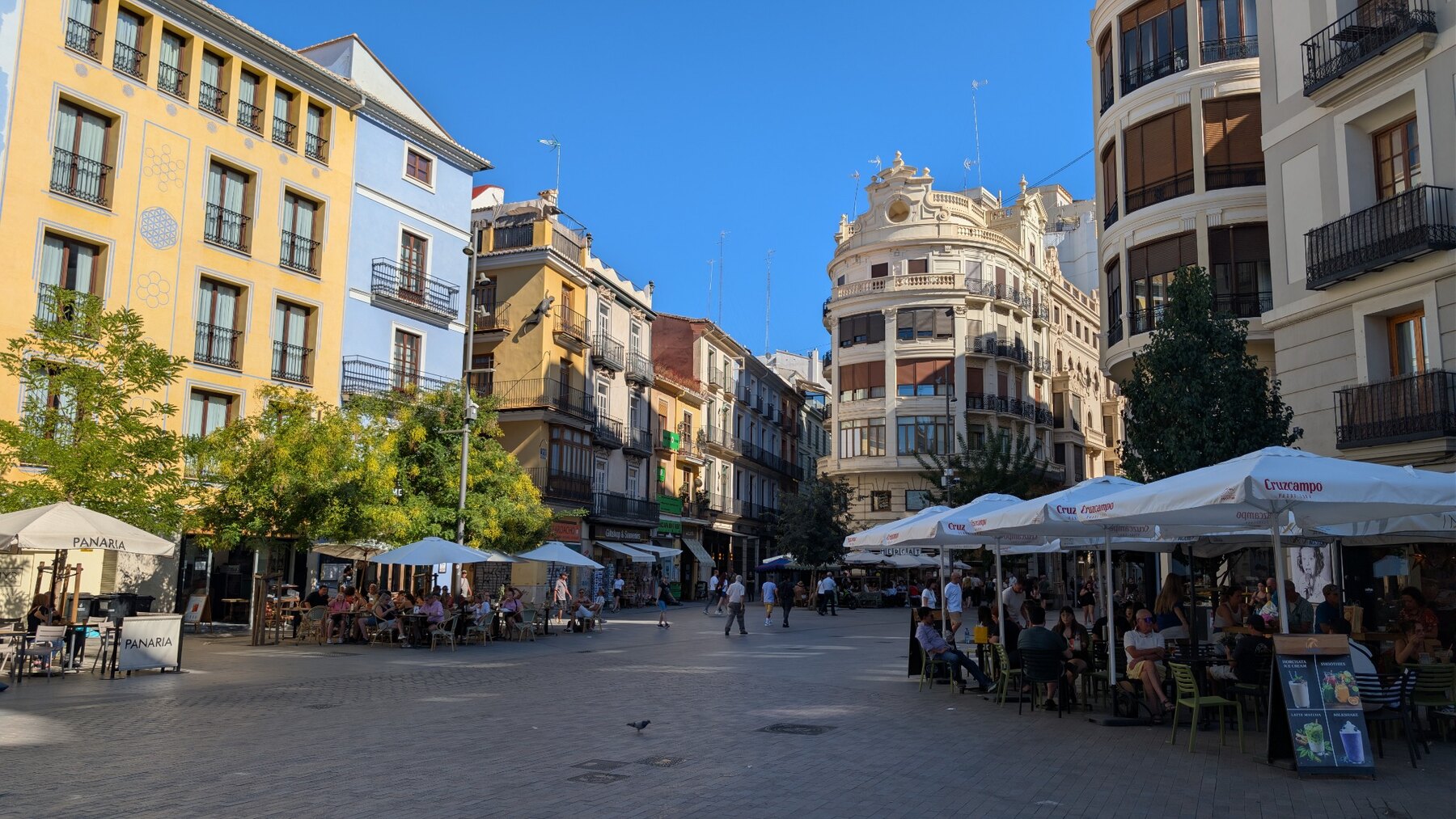
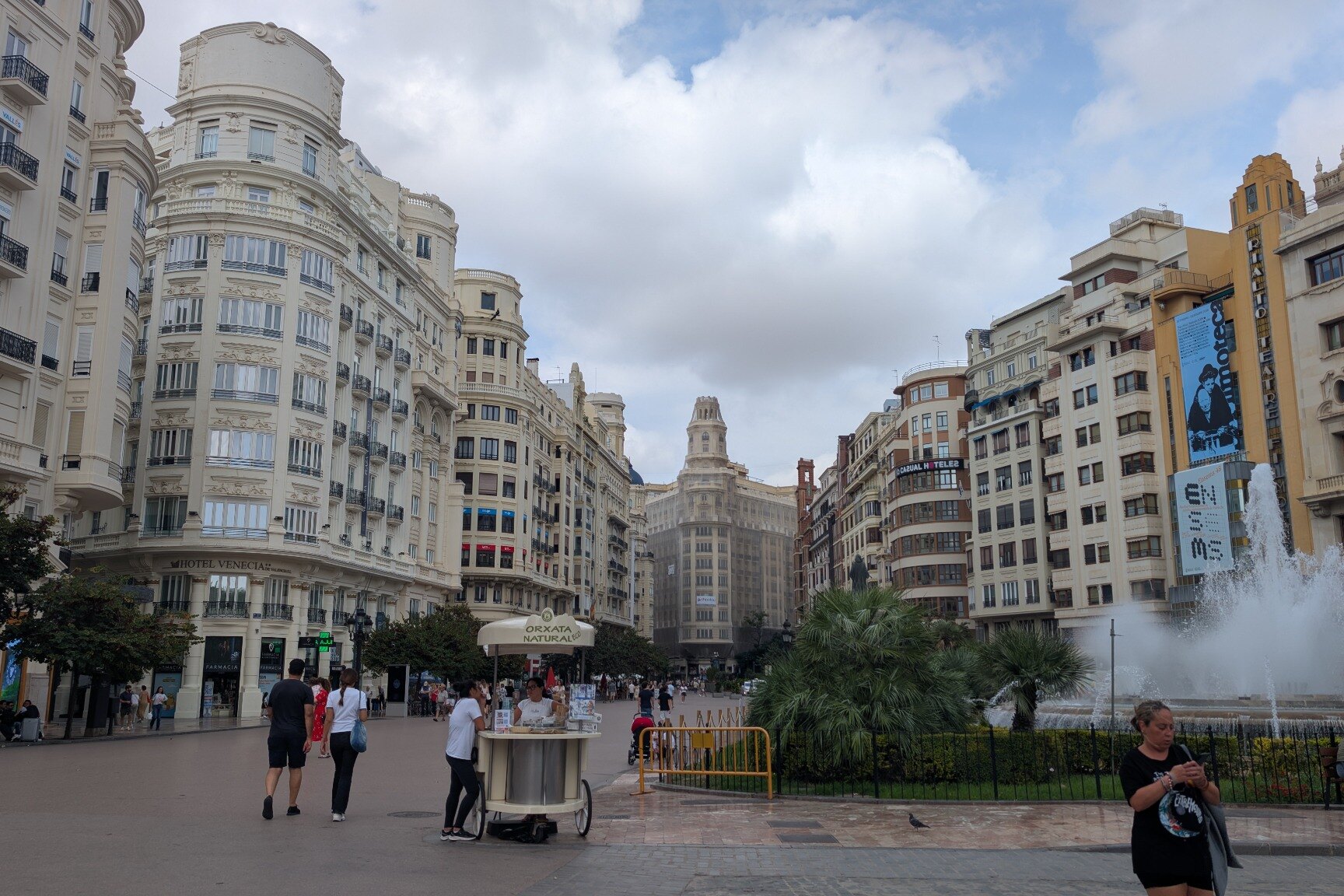
People crossing a broad square among Valencia's historic city-centre buildings
Cafés and pedestrians in a sunny Valencia neighbourhood square
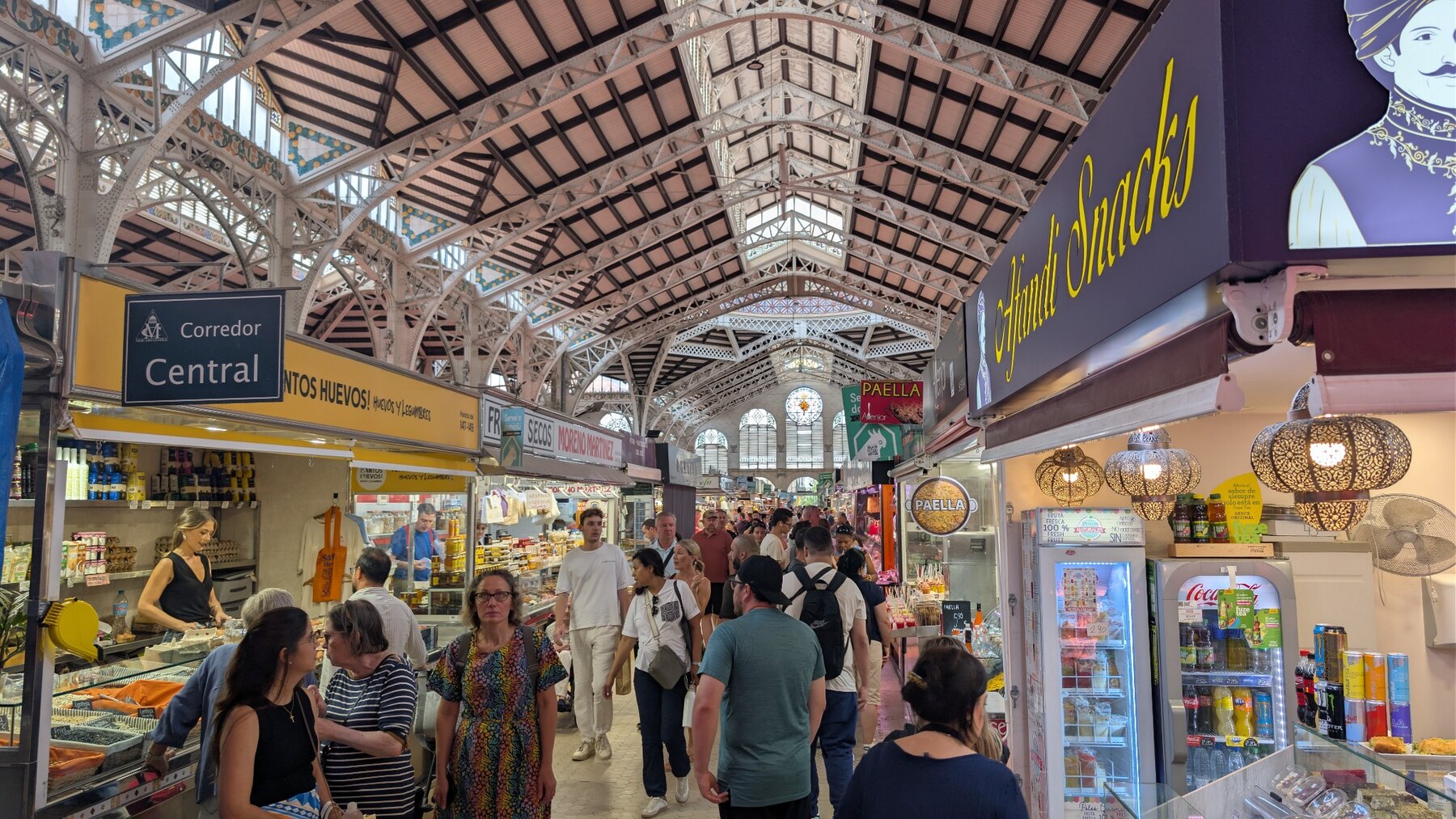
Shoppers beneath the iron roof of Valencia's Central Market
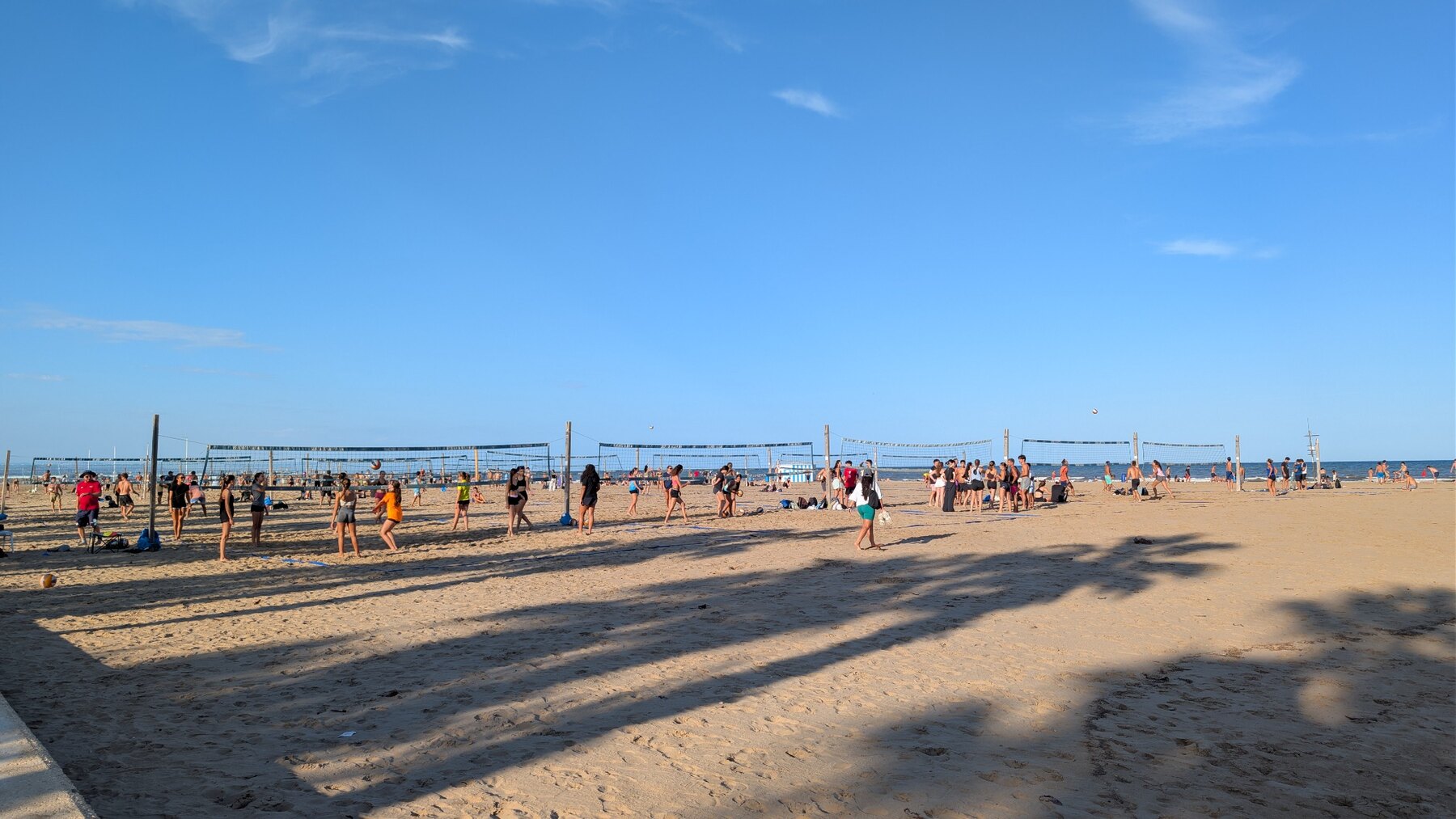
People relaxing on the broad sands of Valencia's city beach

Valencia

València

Spain

Old city, market, then the future.

Valencia works because its contrasts are easy to reach: medieval lanes and civic buildings, one of Europe's great markets, a huge green park in a former riverbed and the futuristic City of Arts and Sciences.

Don't force them into one visual story — enjoy the change.

4 days is ideal for Valencia.

Food & Drink

Food & Drink

Rice is the centre of Valencian cooking, and it comes from the Albufera lagoon just south of the city. But the everyday food here is at least as interesting: the mid-morning esmorzaret, horchata pressed from tiger nuts grown in the fields to the north, and mussels that appear for only part of the year.

Valencian food begins with rice, market-garden produce and Mediterranean seafood, but the local rituals of esmorzaret, horchata and seasonal clóchinas make it much richer than paella alone.

Must try

Paella Valenciana

The original paella: rabbit, chicken and beans, cooked over wood, and eaten at lunch.

Valencian paella comes from the rice fields and market gardens around the Albufera, and the traditional recipe is specific — rabbit, chicken, flat green beans, garrofó butter beans, tomato, saffron and rice, cooked wide and shallow. No chorizo, and in the strict version no seafood. The rice matters most: a thin layer, dry rather than creamy, with a toasted crust called socarrat on the base of the pan.

Almost everyone arrives having eaten something called paella. Here you find out what the dish actually is.

Rice only a few grains deep, cooked to order — a genuine one takes thirty to forty-five minutes and is usually made for two people upwards.

Lunch rather than dinner; rice is a midday meal here and many rice restaurants do not serve it in the evening.

Rice specialists in El Palmar and along the Malvarrosa seafront, or established arrocerías in the city.

All i pebre

Albufera eel stewed with garlic, paprika and potato.

A short, punchy stew of eel from the freshwater lagoon, cooked with a great deal of garlic, sweet paprika, olive oil and potatoes, sometimes thickened with ground almonds. It belongs to the lakeside villages rather than the city — the dish the Albufera fishermen made from their own catch.

It is the other half of the Albufera's food story: the same landscape that grows the rice also produces this.

Eel on the bone in a brick-red sauce, with potatoes that have taken on the paprika rather than sitting pale in it.

Wendelse tip: It pairs naturally with a boat trip on the lagoon — eat it in one of the lakeside villages rather than in the centre.

Restaurants in El Palmar and the villages around the Albufera, south of the city.

Esmorzaret

Valencia's second breakfast: a large filled roll, eaten mid-morning with a beer.

Between roughly nine and eleven, bars fill with people eating an almuerzo — a substantial bocadillo, often the sausage-and-egg 'blanc i negre', served with olives, peanuts, a spirit measure and a small beer or a cremaet coffee. It began as a labourers' meal and is now a genuinely defended local ritual, usually offered as one set price rather than a menu of parts.

It is the most everyday Valencian custom a visitor can simply join, at a fraction of the cost of a restaurant meal.

A neighbourhood bar busy at ten in the morning.

Walk in mid-morning and ask for the almuerzo; the options are usually spoken rather than written.

Wendelse tip: It is a full meal. Plan a light lunch, or treat this as lunch.

Ordinary bars in Ruzafa, Benimaclet and El Cabanyal rather than the tourist centre.

Horchata with fartons

Chilled tiger-nut milk with long sugar-glazed buns made for dipping.

Horchata de chufa is pressed from tiger nuts grown in the Alboraya fields just north of the city, lightly sweetened and served very cold, either liquid or half-frozen as granizada. Fartons are soft, elongated glazed buns made specifically to be dunked in it without collapsing. The pairing is an established afternoon habit rather than a novelty.

The tiger-nut crop belongs to this stretch of coast, which is why the drink is tied so closely to Valencia.

Freshly pressed horchata, which separates slightly and tastes nutty; the cartons do not.

Try it with: Fartons — the two are designed around each other.

Long-standing horchaterías in the centre and in Alboraya, where the crop is grown.

Clóchinas

Small local mussels, steamed simply, and available only in the warm months.

Clóchinas are Valencia's own mussels — smaller and sweeter than the Galician kind — farmed off this coast and traditionally sold only between roughly May and August. They are cooked plainly with oil, bay, paprika, lemon and pepper so the shellfish carries the dish.

They are a seasonal marker: their appearance in bar windows is how the city announces summer.

Small shells and a short broth of oil and paprika rather than a cream or wine sauce.

As a shared ración at the bar, with bread for the broth.

Seafood bars in El Cabanyal and around the Central Market during the season.

Agua de València

Cava, fresh orange juice, gin and vodka — invented in a Valencia bar.

Created in the city in the 1950s as a joking answer to ordering 'a water from Valencia', it mixes cava with juice from the region's oranges plus gin and vodka. It is normally made by the jug for a table to share, and it is stronger than it tastes.

It ties together the two things the region is best known for producing — oranges and sparkling wine — in a drink that genuinely started here.

Juice squeezed to order rather than poured from a carton.

Order a jarra for the table as an early-evening aperitif.

Bars around the Barrio del Carmen and Plaza de la Virgen, where it is a standard listing.

Mercado Central

One of Europe's largest working food markets, still supplying the city daily.

The modernista market hall opened in 1928 — iron, glass and tiled domes on the scale of a cathedral — and it still functions as a working market rather than a food court, with fish, huerta vegetables, rice, oranges and cured meats sold from hundreds of stalls each morning. It is the clearest way to see the ingredients behind the city's rice dishes before they reach a restaurant table.

It shows the market gardens and the coast that supply Valencia's kitchens in one building, and the building itself is a significant piece of the city's architecture.

Mornings, Monday to Saturday; trading winds down early in the afternoon.

Plaça de la Ciutat de Bruges, beside the Llotja de la Seda.
Good to know

  • Opening days and named businesses change: verify any business-level recommendation at trip time.

Art & Architecture

A modern city with old bones

Valencia is not a city you sink into the way you sink into Seville or Siena. There are beautiful medieval streets here, but they come in pockets, and between them the city is emphatically twentieth- and twenty-first century. That is the pleasure of it: in a single afternoon you can stand in a Gothic trading hall, walk through an iron-and-glass market still full of fishmongers, drop down into a dry riverbed that is now the city's park, and end up under Calatrava's white shells at the far end of it. One large reason those contrasts are so easy to move between is a change to the city's geography. After the Turia flooded catastrophically in 1957, the river was diverted around the south of the city under the Plan Sur, and the empty bed through the middle became gardens. Valencia therefore has no river through it. It has a long green trench where one used to be, with its historic bridges still standing over dry ground — and those bridges are the hinge between the old city and the new.

A Mediterranean trading city that kept its Gothic set-pieces, built confidently in the Valencian modernista manner around 1900, then spent the late twentieth century filling in its own former river with parkland and spectacle.

Don't missWalk under a fifteenth-century bridge from the riverbed. You will never look at the old city the same way again.

Wendelse tipTreat the Turia as your main route rather than the metro. Almost everything in this section connects along it, and you get the bridges from underneath as a bonus.

Something you might missCeramics are not confined to the famous buildings. Tiled shopfront panels, stair risers, house numbers and doorway surrounds turn up all over the centre and along the coast — this is a region that industrialised tile-making and then used it on ordinary buildings.

Must see

La Lonja de la Seda

A merchants' exchange whose trading hall is a stone forest of twisted columns — a commercial building given the treatment a cathedral would get.

Built between 1482 and 1533 to a design by Pere Compte, the Silk Exchange was where contracts were struck, and it does not pretend otherwise: there is no altar, no nave, no liturgy. The Sala de Contratación is one high room whose columns rise, twist through their full height and open out into the vault ribs without capitals to interrupt them, so the whole hall reads as growth rather than structure. Around the top of the walls runs an inscription in Latin addressed to the traders about honest dealing. The point is worth sitting with: a city put its finest late Gothic craftsmanship into a room for doing business, and carved a warning about usury round the edge of it.

It is the clearest surviving statement of what Valencia was at its wealthiest — a Mediterranean commercial power that chose to monumentalise trade rather than piety.

Look for: The point where each column stops being a column: there is no capital, the spiral simply divides into vault ribs.

Something you might otherwise miss: The gargoyles and corbels on the exterior, several of them frankly obscene. They were carved for a building nobody had to enter reverently.

Wendelse tip: Do the hall and then the walled orange courtyard behind it, which is where you feel the building as a workplace rather than a monument.

Late Valencian Gothic, 1482–1533 · 45 minutes, longer if the hall holds you · Early, when the low light rakes across the spiral columns

Mercado Central

An iron, glass and tile market hall directly across the square from La Lonja, still operating as a market.

Chosen by competition in 1910 from six proposals, the building is the work of Alejandro Soler March and Francisco Guardia Vial, both trained in Barcelona in the circle of Domènech i Montaner, and it was completed in 1928 by Enrique Viedma and Ángel Romaní. Everything that makes Catalan modernisme recognisable is here — ironwork, coloured glass, ceramic surfaces, a big central dome — but applied to a working food hall rather than a concert hall or a mansion. Stand in the middle and look up: the roof is high and largely glazed, so the interior is daylit rather than lit, and the light falls on fish, fruit and hanging hams. The best thing about it is that the comparison is right there across the square. Two buildings, four hundred and fifty years apart, both built to house commerce, both taking it seriously.

It shows Valencia doing the same thing twice in different centuries: treating trade as the thing worth building beautifully for.

Look for: The weathervane on the dome — a parrot, of all things — and the tiled and stained-glass panels showing the produce sold below.

Wendelse tip: Come when it is trading, not for the architecture alone. Empty, it is half a building.

Valencian modernismo, competition 1910, opened 1928 · 30–45 minutes · Mid-morning on a trading day, when it is loud

The Turia gardens and the old bridges

Nine kilometres of park in a dry riverbed, crossed by the bridges that used to span water.

After the flood of 14 October 1957, which killed at least eighty-one people and wrecked large parts of the city, the government's Plan Sur rerouted the Turia around Valencia's southern edge. The abandoned bed was eventually laid out as gardens. What makes it architecturally interesting rather than merely pleasant is the change of level. You are walking where the water was, which means you pass beneath the bridges instead of over them — the Puente de Serranos and the Puente de la Trinidad among them — and you get to look directly at masonry, cutwaters and arch springings that were designed to be seen from a boat or not at all. It is also the city's main everyday space: runners, football, dog-walkers, people cutting across town. You are not visiting a park, you are using the same corridor as everyone else.

Diverting the river and keeping the bed as public space shaped how modern Valencia is used, and it is the easiest thing in the city to experience directly.

Look for: The masonry from below: cutwaters, arch springings and the courses of stone that were built to stand in water, and the difference between a medieval arch seen from beneath and the same arch from street level.

Something you might otherwise miss: The Torres de Serranos beside the northern stretch: a fourteenth-century gate that looks solid from outside and opens up on the city side into tiers of arched galleries. That open back was deliberate — a gate that could not be held against the city if it were ever taken.

Wendelse tip: Walk one section rather than trying to do the whole length. The stretch between Serranos and the Palau de la Música gives you the most bridges per kilometre.

Medieval and Renaissance bridges over a 1980s-onward park · 1–2 hours for a good stretch · Early evening, when the city is using it

City of Arts and Sciences

A complex of white structures at the seaward end of the former riverbed, opened from 1998 onward.

The complex sits along roughly two kilometres of the old Turia bed, which is why it should be reached through the park rather than treated as another city-centre sight: the approach is part of the argument. Calatrava designed the Hemisfèric, the Science Museum, the Umbracle, the Palau de les Arts and the Àgora; Félix Candela is responsible for the shell roofs of the Oceanogràfic, and they are the most structurally daring thing on the site — thin concrete curves doing the work with very little material. Calatrava's buildings are skeletal in a different way, repeating ribs and fins until a roof becomes something closer to a ribcage. Whether you love them or find them cold, they are worth walking around slowly rather than photographing once: the surfaces are broken white ceramic, the reflecting pools are there to double everything, and the buildings are composed for the view across water.

It is the far end of the same story as La Lonja — a city spending heavily on architecture to announce what it now is.

Look for: The white skin close up. It is broken ceramic laid as mosaic, a local technique at enormous scale, and up close you can see the cracking and repair that comes with it.

Wendelse tip: Go at dusk. The pools and the lighting are doing half the design work and they only switch on then.

Late twentieth and early twenty-first century; Santiago Calatrava and Félix Candela · 1–2 hours outside; interiors are separate visits · Late afternoon into dusk

Look closer

Valencia builds with tile

Ceramic is not decoration reserved for monuments here; it is an ordinary building material.

This region has made tiles industrially for a very long time, and the habit shows in buildings nobody would call architecture: advertising panels fired into shopfronts, tiled skirting on street walls that can be hosed down, saints' panels set into corners. Start noticing it and it keeps turning up, street after street.

Shopfronts and doorways in the centre, the Mercado de Colón's façade, and house fronts throughout Cabanyal.

Where the old city stops

The medieval centre ends abruptly, and you can walk across the join in a couple of minutes.

The historic core was walled, and when the walls came down in the nineteenth century the city laid out a regular grid outside them. So the change is not gradual: irregular lanes and varied plot widths give way to straight streets, uniform block heights, wide pavements and consistent balcony lines within a few steps. Feeling the street straighten under your feet tells you more about Valencia's growth than any date.

Walking south-east out of the old centre towards Mercado de Colón and the Ensanche streets around it.

Cabanyal works by repetition

A seafront neighbourhood of low houses on a tight grid, where no single building is the point.

Cabanyal began as a fishing settlement of barracas laid out in lines along the shore, and its long blocks still run parallel to the coast — a grid you can read as you walk it. Much of what you see now dates from around 1900, a popular, domestic version of modernismo: two low storeys, tiled fronts, ironwork, repeated house after house. The neighbourhood has held protected heritage status since 1993. Do not come here for a monument. Come to see what a whole district built to one modest pattern looks like, and then use the beach and the bars like everyone else does.

The streets between Calle de la Reina and the beach, north of the port.

From the trading city down into the river

This walk has one subject: the moment mercantile Valencia hands over to the Valencia that was built on top of its own river. It is short, mostly flat, and it ends with you standing below ground level looking up at a medieval bridge. Do not extend it to the City of Arts and Sciences — that belongs to a separate outing along the park.

  1. 1. Mercado Central30–45 min

    Start inside, in the noise. Look up at the glazed roof and then out at the square — you are about to cross from 1928 to 1482 in fifty metres.

  2. 2. La Lonja de la Seda45 min

    Directly opposite. The trading hall, then the orange courtyard. Note that both buildings on this square were built for commerce, four and a half centuries apart.

  3. 3. The lanes towards the cathedral20–30 min

    Walk north through the old centre without a target. This is the part of Valencia that feels genuinely medieval; notice how few minutes it takes to cross it, and where the lanes hand over to something later.

  4. 4. Torres de Serranos20 min

    The fourteenth-century gate marking the old northern edge. Walk round to the back and see that it is open — the city side was never enclosed.

  5. 5. Down into the Turia30–40 min

    Take the steps down beside the gate into the riverbed and walk a stretch under the bridges. From here the old city is above and behind you and the park runs away east. This is the transition the whole walk was for.

What to look forThe change in level at the end, and how differently the bridges read from beneath.

Total Around 2.5 to 3 hours at an unhurried pace · Morning for the market, or late afternoon so the riverbed comes at golden hour · easy

Good to know

  • No architecture day is offered here on purpose: Valencia's layers are far apart and a forced single day flattens the contrast between them.
  • Ticketed interiors change their arrangements; nothing above depends on a particular ticket or entry order.

Why Wendelse likes it

Getting around

Walk in the centre, cycle or walk through the Turia Gardens, and use metro/tram/bus for longer jumps such as the beach. Valencia is exactly the kind of city where local transport expands what fits comfortably into a short break.

Rhythm and pacing

Separate old Valencia from the City of Arts and Sciences instead of racing between them. Lunch is a good time for the serious rice meal; evenings can be lighter.

Don't overdo it

Don't eat paella for dinner just because you think you should. There's no need to treat the City of Arts and Sciences as one building you photograph for ten minutes.

Season and timing

Heat strongly affects summer pacing. Beach weather can legitimately replace an interior. Market opening patterns are worth checking.

Birmingham · 6–9 November · 4 days

A suggested shape for your days.

Built around your dates and what you said you're in the mood for. The journey itself isn't checked until you choose dates in Results.

Friday · 6 November

Arrive & settle in

Arrival day

Afternoon
  • Arrive and check in.
  • City of Arts and Sciences — City of Arts and Sciences is one of the strongest ways to understand Valencia without turning the day into a checklist.

Nothing else planned. That's deliberate.

Saturday · 7 November

Your big exploring day

Weekend

Morning
  • Central Market & Lonja — Central Market & Lonja is one of the strongest ways to understand Valencia without turning the day into a checklist.
  • Cathedral and old-city walk — Cathedral and old-city walk is one of the strongest ways to understand Valencia without turning the day into a checklist.

Keep the afternoon free — wander, sit somewhere, do nothing.

Sunday · 8 November

Take Valencia at your own pace

Weekend

Afternoon
  • Cycle or walk the Turia Gardens — Cycle or walk the Turia Gardens is one of the strongest ways to understand Valencia without turning the day into a checklist.
Evening
  • Proper Valencian paella meal — Proper Valencian paella meal is one of the strongest ways to understand Valencia without turning the day into a checklist.

Nothing else planned. That's deliberate.

Monday · 9 November

One last morning

Departure day

Morning
  • Breakfast, then a last walk through town.
Afternoon
  • Lunch, then the journey home.

Leave gaps between plans — nothing here needs rushing.

Prototype itinerary. Activity availability is illustrative, not live opening hours.

Don't miss

Even if it's not what you came for.

Food & Drink

Taste Valencia properly

Valencian food begins with rice, market-garden produce and Mediterranean seafood, but the local rituals of esmorzaret, horchata and seasonal clóchinas make it much richer than paella alone.

  • Paella Valenciana
  • All i pebre
  • Esmorzaret
Explore Food & Drink →

Art & Architecture

The city with a park where its river used to be

Valencia's pleasure is movement between very different versions of itself: a Gothic trading hall, a modernista market, a dry riverbed full of runners, and Calatrava's white shells at the end of it.

  • La Lonja de la Seda
  • Mercado Central
  • The Turia gardens
Explore Art & Architecture →

Getting there

Valencia has its own airport: Valencia Airport

Choose your dates and we'll check real flights and the journey from Birmingham.

Check a journey for your dates →

Traveller fit

Is Valencia your kind of place?

Food
★★★★★5 out of 5
History
★★★★☆4 out of 5
Architecture
★★★★★5 out of 5
Walkability
★★★★★5 out of 5
Outdoors
★★★★★5 out of 5
Atmosphere
★★★★★5 out of 5

Things worth doing

A first day that works

Central Market; La Lonja and old centre; long lunch with rice; relaxed afternoon streets and squares.

If you have a second day

Move through Turia Gardens towards the City of Arts and Sciences; spend time there according to interest; continue towards the coast or use transport.

An extra day, or bad weather

With another day, the beach, museums or neighbourhood exploration become easy without sacrificing the centre.

Where to stay

Stay in Ciutat Vella or near the Turia

Best for mixed interests

A central/Turia base keeps the old city walkable and makes cycling or transit to the contemporary complex and beach easy.

Ready to make it a trip?

Valencia

4 days · Food · Architecture · Outdoors · Culture · Walkable

Prototype placeholders — nothing is connected to a booking service yet.

← Back to your Wendelse