Culture & Atmosphere
Siena still belongs to its neighbourhoods
Look past the medieval backdrop and the city's contrade, symbols and civic traditions reveal a very different Siena.
- The Contrade
- Piazza del Campo
- Sienese civic traditions
Italy
Medieval Italy with the volume turned up.
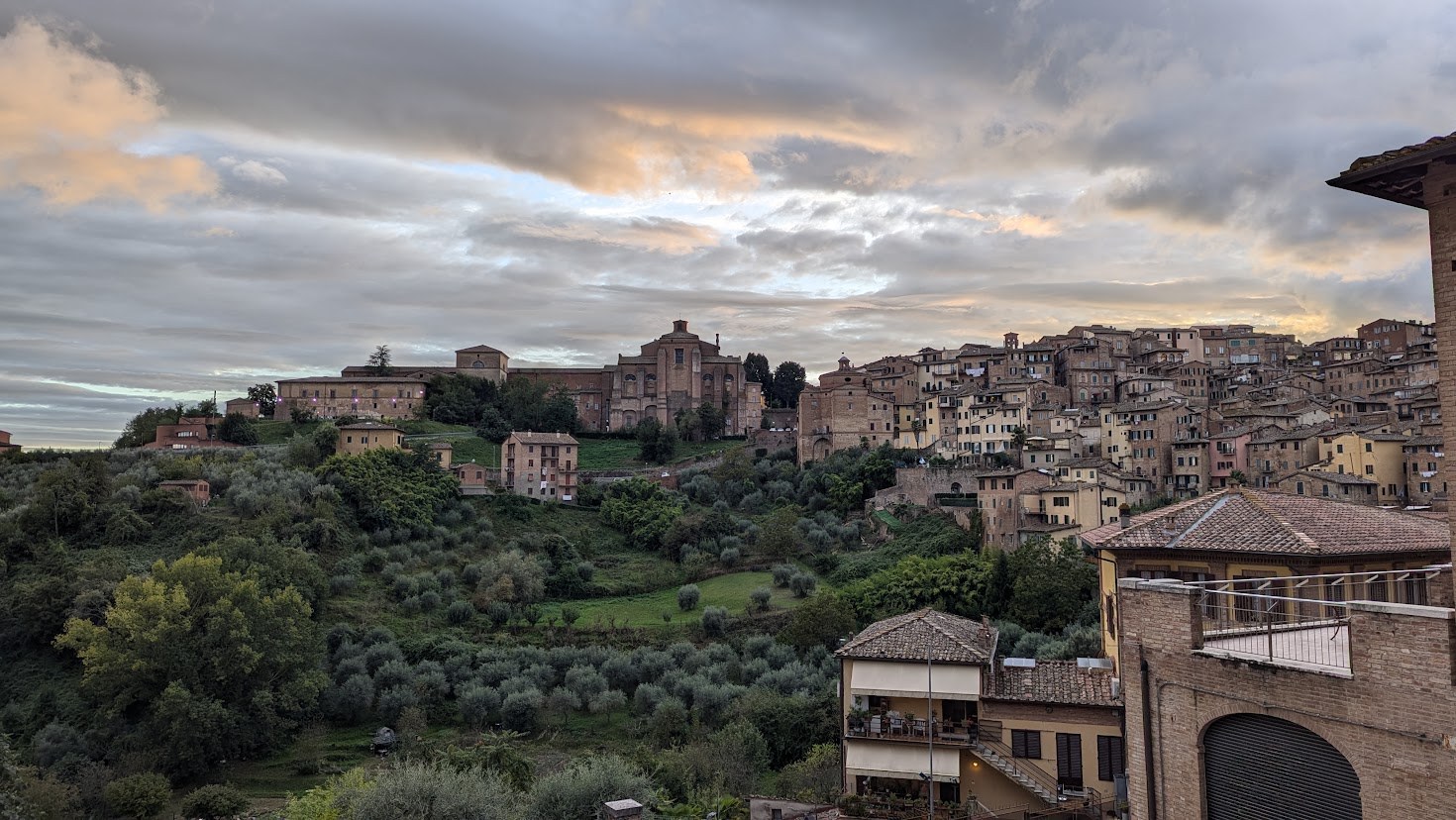
Steep streets converge on one extraordinary square, in a Gothic city that still lives by its own neighbourhoods.
4 days works well in Siena.
Culture & Atmosphere
Siena can look almost impossibly preserved, but it isn't a medieval backdrop. The streets are divided between neighbourhoods with identities of their own, symbols appear on walls and fountains once you know to look, and the traditions visitors associate with the Palio run far wider than the race itself.
Understanding even a little of that changes how Siena feels. Instead of a collection of Gothic sights, you start to see a city whose past is still part of how people organise their belonging today — to a contrada first, and to Siena through it.
Siena's historic centre is largely pedestrian, and the balance of who is using it shifts across the day. Later on, the streets are used more for walking, meeting and eating than for sightseeing, and the Campo becomes somewhere to sit rather than somewhere to cross.
Wendelse tipLearn the symbol of the contrada you're staying in. You'll start seeing it on flags, plaques and lamps all over that part of the city — and the medieval street maze quickly turns into distinct neighbourhoods.
Living traditions
Siena's historic centre is divided into seventeen contrade — neighbourhood communities, each with a defined territory, a name, an emblem and its own colours.
The contrade developed over centuries out of the city's medieval districts and companies, which had practical civic roles long before they became associated primarily with the Palio. Their number and boundaries were formally fixed in the eighteenth century.
A contrada is not a team and not a tourist district. Each has its own society premises, a museum holding the banners it has won, an oratory or chapel and a baptismal fountain, and it marks births, celebrations and losses within the neighbourhood. People are usually connected to a contrada through family or where they live, and involvement varies enormously from person to person.
Flags, wall plaques, street lamps and small emblems marking where one territory ends and another begins; contrada names appearing alongside street names; occasional decorations for a neighbourhood occasion.
Contrada premises and events are community life, not attractions. Some contrada museums can be visited by arrangement; treat anything beyond public streets as an invitation rather than an entitlement.
Year-round
A bareback horse race run around Piazza del Campo, contested between contrade, traditionally held twice each summer.
Racing in Siena has medieval roots, and the Palio in its present form in the Campo has been run since the seventeenth century. Each race is dedicated to the Virgin Mary, and only some of the seventeen contrade take part in any single running.
The race lasts a matter of minutes; what surrounds it — the preparation, the blessing, the historic procession, the rivalries, the aftermath — belongs to the contrade and their year. Understood that way, the Palio is a civic and religious expression of neighbourhood identity rather than a sporting event that happens to be old.
Outside the Palio period the city looks ordinary, but its traces are permanent: winning banners kept in contrada museums, the shape of the Campo itself, and the way people describe parts of the city by contrada.
Understanding why the Palio matters to Siena is far more useful to a short break than working out how to attend it. Around the race, the city is exceptionally busy and normal rhythms change; outside it, the culture the race belongs to is still there to be read.
Traditionally held twice each summer; culturally present all year
Almost every trip to Siena falls outside the Palio, and almost nothing important is missed by that.
Contrada identity is a permanent feature of the city, not a summer event. The territories, symbols, fountains, museums and society buildings are all there in an ordinary week, and the relationship between neighbourhood and city is visible in how the streets are marked and used.
Emblems on corners and lamps, the colours of a contrada repeated along a run of streets, a fountain at the heart of a district, quiet premises with a name over the door.
Pick up the boundaries as you walk rather than making a route of them. The point is that the city stops being anonymous, not that you collect all seventeen.
Year-round
Public spaces
A shell-shaped, sloping square divided into nine paved sections, closed by the Palazzo Pubblico and the Torre del Mangia — covered properly in Siena's architecture guide.
Laid out as the meeting point of the city's districts and the stage of its medieval government.
In daily life it works as Siena's shared living room: somewhere to sit on the brick slope, meet someone, eat lunch, watch the light move across the Palazzo Pubblico, or simply pass through several times a day. It is also the ground the Palio is run on, which is part of why the city treats it as belonging to everyone rather than to any one contrada.
How many people sit directly on the paving; the way the slope gathers everyone towards the lowest point; the Fonte Gaia at the top edge, still the square's water source in form if not in function.
Don't just cross it. Most routes through Siena eventually deliver you into the Campo, and it's easy to treat it as the space between sights. Sit for a while, and come back at a different time of day — the square feels quite different depending on how it's being used.
Siena's three main ridge streets — Banchi di Sopra, Banchi di Sotto and Via di Città — meet near the Croce del Travaglio, just above the Campo.
These are the city's everyday arteries: shops, banks, errands, and the route people take for an evening walk. Watching where they converge explains why the Campo works as it does.
The change in surface and gradient as side lanes drop away steeply from the ridge, and how quickly a busy street becomes a quiet residential one.
Neighbourhoods
A way of walking Siena as neighbourhoods rather than as a list of sights.
It gives an unstructured walk a thread without turning it into a checklist, and it makes the geography of a confusing medieval street plan suddenly legible.
Choose one area of the historic centre. Find its emblem on a plaque or lamp, look for its fountain, then keep walking and watch for the point where the symbols change to another animal and another set of colours. Carry on into the next district instead of turning back.
Stay on public streets. Contrada premises, oratories and gatherings belong to the community; don't enter or photograph private activity without a clear invitation.
The streets dropping away from the three main ridge streets are residential, steeper and much quieter.
Within a couple of minutes of the busiest shopping street, the city becomes ordinary: washing, parked scooters, small shops, and views out over the countryside at the end of a lane.
Go down one and come back up another. Siena's gradients are real, so plan on fewer descents than the map suggests.
The city's symbols
Each contrada has an animal or emblem — among them the wolf, the goose, the snail, the tortoise, the panther, the giraffe and the dragon — with its own colour combination.
Once you can read them, the boundaries of the neighbourhoods appear without a map, and the same symbols recur in museums, fountains and celebrations.
Look for: Emblems set into wall plaques, cast on street lamps, painted on flags and repeated in decoration along a district's streets.
Each contrada has its own modern baptismal fountain, usually carrying the district's emblem.
They are used for a contrada's own ceremonies, which is why they sit at the heart of a district rather than at a sight.
Look for: The emblem worked into the stone or bronze, and the district's colours nearby.
Two symbols of the city itself, as opposed to its neighbourhoods: the black-and-white Balzana, Siena's civic emblem, and the she-wolf suckling Romulus and Remus.
Siena traditionally traced its founding to Senius, son of Remus, which is why the Roman she-wolf appears as a civic emblem on columns and buildings around the city.
Look for: Black-and-white shields on public buildings, and she-wolf statues on columns near the Cathedral and the Campo.
Street corners carry small shrines, dedications and inscriptions alongside contrada and civic symbols.
Siena's identity was built out of civic government and religious devotion together, and the walls still show both, often within a few metres of each other.
Ways to spend time here
The single most useful cultural thing to do in Siena costs nothing and involves staying still.
It converts the Campo from a photograph into a place, and it's the clearest way to see the difference between a monument and a functioning public space.
Find a spot on the brick slope, and give it half an hour. Watch who's crossing, who's meeting, where people sit and how that changes.
30–60 minutes
Several contrade keep museums holding the banners they have won, their costumes and their history.
Seeing a neighbourhood's own record of itself explains the Palio more convincingly than any account of the race.
These are community collections rather than public attractions, and access is generally arranged in advance rather than walked into. Ask locally or through your accommodation, and treat a visit as hospitality.
Booking required
Walking the main streets and squares in the evening, without sightseeing goals.
Once the day's schedule is finished, you notice the city rather than its contents.
Take Banchi di Sopra or Via di Città, drift into whichever squares you've come to like, and let the route repeat itself. Returning to familiar places is the point.
After dinner
Siena is often visited for a few hours from elsewhere in Tuscany. Staying overnight is a genuinely different experience.
An overnight stay lets you see the historic centre at several rhythms — early morning, the middle of the day, and after the day's visiting has finished — instead of only during the busiest window. That is the whole argument for a short break here.
The rhythm of the city
Deliveries, errands and school runs in a centre where almost everything is done on foot.
The Campo and the main streets are at their least crowded, and shops along the ridge open onto a city going about its business.
The busiest sightseeing window, concentrated around the Cathedral, the Campo and the main streets between them.
A good time to be somewhere with a chair — a long lunch, or a district away from the two main sights.
The balance shifts back towards residents, walking, aperitivo and dinner.
More of the movement is along the ridge streets and between squares, and the Campo is used for sitting rather than crossing.
Markets
Siena's big general market is held on the open ground by La Lizza and the Fortezza Medicea, outside the tightest part of the historic centre.
It is a working city market rather than a visitor one — useful if you want to see Siena doing something entirely ordinary at scale.
How local it is, and how little of it is aimed at visitors.
Check the current day and hours locally before making the walk.
Things to notice
The moment the emblems and colours on the lamps switch is the moment you've crossed into another contrada.
Sitting, waiting, meeting and eating on the paving — a monumental space treated as ordinary ground.
Siena is built on ridges. The steepness is part of why neighbourhoods feel distinct, and part of why you'll want fewer stops than you planned.
The consistency of Siena's building materials is one reason the city reads as a single composition — the detail belongs to the architecture guide, the effect belongs to how it feels to walk here.
Deliberately underfilled. Siena rewards repetition and time spent still more than a longer list of sights.
Siena is compact but hilly. Group things geographically and expect fewer crossings of the centre than the map suggests.
What creates the atmosphere
Visiting a living city
Local tips
Good to know
Why Wendelse likes it
Choose Siena if you want a medieval city where the political and civic history is still visible in its streets, squares and neighbourhoods.
Choose Siena for a remarkably coherent Gothic cityscape rather than a collection of isolated monuments.
Siena's Contrade and civic traditions give the historic centre a stronger sense of lived identity than most preserved medieval cities.
Birmingham · 6–9 November · 4 days
Built around your dates and what you said you're in the mood for. The journey itself isn't checked until you choose dates in Results.
Friday · 6 November
Arrival day
Nothing else planned. That's deliberate.
Saturday · 7 November
Weekend
Keep the afternoon free — wander, sit somewhere, do nothing.
Sunday · 8 November
Weekend
Nothing else planned. That's deliberate.
Monday · 9 November
Departure day
Leave gaps between plans — nothing here needs rushing.
Prototype itinerary. Activity availability is illustrative, not live opening hours.
Don't miss
Culture & Atmosphere
Look past the medieval backdrop and the city's contrade, symbols and civic traditions reveal a very different Siena.
History
Siena's medieval civic history is still legible in its streets, neighbourhoods and extraordinary central square.
Art & Architecture
Gothic streets, the Cathedral and Piazza del Campo make Siena far more than a collection of individual monuments.
Choose your dates and we'll check real flights and the journey from Birmingham.
Check a journey for your dates →Traveller fit
Wander the old streets of Siena with nothing booked and nowhere to be.
See what the town actually eats, and pick up lunch while you're there.
A local perspective on the architecture, the history and the everyday character.
Siena
4 days · History · Architecture
Prototype placeholders — nothing is connected to a booking service yet.