Food & Drink
Seville is a city for one-more-tapa
Tapas hopping, markets and specifically Sevillian bar dishes make eating a social route through the city.
- Tapas hopping
- Pringá
- Solomillo al whisky
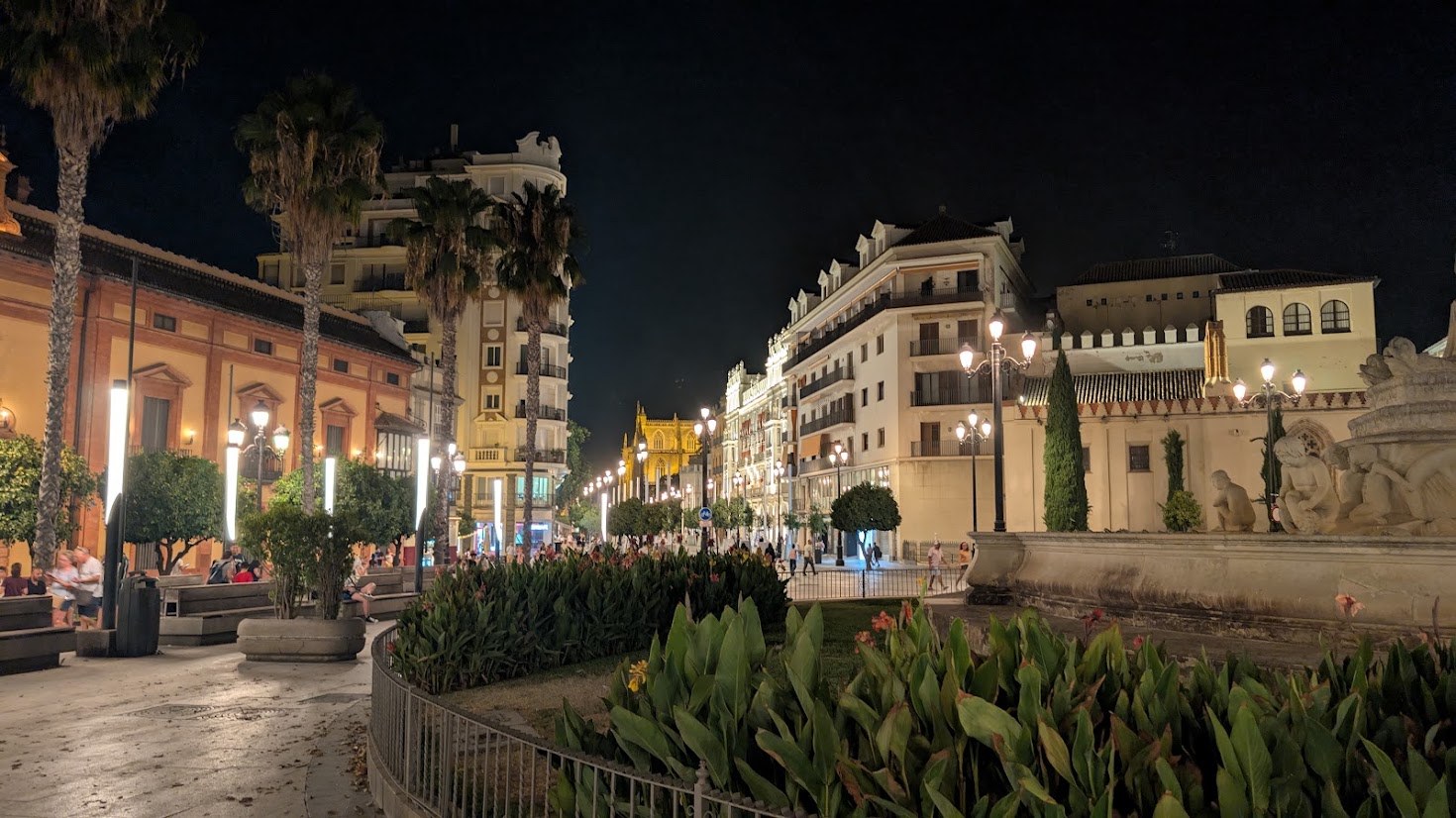
Sevilla
Spain
Tapas streets. Monumental scale.
Seville has the depth of a major European city but still works beautifully for a short break. The Alcázar and Cathedral are exceptional, but the city is at its best when you do not spend the whole trip moving from one major sight to another.
Make time to cross the river into Triana, wander without a route, eat tapas slowly and leave space for the evenings. Streets and squares that can feel sleepy in the afternoon come back to life later on.
4 days is ideal for Seville.
Food & Drink
Do not organise a single 'tapas dinner'. Go to a bar, order a drink and one or two things, then decide whether to stay or move somewhere nearby. Andalusians eat late, so forcing dinner into a British timetable can mean eating before the city has really started its evening. Have a drink and a tapa first and let dinner drift later. If you see a montadito de pringá, try one. Solomillo al whisky usually means pork loin in a garlicky whisky-based sauce and is another useful Sevillian name to recognise. Let markets fit the neighbourhood: Mercado de Triana when you are in Triana, Mercado de Feria around Feria or Alameda.
Must tryMontadito de pringá; solomillo al whisky; a market stop; an evening tapas crawl.
Don't missNotice how traditional taverns and newer bars interpret the same small-plate rhythm.
Wendelse tipChoose two neighbouring districts rather than racing across the whole city for famous bars.
Must try
Move between two or three bars rather than ordering one large dinner.
The social rhythm is as important as any individual dish.
A small bread roll filled with slow-cooked meat mixture.
A specifically Andalusian and Sevillian bar classic.
Use a market to connect produce, neighbourhood and lunch.
Markets keep the food guide grounded in daily city life.
Good to know
Art & Architecture
In most cities you go looking for the old part. In Seville it is simply the part you are standing in. Walk almost anywhere inside the historic centre and you get horseshoe arches, tiled dados, brick towers, orange trees in courtyards and whitewash, not as preserved set-pieces but as the material of an ordinary lived-in city — shops, flats, bars, people going home. What gives it that density is that nothing here replaced anything cleanly. The cathedral sits on the footprint of the Almohad mosque and kept its minaret and its courtyard of orange trees. The royal palace is a fourteenth-century Christian king's building made by craftsmen working in the Islamic tradition. Later Seville got rich on American trade and built Baroque over the top, then invented a self-consciously Andalusian style for a world's fair in 1929. All of it is within walking distance, and none of it is quarantined. The effect is enveloping rather than monumental: the city does not present its history to you at intervals, it surrounds you with it and then carries on with its afternoon.
Almohad foundations, a Mudéjar royal palace, Europe's largest Gothic cathedral, Baroque paid for by a city grown rich on the Atlantic trade, and a theatrical 1929 regionalism — all of it inside a still-inhabited centre of narrow shaded streets.
Don't missThe reuse. Almost nothing here was built on empty ground: look for the older building surviving inside the newer one.
Wendelse tipGive the Alcázar its own half-day and do not stack the cathedral onto the end of it. Two great interiors in one morning cancel each other out.
Something you might missHow much of Seville is shade. Narrow streets, awnings, courtyards, arcades and deep window reveals are climate engineering, and they are the reason the city feels the way it does in the heat.
Must see
A royal palace still in use: a Christian king's building, made in the Andalusi manner, on a site with centuries of earlier Islamic palace history beneath and around it.
The building most people picture — the Palace of Pedro I, with its stucco, tilework and coffered ceilings — was built for a Castilian king in the 1350s and 1360s, using craftsmen working in the Andalusi tradition, roughly a century after Seville had ceased to be a Muslim city. That is the thing to hold on to as you walk through: this is not a surviving Moorish palace, it is a Christian one that chose to be built this way, inside a walled compound that had been added to and rebuilt many times before he arrived. The site keeps going underneath and around it. Excavations in the Patio de las Doncellas uncovered the sunken garden of the original fourteenth-century courtyard — walkways, planting beds and pools that had been paved over — and there is much earlier occupation below that. Above ground the Renaissance added an upper storey to the same patio, so you can stand in one courtyard and read three different periods from the floor up. Move slowly, and pay attention to the sequence of spaces rather than to individual rooms: you are steered from bright to dark, from tight to open, from indoors to garden, again and again.
Few buildings make the entanglement of Islamic and Christian Seville as tangible: here they are not two stories with a date between them but one set of rooms.
Look for: The plasterwork inscriptions. Arabic and Castilian appear together, on the same walls, in the same palace.
Something you might otherwise miss: The floor level of the Patio de las Doncellas. What you walk on is not the original ground — the fourteenth-century garden lies below it.
Wendelse tip: Leave real time for the gardens. The palace only makes sense as a machine for moving between built rooms and planted ones.
Islamic foundations; the Mudéjar palace of Pedro I, 1356–1366; centuries of later work · Half a day if you are enjoying it; two hours is the minimum that is not a rush · First thing, while the courtyards are still cool and empty
The largest Gothic church in Europe, built on the mosque's footprint, with the mosque's minaret still attached to it as a bell tower.
Treat these as one building, because that is what they are. The decision taken in 1401 was to replace the old Almohad congregational mosque, damaged by earthquake, with a new Gothic cathedral at a scale nothing in the city justified — while keeping the minaret, and keeping the ablutions courtyard, which is still planted with orange trees. The tower is the more interesting half. It has the classic Almohad minaret structure: a square central core wrapped by four outer walls, with ramps rising in the space between them, wide and shallow enough that the climb was possible on horseback. You feel that as you go up — there are no stairs for most of the ascent, just a long turning slope, and the openings give you the city in instalments before you reach the top. The last stage of the Almohad tower was replaced in the sixteenth century by a Renaissance belfry by Hernán Ruiz, crowned by the four-metre bronze weathervane that gives the tower its name. So the tower is literally a twelfth-century Islamic structure wearing a sixteenth-century Christian hat, and nobody thought that strange enough to hide.
One ensemble, two religions and four centuries, with none of the joins concealed — Seville's layering made physical.
Look for: Where the brickwork changes as you climb. The Almohad structure and the Renaissance addition do not match, and the seam is visible from the outside too.
Something you might otherwise miss: The Patio de los Naranjos. Its shape and its irrigation channels are the mosque's courtyard, not the cathedral's garden.
Wendelse tip: Walk the full exterior before you go in. From the outside you can see the cathedral's Gothic bulk pressing against an older, calmer tower it did not build.
Almohad minaret, late 12th century; Gothic cathedral begun 1401; Renaissance belfry, 16th century · 1.5–2 hours including the ramp ascent · Late afternoon, for the light on the tower's brick
An enormous semicircle of brick, ceramic and water on the edge of María Luisa Park, built for a world's fair.
This is the largest thing built for the 1929 Ibero-American Exposition, and it does not behave like the rest of Seville at all. Aníbal González laid it out as a semicircle roughly 230 metres across between its two towers, turning its open side towards María Luisa Park and, beyond it, the river the exposition's American guests arrived by. Everything about it is scaled for crowds and photographs: a curved canal with bridges over it, continuous galleries, monumental stairs, towers at each end. What holds it together is the material. It is brick and ceramic, industrially produced and applied everywhere, including the ring of 48 tiled alcoves around the perimeter, one for each Spanish province. That tells you the point: this was a national advertisement in local materials, designed in a consciously Andalusian manner, and completed a few months before the crash that ended the exposition's ambitions. Which is why it feels unlike the medieval centre — it was not grown, it was staged.
It shows Seville inventing a version of itself for an international audience, and shows you exactly which parts of the old city it chose to imitate.
Look for: The province alcoves. Find yours, or find one for a province you have been to, and compare the tiled scenes — they are not interchangeable.
Wendelse tip: Come on foot through María Luisa Park rather than arriving at the front. The plaza was designed to be revealed from inside the park.
Regionalism; Aníbal González, built 1914–1929 for the Ibero-American Exposition · 45–60 minutes, plus the park · Early morning or the last hour of light; the open plaza is punishing at midday
Buildings
A vast timber canopy dropped into a square in the old quarter, over the Roman city it was built on top of.
This is not here because it is famous. It is here because it is the one place in central Seville where the historic city is deliberately interrupted, and encountering it after a day of brick and tile is genuinely interesting. Chosen from 65 competition entries and completed in 2011, it is around 150 by 70 metres and some 26 metres high, built mainly of micro-laminated timber over the Plaza de la Encarnación. It came about almost by accident: excavation for an underground car park in the 1990s hit substantial Roman and later remains, which stopped the project and eventually produced the Antiquarium beneath the structure, opened in 2011. So the sequence goes Roman house mosaics at the bottom, a market and public square in the middle, and a walkway across the roof at the top. Go up for the view by all means, but look at the thing itself: it takes the shading and the raised public terrace that Seville has always used and builds them at an inhuman scale in an unexpected material.
A city this confident about its past is the right place to see what a deliberate contemporary intrusion does to a historic square.
Look for: How the structure meets the ground. It touches the square at very few points, which is what makes the plaza usable underneath it.
Wendelse tip: Do the Antiquarium and the roof in one visit rather than treating the walkway as a viewpoint alone. The two levels are the argument.
Completed 2011; Jürgen Mayer H., engineered by Arup · 1 hour for both levels · Towards sunset
Look closer
The tower turns up at the end of streets across the centre, usually when you are not looking for it.
The old streets are narrow and rarely straight, so you get the tower in slices — a fragment above a roofline, a whole face at a junction, nothing at all for three turnings. It is how the city is navigated without a map, and it is why the tower feels omnipresent in a place where you can almost never see it whole.
Anywhere in Santa Cruz, the Alfalfa area and the lanes north of the cathedral.
Ceramic is everywhere in ordinary Seville: bars, street signs, house numbers, the bottom metre of a wall.
Seville has made tiles on an industrial scale for centuries, much of it historically on the Triana side of the river, and the material ended up in everyday use rather than reserved for palaces. A tiled dado can be washed down and it takes the wear that the bottom metre of any street wall gets. Street names painted onto ceramic panels rather than printed on signs are the easiest version to spot.
Neighbourhood streets in Triana, Santa Cruz and around the Alfalfa.
Many Seville houses turn inward, and the street door is often open onto the courtyard behind it.
The plan is inherited: rooms arranged around a central patio with the plain wall to the street. Privacy and household life account for much of it, and the climate for a good deal more — the courtyard is the shaded, ventilated, planted heart of the house and the façade is a barrier. What you will actually see through an open door and its iron gate is tiles, plants, a floor being hosed down, sometimes a fountain. It is worth slowing down for, and worth not photographing: these are people's hallways.
Residential lanes in Santa Cruz and Triana, particularly in the evening.
The subject of this walk is not sights, it is size. You start at the scale of empire and end up, forty minutes later, in a square where people are having a beer under a contemporary timber canopy — and the interesting part is what happens between those two things. Do it in one go so the contrast lands.
1. The cathedral's south side20 min
Start outside, where the Gothic bulk and the older tower stand together. This is the largest scale the city ever built at, and everything after this is smaller.
2. Barrio de Santa Cruz30–40 min
Walk in without a route and let the streets narrow. Within two minutes of the cathedral the city is at the width of a single house. Look for open doors and courtyards, and lose the tower and find it again.
3. Plaza de la Alfalfa20–30 min
A working central square rather than a monument: bars, flats above the shops, people meeting. This is what the historic centre is for the people who live in it, and it is the part of the walk most visitors skip.
4. The lanes to Encarnación10–15 min
Keep going north on ordinary streets. Note that nothing announces what is coming — the canopy is invisible until you are almost in the square.
5. Plaza de la Encarnación and Las Setas30 min
Arrive underneath it. After an hour of narrow streets and small scale, a 26-metre timber structure over a square is a shock, and that is the point of ending here.
What to look forThe width of the street you are in. It is the single measurement that tracks the whole walk.
Total Around 2 to 2.5 hours at an unhurried pace · Late afternoon into the evening, when Alfalfa fills up and Las Setas is lit · easy
Good to know
Why Wendelse likes it
Walk unless you have a reason not to. Seville has trams and buses, but most first-time sightseeing in the historic centre is better on foot. The distances are manageable and many smaller streets, squares and alleyways you would otherwise miss are part of the experience. Use public transport when it genuinely saves an inconvenient journey rather than automatically using it between sights.
Seville has two useful speeds: see the exceptional things properly, then stop trying to see things. Mornings suit major monuments; afternoons naturally slow down; the city fills again towards evening. Leave room to sit outside with a drink and watch a square such as Plaza de la Alfalfa come alive.
Do not stack the Alcázar, Cathedral and every other major monument into one morning. Do not turn Santa Cruz into a prescribed route or Triana into a checklist of museums. Flamenco deserves an evening if it interests you, but it does not need to become an obligation if it does not.
Heat materially changes the rhythm of Seville, particularly in summer: use mornings and evenings well and accept a slower middle of the day. Major sights such as the Alcázar can require advance booking. Evening life runs later than many UK visitors are used to.
Birmingham · 6–9 November · 4 days
Built around your dates and what you said you're in the mood for. The journey itself isn't checked until you choose dates in Results.
Friday · 6 November
Arrival day
Nothing else planned. That's deliberate.
Saturday · 7 November
Weekend
Leave gaps between plans — nothing here needs rushing.
Sunday · 8 November
Weekend
Nothing else planned. That's deliberate.
Monday · 9 November
Departure day
Leave gaps between plans — nothing here needs rushing.
Prototype itinerary. Activity availability is illustrative, not live opening hours.
Don't miss
Food & Drink
Tapas hopping, markets and specifically Sevillian bar dishes make eating a social route through the city.
Art & Architecture
A Christian king's Islamic palace, a mosque's minaret serving as a cathedral bell tower, and a timber canopy over Roman ruins — all in a city still using its historic centre as a centre.
Seville has its own airport: Seville Airport
Choose your dates and we'll check real flights and the journey from Birmingham.
Check a journey for your dates →Traveller fit
Start with the Royal Alcázar and give it the morning. Have a coffee or early lunch and wander Santa Cruz without trying to achieve anything. Visit the Cathedral and Giralda later, then stop sightseeing. Walk towards the Guadalquivir, cross into Triana, go to the market if the timing works and stay for drinks and tapas if you are enjoying the evening.
Have a slower morning in María Luisa Park and Plaza de España, then leave a large gap for lunch, coffee, a rest or simply sitting somewhere. Later explore Alameda/Feria as a contrast to the monumental centre. Use Las Setas towards evening if it appeals, then let dinner develop across nearby tapas bars.
Do not automatically create another sightseeing programme. Revisit a neighbourhood, spend longer in Triana, choose a museum you genuinely want, have a long lunch or make room for a flamenco performance. The extra day is valuable partly because it lets you stop behaving as though you only have two.
Where to stay
Best for first-time visitors
A central base keeps the Alcázar, Cathedral, river and tapas districts walkable while Santa Justa remains easy by taxi or local transport.
Seville
4 days · Food · Art & Architecture · History · Culture · Walkable
Prototype placeholders — nothing is connected to a booking service yet.