WendelseShort breaks, reconsidered
Salzburg, Austria

Salzburg

Austria

Mozart is part of it. The city is bigger than Mozart.

Salzburg can easily become a checklist of Mozart, Sound of Music locations and Baroque landmarks. Resist that.

The strongest short break combines the old town, fortress, river and mountain setting, with music included according to your actual interest instead of as an obligation.

4 days is ideal for Salzburg.

Food & Drink

Food & Drink

Salzburg's food runs from Alpine tavern cooking to theatrical desserts and a genuinely old brewing tradition, plus a daily market that has operated in the same square for centuries.

Salzburg mixes Alpine tavern food, a serious brewing tradition and theatrical sweets: Nockerl, Mozartkugel, Bosna and cheese-rich dumplings fit a city where high culture and everyday appetite sit close together.

Must try

Salzburger Nockerl

A giant sweet soufflé with three peaks said to represent the hills around Salzburg.

Salzburger Nockerl is a baked soufflé of whisked egg whites, sugar and a little flour, shaped into three or more peaks before baking so it arrives at the table still rising, dusted with icing sugar and served with a fruit compote. The three peaks are traditionally read as a reference to the hills — Mönchsberg, Kapuzinerberg and Festungsberg — that surround the old town.

It should arrive freshly baked and still warm and airy; a Nockerl made to order collapses within minutes.

Traditional Austrian restaurants across the old town.

Original Salzburger Mozartkugel

A pistachio-marzipan and nougat sweet dipped in dark chocolate, invented by a Salzburg confectioner in 1890.

The Mozartkugel was created in 1890 by Salzburg confectioner Paul Fürst: a ball of pistachio marzipan around a nougat centre, hand-dipped in dark chocolate. Fürst's original shop, Café Konditorei Fürst, still makes it by hand to the original recipe and calls it the 'Original Salzburger Mozartkugel' to distinguish it from the machine-made, foil-wrapped versions sold everywhere as souvenirs.

The handmade version is wrapped in plain paper rather than the blue-and-silver foil used by mass-market copies.

Café Konditorei Fürst's original shops in the old town.

Bosna

A grilled sausage in a roll with onion, curry powder and mustard, a Salzburg street-food invention rather than an old regional dish.

Bosna is a grilled bratwurst-style sausage served in a soft roll or open bun with fried onions, curry powder, mustard and parsley. It is usually credited to Salzburg's Balkan Grill, a small stand near the old town that has served it since the 1950s, making it a genuinely local invention rather than an imported Balkan dish despite the name.

Sausage stands in the old town, including the long-running Balkan Grill.

Kasnocken

Small Alpine dumplings baked with mountain cheese and topped with fried onions.

Kasnocken are small spaetzle-style dumplings mixed or baked with a mild Alpine mountain cheese until it melts through, then finished with crisp fried onions on top. It is tavern food from the surrounding Alpine region rather than a Salzburg-city-specific dish, but it is a standard, reliable order in the old town's traditional Gasthäuser.

Traditional taverns (Gasthäuser) in and around the old town.

Stiegl beer

Austria's largest privately owned brewery, founded in Salzburg in 1492.

Stiegl has brewed in Salzburg since 1492, making it one of the older continuously operating breweries in the German-speaking world, and it remains the city's dominant beer on tap. The Stiegl-Brauwelt, the brewery's visitor site, runs tastings and tours for anyone who wants the history alongside the drink.

On tap in most Salzburg bars and restaurants; tours at Stiegl-Brauwelt on the edge of the city.

Grünmarkt

Salzburg's daily fresh-produce market on Universitätsplatz, running for centuries beside the Collegiate Church.

The Grünmarkt sets up on Universitätsplatz most days except Sunday, with stalls selling fruit, vegetables, cheese, flowers and prepared food in the shadow of the Kollegienkirche. It is a working local market rather than a tourist stop, and a straightforward way to see Alpine produce and everyday shopping habits away from the restaurant menus.

It connects the destination's food identity to place, season and everyday shopping rather than restaurant menus alone.

Wendelse tip: Go in the late morning; stalls thin out by early afternoon.

Universitätsplatz, old town.
Good to know

  • Opening days and named businesses change: verify any business-level recommendation at trip time.

Art & Architecture

Salzburg makes more sense as a skyline

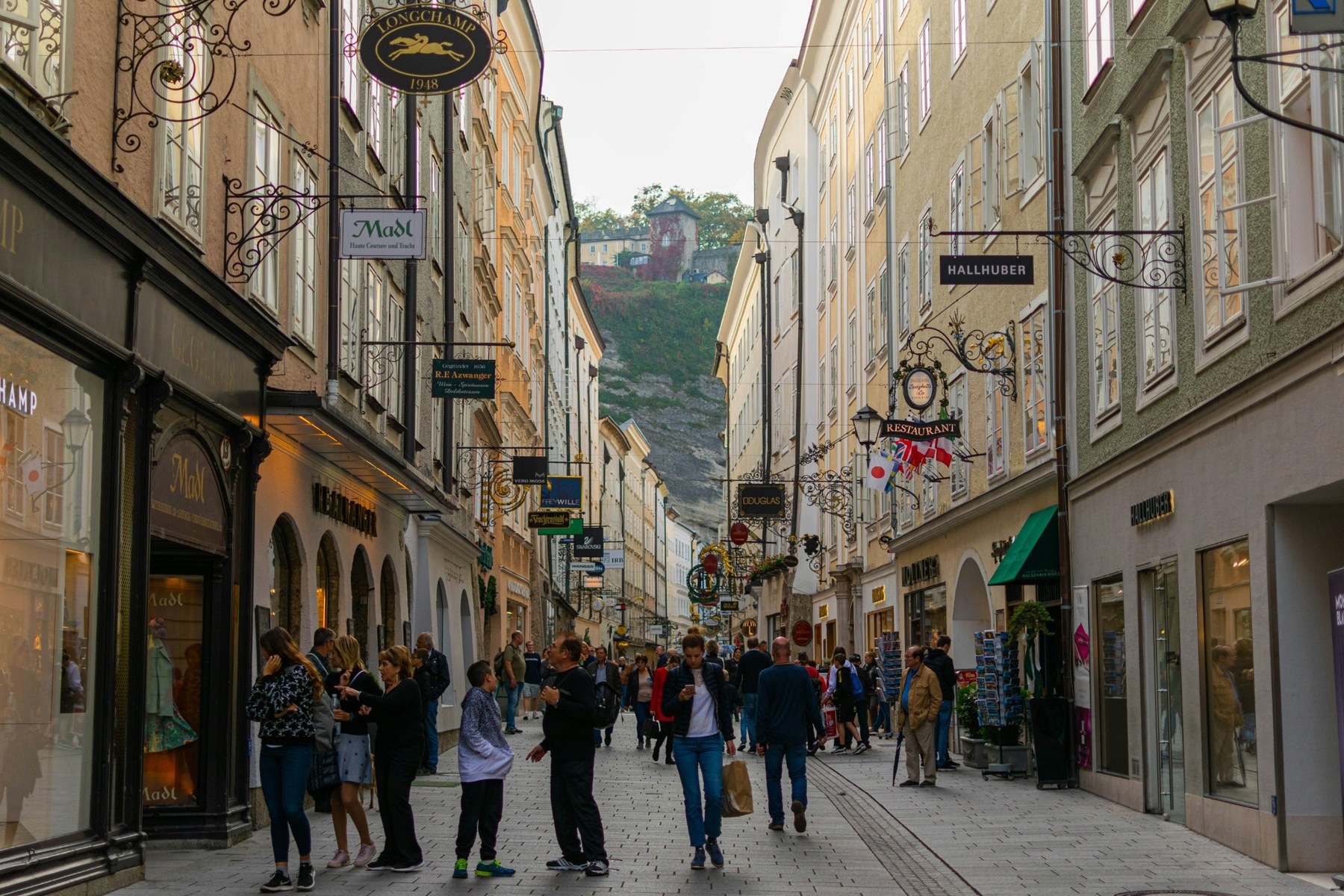
At street level Salzburg can seem almost too polished: narrow lanes, pale façades, wrought-iron signs and church fronts arranged beneath a fortress that appears whenever the roofs open up. Cross the river or climb above the centre and the logic becomes clearer. This was an ecclesiastical city-state ruled for centuries by prince-archbishops. Their churches, cathedral, squares and residence occupy one part of the historic centre; the tighter streets of the burgher city occupy another. Above both sits Hohensalzburg, while domes and spires rise against mountains close enough to feel like part of the architecture.

Salzburg is therefore a city to look at as well as walk through.

Don't missCross the Salzach and turn around before deciding what you think of the old town.

Wendelse tipDon't spend the whole visit inside Getreidegasse. Salzburg's setting is too important to experience only at street width.

Must see

Hohensalzburg and the city below it

The fortress matters before you ever enter it.

Its position above the old town makes political geography unusually obvious: fortified authority literally occupies the high ground above the ecclesiastical and commercial city.

Go up for the view, but don't treat the panorama as a reward unrelated to the building. From the fortress, trace the cathedral, squares, river and dense old-town roofs below. The city-state becomes much easier to read from here. Then, once you're back down, notice how often the fortress appears at the end of streets. It never really leaves the architecture.

Cathedral and Residenzplatz

Salzburg's Baroque centre expresses the ambitions of its prince-archbishops at urban rather than merely building scale.

The cathedral, residence and surrounding squares create a sequence of open spaces quite different from the compressed burgher streets nearby. Italian architectural influence is important to Salzburg's Baroque identity, but you don't need to turn the square into a stylistic lesson.

Instead, walk across it slowly. Notice how the cathedral façade is given room to work, how routes pass between squares, and how the fortress remains above the composition. Power here was arranged spatially.

The old-town lanes and passages

Getreidegasse is famous enough to become distracting. Look past the shop signs and into the buildings.

Long, narrow plots run back from the street, and passages lead through buildings into courtyards and towards parallel streets. That depth is the useful architectural experience: the façade is only the front edge of a much longer piece of city.

Take a passage when one is publicly accessible and see where it comes out. Salzburg's burgher city is more porous than it first appears.

Details to notice

Cross the river before judging Salzburg

There is no formal architecture walk here because the most useful intervention is simpler. Cross the Salzach. Then turn around.

From the opposite bank, the pieces that feel separate when you're among them begin to form one composition: fortress above, domes and spires below, dense roofscape between them and mountains immediately beyond.

Walk along the river for a while rather than rushing back across the first bridge. At street level Salzburg can sometimes feel like a sequence of immaculate historic façades. From across the water it becomes what it actually is: a compact city built between authority, river and mountain.

Look closer

Use the towers to work out where you are

Salzburg's domes and spires aren't only individual monuments.

They rise above streets that often restrict longer views, so fragments of skyline repeatedly tell you where the larger ecclesiastical city lies.

Look up when a lane opens into a square. The skyline reorganises itself surprisingly quickly.

A façade may hide another street

In the dense old town, entrances and passages can lead much further through a block than the street frontage suggests.

Notice courtyards, connecting routes and buildings with active fronts on more than one side.

The city is deeper than its narrow streets make it look.

Why Wendelse likes it

Getting around

Walk in the centre. Buses are useful for outer sights and poor weather. The fortress funicular saves a climb if you want it to; walking up is optional, not morally superior.

Rhythm and pacing

Old town and fortress deserve a day without adding three excursions. Music should be scheduled only if a concert or venue appeals.

Don't overdo it

Don't make every Sound of Music location compulsory. There's no need to confuse buying Mozart chocolates with experiencing Salzburg.

Season and timing

Seasonality matters greatly: summer festivals, winter markets and mountain weather all change the trip. Concerts and major events need dated checks.

Birmingham · 6–9 November · 4 days

A suggested shape for your days.

Built around your dates and what you said you're in the mood for. The journey itself isn't checked until you choose dates in Results.

Friday · 6 November

Arrive & settle in

Arrival day

Afternoon
  • Arrive and check in.
  • Cathedral & DomQuartier — Cathedral & DomQuartier is one of the strongest ways to understand Salzburg without turning the day into a checklist.

Nothing else planned. That's deliberate.

Saturday · 7 November

Your big exploring day

Weekend

Morning
  • Hohensalzburg Fortress — Hohensalzburg Fortress is one of the strongest ways to understand Salzburg without turning the day into a checklist.
Afternoon
  • Getreidegasse and old-town walk — Getreidegasse and old-town walk is one of the strongest ways to understand Salzburg without turning the day into a checklist.

Leave gaps between plans — nothing here needs rushing.

Sunday · 8 November

Take Salzburg at your own pace

Weekend

Afternoon
  • Salzburg café and pastry stop — Salzburg café and pastry stop is one of the strongest ways to understand Salzburg without turning the day into a checklist.
Evening
  • Mirabell and riverside walk — Mirabell and riverside walk is one of the strongest ways to understand Salzburg without turning the day into a checklist.

Nothing else planned. That's deliberate.

Monday · 9 November

One last morning

Departure day

Morning
  • Breakfast, then a last walk through town.
Afternoon
  • Lunch, then the journey home.

Leave gaps between plans — nothing here needs rushing.

Prototype itinerary. Activity availability is illustrative, not live opening hours.

Don't miss

Even if it's not what you came for.

Food & Drink

Taste Salzburg properly

Salzburg mixes Alpine tavern food, a serious brewing tradition and theatrical sweets: Nockerl, Mozartkugel, Bosna and cheese-rich dumplings fit a city where high culture and everyday appetite sit close together.

  • Salzburger Nockerl
  • Original Salzburger Mozartkugel
  • Bosna
Explore Food & Drink →

Art & Architecture

What makes Salzburg look like Salzburg

Salzburg's prince-archbishops deliberately reshaped the city as a northern echo of Rome: Baroque squares and churches sit beneath the medieval fortress, while narrow through-houses preserve an older commercial grain.

  • Salzburg Cathedral
  • Hohensalzburg Fortress
  • Residenzplatz & Residenz
Explore Art & Architecture →

Getting there

Salzburg has its own airport: Salzburg Airport

Choose your dates and we'll check real flights and the journey from Birmingham.

Check a journey for your dates →

Traveller fit

Is Salzburg your kind of place?

Food
★★★★☆4 out of 5
History
★★★★★5 out of 5
Architecture
★★★★★5 out of 5
Walkability
★★★★★5 out of 5
Outdoors
★★★★☆4 out of 5
Atmosphere
★★★★★5 out of 5

Things worth doing

A first day that works

Old town and Cathedral area; fortress; long break; river walk; evening according to music/food interests.

If you have a second day

Mirabell and opposite bank; choose one museum, neighbourhood or nearby landscape experience; café time.

An extra day, or bad weather

If you stay longer, that is where a lake/mountain excursion can fit, but weather should decide. In winter, Christmas-market atmosphere can become a major part of the destination.

Where to stay

Stay in or beside the Altstadt

Best for culture and architecture

A central base keeps the old town, fortress funicular, river and most cultural sights walkable.

Ready to make it a trip?

Salzburg

4 days · Architecture · History · Culture · Food · Walkable

Prototype placeholders — nothing is connected to a booking service yet.

← Back to your Wendelse