WendelseShort breaks, reconsidered
Reims, France

Reims

France

Cathedral and Champagne. Don't pretend they're side notes.

Reims has two enormous reasons to visit: the cathedral and Champagne. The guide should be comfortable saying that instead of manufacturing eight equally important attractions.

See the cathedral properly, choose a Champagne experience that suits you, then use the remaining time for a compact, relaxed city.

4 days is ideal for Reims.

Food & Drink

Food & Drink

Champagne is not just a drink item here; it is part of the place. Choose one cellar/house experience instead of trying to collect famous names. Learn enough about production to make the next glass more interesting. Pair that with ordinary local eating rather than making every meal a luxury event. Biscuits roses are a small local curiosity, not a pilgrimage.

Reims is inseparable from Champagne, but the city's food identity also includes its pink twice-baked biscuit, local ham and cheeses that make cellar visits part of a broader regional table.

Must try

Champagne house cellar visit

Reims sits above kilometres of chalk cellars (crayères) used for ageing Champagne, some Roman or medieval in origin.

Houses such as Taittinger, Pommery, Ruinart and Veuve Clicquot age their wine in these cellars because the chalk holds a near-constant cool temperature and humidity year-round, without mechanical cooling. Pommery's crayères are former Gallo-Roman chalk quarries later linked into a single network; Ruinart's are recognised by UNESCO alongside other Champagne sites. A visit typically covers how the base wine is blended, the second fermentation that creates the bubbles, and riddling and disgorgement, ending in a tasting.

Wendelse tip: Cellar tours generally need booking ahead, especially in summer and around the year-end period.

Champagne — grape and style

The three permitted grapes and the difference between non-vintage, vintage and blanc de blancs.

Champagne is made from Chardonnay, Pinot Noir and Pinot Meunier, usually blended across several years to keep a house style consistent — this is what "non-vintage" or NV means, not a lesser wine. A vintage Champagne is made entirely from grapes of a single strong year and only declared when the harvest justifies it. Blanc de blancs is made only from Chardonnay; blanc de noirs from the black grapes alone, pressed off their skins before colour transfers.

The dosage level on the label — brut, extra brut or the rarer brut nature — which states how much sugar was added at the final stage and ranges from bone-dry to noticeably sweeter.

Biscuit rose de Reims

A pale pink, twice-baked, sugar-crusted biscuit designed to be dunked in Champagne.

Made by the Fossier bakery since the 18th century, the biscuit was originally baked twice to use the receding heat of wood-fired ovens after bread, which is why it is dry and light rather than soft. The pink colour comes from added carmine or food colouring rather than any pink ingredient, and the vanilla-sugar crust means it doesn't turn soggy when dipped in a glass of Champagne, which is its traditional use.

Jambon de Reims

A cooked, pressed ham coated in breadcrumbs and parsley, sliced cold.

The ham is poached, pressed into a compact shape, then rolled in a mix of fresh breadcrumbs and chopped parsley (persillé) before being sliced thin. It's typically served cold as a starter or in a sandwich, and its parsley coating is what distinguishes it from a plain cooked ham elsewhere in France.

Chaource

A soft, bloomy-rind cows'-milk cheese from the southern edge of the Champagne region.

Made in and around the town of Chaource in the Aube, this AOC cheese is thick, creamy and mild when young, developing a runnier texture and stronger flavour as it ages. It's traditionally paired with Champagne itself, since both come from the same wider region — the cheese's acidity and cream work against the wine's dryness and bubbles.

Pain d'épices de Reims

A dense honey-and-spice bread, historically linked to Reims alongside Dijon.

Reims had its own pain d'épices-making guild from the medieval period, distinct from — and a long-running rival to — the more famous Dijon version. It is made with rye flour, honey and spices such as aniseed and cinnamon, left to mature before baking, giving it a moist, dense crumb rather than the lighter texture of a cake.
Good to know

  • Opening days and named businesses change: verify any business-level recommendation at trip time.

Art & Architecture

The medieval city survived by being rebuilt

Notre-Dame de Reims looks convincingly medieval enough to make you forget what happened to it. Don't. The cathedral was heavily damaged during the First World War. Its roof burned, lead melted through the gargoyles and the building became an international image of wartime destruction. What followed was not simply repair: the restored cathedral acquired a remarkable reinforced-concrete roof structure beneath its historic silhouette.

That makes Reims a more interesting architectural city than an untouched-Gothic story would allow. The medieval monuments matter. So does what happened to them afterwards.

Don't missLook at something medieval, then deliberately ask which parts of what you're seeing have survived, been restored or been remade.

Wendelse tipDon't let the cathedral's façade consume the entire visit. Reims gets more interesting when you put the monument back into the damaged and reconstructed city around it.

Must see

Notre-Dame Cathedral

Start with the west front, but don't treat it as a giant stone picture.

At Reims, sculpture is integrated deeply into the architecture. Figures occupy portals, jambs and galleries so thoroughly that the boundary between building and sculpture starts to disappear.

Then go inside. The height and light are what you expect from a major Gothic cathedral, but the windows complicate the chronology. Medieval glass survives alongside much later work, including twentieth-century windows by Marc Chagall. That coexistence is very Reims. Finally, remember the roof above you. After the destruction of the First World War, architect Henri Deneux reconstructed the roof using reinforced concrete rather than simply reproducing the lost timber structure. The cathedral looks old because it is old. It survives because later generations were prepared to build into it.

Look for: Sculpture behaving as part of the façade rather than objects placed against it.

Saint-Remi

Saint-Remi gives you a different Reims.

The former abbey church developed from a much older religious foundation and preserves fabric of different periods. Compared with the cathedral's concentrated vertical drama, it feels broader, quieter and more cumulative.

That difference matters. Reims' religious architecture isn't one Gothic moment repeated twice. Saint-Remi has been altered and extended across centuries, carrying the city's earlier association with Saint Remi and French royal anointing into a building that visibly accumulated history. Give it enough time for the cathedral to stop being your reference point.

The city around the monuments

This is the unusual Don't Miss. Walk away from Notre-Dame and look at the ordinary city.

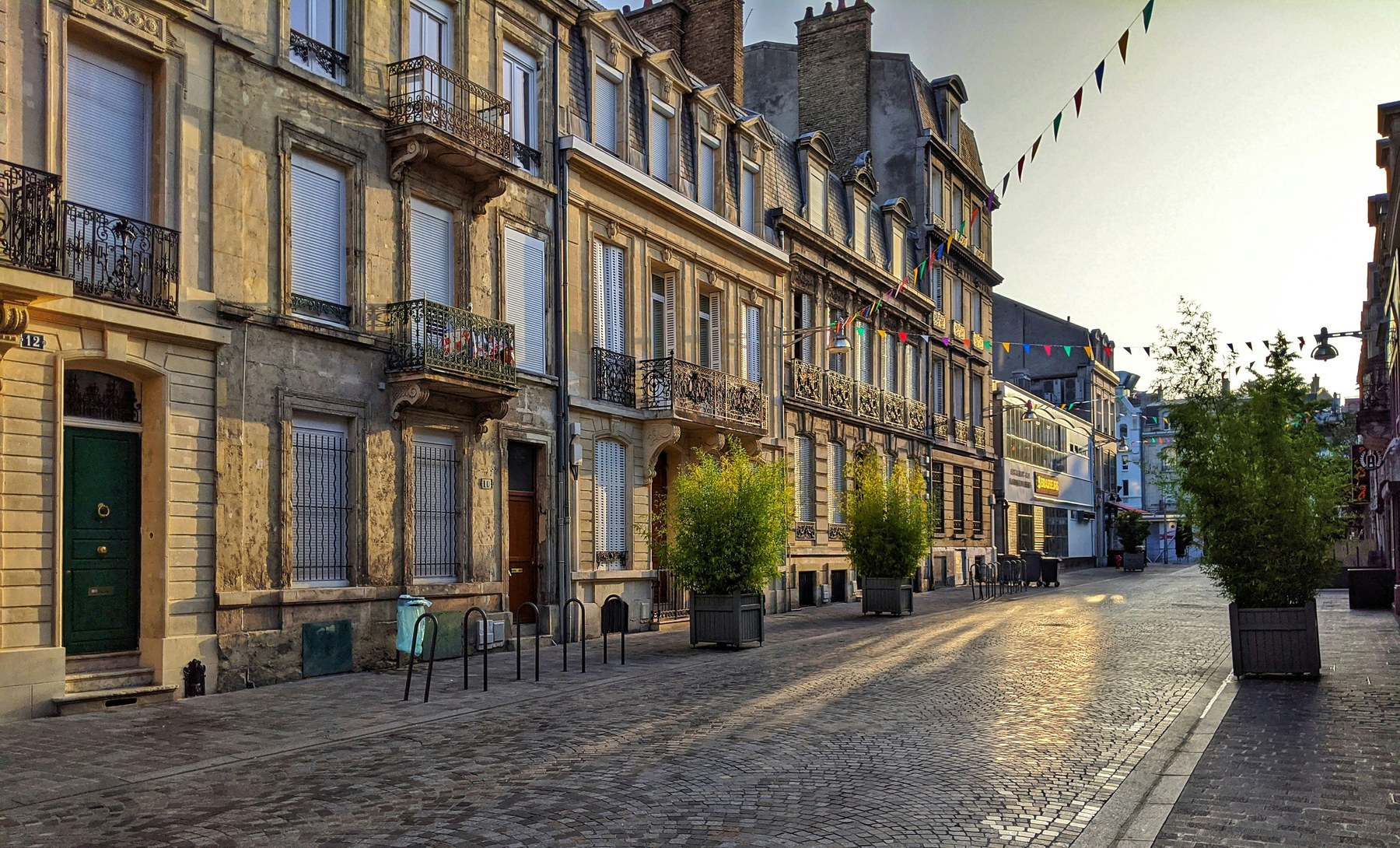
The First World War devastated much of Reims, so the streets surrounding its medieval monuments contain restored older buildings, post-war reconstruction and later architecture side by side.

Don't expect every façade to announce which category it belongs to. The important thing is the contrast between the apparently timeless monument and a city that had to rebuild around it. Reims is not a medieval city preserved under glass. It is a city that reconstructed itself while deciding which pieces of its past had to return.

Details to notice

The cathedral is older than the roof above it

Reims is a good place to abandon the idea that authenticity means every surviving piece must be original.

Notre-Dame is genuinely medieval. Its sculpture, plan and much of its fabric belong to that history. It is also a building profoundly marked by destruction and reconstruction.

Stand inside and hold both ideas at once. The restoration didn't erase the cathedral's history. It became another part of it. Then take that thought outside. Much of Reims asks the same question at city scale: after catastrophic destruction, how do you rebuild without pretending nothing happened?

Look closer

The façade is architecture and sculpture at once

Don't try to identify every saint.

Instead, watch how figures occupy the building: around doors, beneath arches, across galleries and within the depth of the portals.

The sculpture isn't a decorative layer added after the architecture. It helps make the façade.

Old glass and new glass can share the same building

Cathedrals accumulate.

At Reims, surviving medieval stained glass sits within a building that has also commissioned modern work.

Rather than deciding which period you prefer, notice how differently colour and figure behave when centuries of glass occupy the same Gothic structure.

Why Wendelse likes it

Getting around

Walk in central Reims. Use local transport or a taxi when a chosen Champagne house or outer site makes it useful. The important movement question is which cellar visit you book, not mastering the network.

Rhythm and pacing

Cathedral and one Champagne visit are enough structure for a day. Leave room for lunch, cafés and noticing the rebuilt city.

Don't overdo it

Don't schedule three cellar tours in two days. There's no need to pretend minor monuments deserve the same time as the cathedral.

Season and timing

Cellar tours require dated booking. Harvest periods and major events can affect availability.

Birmingham · 6–9 November · 4 days

A suggested shape for your days.

Built around your dates and what you said you're in the mood for. The journey itself isn't checked until you choose dates in Results.

Friday · 6 November

Arrive & settle in

Arrival day

Afternoon
  • Arrive and check in.
  • Notre-Dame de Reims — Notre-Dame de Reims is one of the strongest ways to understand Reims without turning the day into a checklist.

Nothing else planned. That's deliberate.

Saturday · 7 November

Your big exploring day

Weekend

Morning
  • Palais du Tau / coronation history — Palais du Tau / coronation history is one of the strongest ways to understand Reims without turning the day into a checklist.
Afternoon
  • Champagne-house cellar visit — Champagne-house cellar visit is one of the strongest ways to understand Reims without turning the day into a checklist.

Leave gaps between plans — nothing here needs rushing.

Sunday · 8 November

Take Reims at your own pace

Weekend

Afternoon
  • Art Deco and central Reims walk — Art Deco and central Reims walk is one of the strongest ways to understand Reims without turning the day into a checklist.
Evening
  • Champagne tasting with food — Champagne tasting with food is one of the strongest ways to understand Reims without turning the day into a checklist.

Nothing else planned. That's deliberate.

Monday · 9 November

One last morning

Departure day

Morning
  • Breakfast, then a last walk through town.
Afternoon
  • Lunch, then the journey home.

Leave gaps between plans — nothing here needs rushing.

Prototype itinerary. Activity availability is illustrative, not live opening hours.

Don't miss

Even if it's not what you came for.

Food & Drink

Taste Reims properly

Reims is inseparable from Champagne, but the city's food identity also includes its pink twice-baked biscuit, local ham and cheeses that make cellar visits part of a broader regional table.

  • Champagne house cellar visit
  • Biscuit rose de Reims
  • Jambon de Reims
Explore Food & Drink →

Art & Architecture

What makes Reims look like Reims

Reims combines high Gothic coronation architecture with a remarkable post-First World War reconstruction, especially Art Deco markets, libraries, shops and houses.

  • Notre-Dame de Reims
  • Palais du Tau
  • Basilique Saint-Remi
Explore Art & Architecture →

Getting there

Choose your dates and we'll check real flights and the journey from Birmingham.

Check a journey for your dates →

Traveller fit

Is Reims your kind of place?

Food
★★★★★5 out of 5
History
★★★★★5 out of 5
Architecture
★★★★★5 out of 5
Walkability
★★★★★5 out of 5
Outdoors
★★☆☆☆2 out of 5
Atmosphere
★★★★☆4 out of 5

Things worth doing

A first day that works

Cathedral in the morning; centre and lunch; one well-chosen Champagne-house visit; relaxed evening.

If you have a second day

Explore Art Deco/rebuilt streets, market or museum according to interest; perhaps a second Champagne experience only if wine is a major reason for the trip.

An extra day, or bad weather

If you stay longer, the vineyards beyond Reims become more relevant, but transport/logistics should be checked instead of assumed.

Where to stay

Stay in central Reims

Best for Champagne and Gothic architecture

The cathedral, restaurants and central Champagne houses are easily reached on foot; some cellar visits require short local transport.

Ready to make it a trip?

Reims

4 days · Food · Architecture · History · Walkable · Culture

Prototype placeholders — nothing is connected to a booking service yet.

← Back to your Wendelse