WendelseShort breaks, reconsidered
Ravenna, Italy

Ravenna

Italy

Plain brick outside. Gold and glass inside.

Ravenna does not look like a great city. The streets are quiet and provincial, the buildings that matter are unremarkable brick from the outside, and several of them you would walk straight past.

Then you go in. Fifth- and sixth-century walls and vaults surfaced entirely in cut glass, set at deliberately uneven angles so that the gold moves as you move. Eight of these buildings are inscribed together as a UNESCO World Heritage site, and six of them are within a few flat streets of each other.

The reason it all survives is unglamorous: after 751 nobody here was rich enough to knock it down and start again.

4 days in Ravenna leaves room to slow right down.
Art & Architecture

The mosaics of Ravenna

Ravenna's great buildings look like almost nothing from the street. Bare brick, no carving, no facade to photograph. Everything was spent on the inside, and specifically on glass: walls and vaults surfaced in millions of small cut cubes that were never intended to be read as pictures alone, but as surfaces that change as you move.

This is late antique architecture rather than medieval: fifth- and sixth-century buildings from the years when the Roman world was becoming the Byzantine one. Eight of them were inscribed together as a single UNESCO World Heritage site in 1996, and the reason they hang together is that they were made within roughly 150 years, by overlapping workshops, for three different rulers with three different ideas about God and empire.

Wendelse tipGo into the smallest one first. After San Vitale, the Mausoleum of Galla Placidia can read as a footnote; in the other order it is the thing you remember.

Must see

Basilica di San Vitale

An octagon rather than a basilica in plan, with a domed core carried on eight piers and an ambulatory wrapped around it, so the space opens and closes as you walk it.

It is the clearest surviving statement anywhere in western Europe of what Justinian's court architecture was doing — and the imperial panels in the chancel are political images, not devotional ones.

The two facing chancel panels: Justinian with his court on one side, Theodora with hers on the other. Neither ever came to Ravenna. Their presence on the walls is the point.

Something you might otherwise miss: The green mosaic ground of the apse, and the way the figures cast no shadows — space here is described by colour, not by depth.

Consecrated 547, Byzantine · 45–60 minutes

Mausoleo di Galla Placidia

A tiny cross-shaped brick building in the same enclosure as San Vitale, lined from floor to vault in mosaic.

The oldest of the mosaic interiors, and the one that shows how completely the effect depends on scale: a room small enough that the decoration reaches you rather than hangs above you.

The deep blue vault of stars, and the alabaster window panes, which turn ordinary daylight amber before it ever touches the glass.

Something you might not know: Despite the name, there is no good evidence that Galla Placidia was ever buried here.

Second quarter of the 5th century · 15–20 minutes

Basilica di Sant'Apollinare Nuovo

A long, calm, colonnaded hall with two continuous mosaic processions running the full length of the nave above the arcade.

It was built as the palace church of Theodoric, an Arian Christian ruler, and then edited by the Byzantines who replaced him. Both versions are still on the wall.

The mosaic of Theodoric's palace on the south wall. Figures who once stood between its columns were removed and replaced with curtains — and on some columns a stray hand was left behind.

Early 6th century, Ostrogothic, altered after 540 · 30–40 minutes

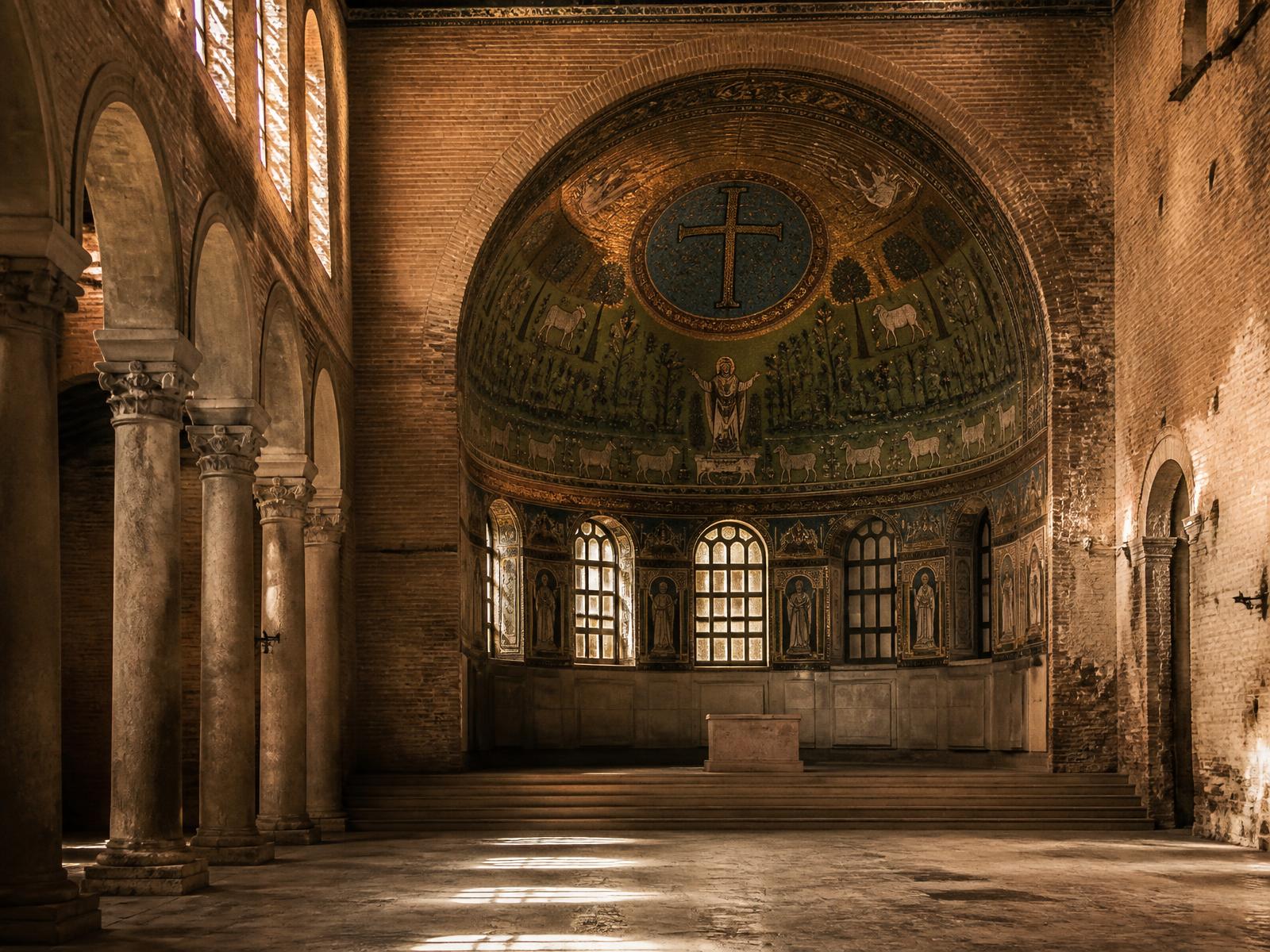
Basilica di Sant'Apollinare in Classe

A very large brick basilica standing alone in flat open ground outside the modern city, on the site of the vanished port of Classe.

Ravenna's monuments are usually experienced as interiors in a dense town. This one is the exception: you see the whole building, and then the apse, in a landscape that explains why the city was here at all.

It sits roughly 5km south of the centre. Local buses run out along the road, and the route is flat enough to cycle.

The apse: Sant'Apollinare standing among twelve sheep in a green, tree-filled field, one of the most legible mosaic compositions in the city.

Consecrated 549 · 1.5–2 hours including the journey

Buildings

Battistero Neoniano

The octagonal baptistery of the Catholic community, converted from a Roman bath building.

Concentric rings in the dome, each smaller than the last, pulling the eye upward to the baptism at the centre.

Mid-5th century · 15 minutes

Battistero degli Ariani

The Arian community's baptistery, built while Theodoric ruled the city, with the same dome subject as the Neonian one.

Seeing the two baptisteries within an hour of each other is the most direct way to understand that Ravenna held two rival churches at once, each with its own buildings.

The differences in the same scene — how the figures are arranged, and how much plainer the surrounding decoration is.

Around 500, Ostrogothic · 10–15 minutes

Cappella Arcivescovile

A small private oratory inside the Archiepiscopal Museum, built for the Catholic bishops during Arian rule.

Christ shown as a young soldier over the entrance — an unusual image, and a pointed one in a city with a theological argument running through it.

Around 500 · 20–30 minutes with the museum

Mausoleo di Teodorico

A two-storey tomb in pale Istrian stone, north-east of the centre, capped by a single enormous monolithic dome.

It is the one major monument here that is not Roman or Byzantine in idea: cut stone rather than brick, mass rather than surface, and no mosaic at all.

The twelve pierced lugs around the rim of the dome, still carrying the names of apostles, and no accepted explanation of how the stone was lifted.

Around 520 · 30 minutes

Domus dei Tappeti di Pietra

The floors of a late antique house, several metres below the church of Santa Eufemia, laid out as a walkway above the excavation.

Everything else here is wall and vault mosaic seen from below. This is domestic floor mosaic seen from above, which is a different craft with different rules.

The 'dance of the seasons' figures, and the depth of the drop — the measure of how much Ravenna has sunk and been buried.

5th–6th century floors, excavated from 1993 · 30–40 minutes

Details to notice

Tesserae are not set flat

The glass cubes are pressed into the bed at slightly varying angles, deliberately.

It is why the gold appears to move as you cross the room. A photograph flattens exactly the quality the makers were working for.

Look for: Stand still, then take three steps sideways and watch one area of gold ground.

Gold is glass with metal inside it

Gold tesserae are made by sealing a leaf of metal between a backing and a thin film of glass.

The light bounces off a surface inside the cube rather than off its face, which is why the walls glow instead of reflecting.

Windows are part of the design

Openings are small, high and often filled with alabaster or thick glass rather than clear panes.

These interiors were composed for weak, warm, moving light. Bright even lighting is a modern condition, and the mosaics look flatter under it.

Look for: Come back to San Vitale at a different hour and the apse reads differently.

Plain brick outside, everything inside

There is almost no exterior sculpture or carved decoration anywhere in the group.

Ravenna teaches you not to judge from the street. Several of the buildings you will walk past without looking up twice.

Reused Roman columns and capitals

Shafts and capitals were shipped in — a good number of them from the eastern Mediterranean — rather than quarried locally.

Ravenna was a port. The stone arriving by sea is the same reason the city could be an imperial capital in the middle of a marsh.

Look for: Capitals in Sant'Apollinare Nuovo that don't quite match one another.

A suggested walk

The mosaic core, in the right order

San Vitale and Galla Placidia sit in one enclosure at the north-west of the centre; the Neonian Baptistery, the Archiepiscopal Chapel and Sant'Apollinare Nuovo are a few minutes' walk south and east of it. The whole circuit is flat and short.

Galla Placidia first, then San Vitale, then out through the centre to the two baptisteries and Sant'Apollinare Nuovo. Sant'Apollinare in Classe and the Mausoleum of Theodoric belong to a separate half-day.

Half a day, without hurrying

Guided experiences

A mosaic-making workshop

Ravenna still has working mosaic studios and a restoration tradition, and short introductory sessions in cutting and setting tesserae are a normal part of the city's visitor offer.

An hour of trying to cut glass squarely changes what you see on the walls more than any amount of reading.

Booking required

If you have one afternoon

Enough for the two that most change how you see the rest.

First
Mausoleum of Galla Placidia — small, and best before your eyes adjust to scale.
Then
San Vitale, slowly, including the two imperial panels in the chancel.
Finish
Sant'Apollinare Nuovo on the way back through the centre.

Three interiors is a full afternoon here. A fourth usually stops registering.

A full architecture day

Morning
San Vitale and Galla Placidia, then the Neonian Baptistery.
Late morning
The Archiepiscopal Chapel and museum, then the Arian Baptistery for the comparison.
Lunch
In the centre — everything so far is within a few streets.
Afternoon
Sant'Apollinare Nuovo, then the Domus dei Tappeti di Pietra for floor mosaic.
Evening
Nothing booked. The centre is small and pedestrianised.

The second day: out to Classe

Morning
Bus or bike south to Sant'Apollinare in Classe — the one monument seen whole, in open ground.
Nearby
The Classis Ravenna museum, on the site of the old port, if you want the context.
Back in town
The Mausoleum of Theodoric, which is a short walk north-east of the station.

Local tips

  • Most of the central monuments are covered by one combined ticket rather than sold separately — buy it at the first one you reach.
  • Entry to the Mausoleum of Galla Placidia is limited and time-controlled in busy periods; ask when you buy the ticket.
  • Binoculars, or a phone with a decent zoom, are genuinely useful for the nave processions in Sant'Apollinare Nuovo.
  • Interiors are cool and dim year-round. In August that is an argument for doing the mosaics in the middle of the day and the streets in the evening.

Good to know

  • The eight UNESCO monuments do not all keep the same hours, and the seasonal timetable changes; check on the day rather than planning to a fixed schedule.
  • Churches are working buildings and can close to visitors for services.
  • Sant'Apollinare in Classe is outside the city; allow travel time in both directions.
  • Flash photography and tripods are generally not allowed inside.

History

How a marsh town became a capital three times

For about 350 years Ravenna was one of the most important cities in Europe, and then it stopped being important and was left almost undisturbed. That combination is the whole reason to come: the evidence of a Roman empire turning into a Byzantine one survives here because nothing later was rich enough to rebuild over it.

Three capitals in succession — the Western Roman Empire, then Theodoric's Ostrogothic kingdom, then Byzantine Italy — followed by a very long quiet period. Ravenna's history is not a story of continuous growth but of one intense era preserved by later irrelevance.

Key periods

Why here at all: the port of Classe

Augustus established a major naval base at Classe, just south of the town, on what was then a lagoon coast.

A minor settlement in the marshes acquired one of the Adriatic's most important harbours, and with it a permanent reason to exist.

The sea has since moved several kilometres east and the harbour silted up. Sant'Apollinare in Classe now stands in farmland.

1st century BC onwards · Roman

Capital of the Western Roman Empire

The imperial court moved from Milan to Ravenna, whose marshes and sea access made it far easier to defend and to supply.

The last decades of the Western Empire were administered from here, which is why 476 is a Ravenna date as much as a Roman one.

The court, the money and the building programme arrived. Ravenna spent the fifth century acquiring the churches and mausolea of a capital.

The Mausoleum of Galla Placidia and the Neonian Baptistery both belong to this period.

402 onwards · Late Roman

Theodoric's Ostrogothic kingdom

Theodoric took the city after a long siege and ruled Italy from it for more than thirty years, keeping Roman administration largely intact.

This is the clearest surviving picture anywhere of a Gothic kingdom governing as a Roman state rather than replacing one.

The ruler was an Arian Christian and his Roman subjects were not, so the city ended up with two parallel church hierarchies and two sets of buildings.

Sant'Apollinare Nuovo, built as his palace church; the Arian Baptistery; and his own stone mausoleum outside the walls.

493–526 · Ostrogothic

Byzantine reconquest and the Exarchate

Justinian's general Belisarius took Ravenna in 540, and the city became the seat of Byzantine authority in Italy.

It explains why Ravenna looks eastern. These are Constantinople's ideas, built in Italy, at Constantinople's expense.

Ravenna was now governed from Constantinople. The most ambitious mosaics in the city — San Vitale and Sant'Apollinare in Classe — date from these first years.

The imperial panels in San Vitale, and the edited mosaics in Sant'Apollinare Nuovo where Arian imagery was removed.

540–751 · Byzantine

The long quiet

The Lombards ended the Exarchate, the coastline retreated, and Ravenna became a provincial town — later under the Da Polenta family, then Venice from 1441, then the Papal States.

No later ruler had the wealth or the motive to demolish and rebuild on the scale the Byzantines had.

The late antique monuments, essentially because of poverty rather than reverence. Piazza del Popolo, with its two columns, is the main visible legacy of the Venetian decades.

751 onwards · Medieval to modern

People who shaped it

Galla Placidia

Daughter of one emperor, sister of another, briefly a Gothic queen, and then regent of the Western Empire for her young son Valentinian III.

She ran the western court from Ravenna in the 420s and 430s, during the decades when the city's first great buildings went up.

The mausoleum that carries her name, though her burial there is not established.

Theodoric the Great

Ostrogothic king who was raised as a hostage in Constantinople and ruled Italy from Ravenna from 493 until his death in 526.

He governed through Roman institutions while remaining culturally Gothic and religiously Arian — the contradiction that shaped half the city's buildings.

Sant'Apollinare Nuovo, the Arian Baptistery, and his mausoleum with its single-stone dome.

Justinian and Theodora

The Byzantine emperor and empress who reconquered Italy in the sixth century.

Neither ever visited Ravenna, yet their portraits face each other across the chancel of San Vitale, which is precisely how imperial authority was projected at a distance.

The two chancel panels in San Vitale.

Dante Alighieri

Exiled from Florence, Dante spent his last years in Ravenna and died here in 1321.

He finished the Commedia in this city, and his remains have stayed here despite centuries of Florentine requests.

The neoclassical tomb beside the church of San Francesco, and the hushed 'zona del silenzio' around it.

Historical sites

Basilica di San Vitale

Begun under Ostrogothic rule and finished under Byzantine rule, and consecrated in 547, a few years after the reconquest.

A building that changes political ownership halfway through its own construction, with the new regime's portraits placed at the altar end.

Justinian and Theodora are shown bringing offerings — the gesture of a donor who is present without being present.

Byzantine

Basilica di Sant'Apollinare Nuovo

Built as the Arian palace church of Theodoric, then re-consecrated for Catholic use after 540 and its mosaics censored.

The palace mosaic on the south wall, where figures between the columns were replaced with curtains and hands were left behind on the shafts.

This is not damage. It is deliberate political editing, and it was done well enough that most visitors walk past it.

Ostrogothic, altered under Byzantine rule

Mausoleo di Teodorico

Built around 520 as the tomb of a king who died in 526.

A stone building among trees, with a dome cut from a single block, and an empty interior — the body did not stay.

Nothing about it is Roman-Italian in construction. It reads as a northern monument built with imported Istrian stone.

Ostrogothic

Basilica di Sant'Apollinare in Classe

Consecrated in 549 beside the imperial port, on the burial site associated with Ravenna's first bishop.

A vast basilica standing in flat fields, with no port and no sea anywhere near it.

The distance to the modern coastline is the single most informative fact about Ravenna's decline.

Byzantine

Dante's tomb and the zona del silenzio

Dante died in Ravenna in 1321 and was buried beside San Francesco; the present tomb was built in the late eighteenth century.

A small domed tomb, a quiet enclosure, and the crypt of San Francesco next door, standing in groundwater with fish in it.

The flooded crypt is the clearest thing in the city about what building on a drained lagoon actually means.

Medieval

Piazza del Popolo

Laid out as the civic centre and given its present character during Venetian rule, which began in 1441.

Two columns and an arcaded square that would not look out of place in the Veneto.

It is the one place in the centre where the city looks like the rest of Italy rather than like the eastern Mediterranean.

Venetian

Details to notice

You are walking above the Roman city

Ground level has risen several metres since late antiquity, and excavated floors sit well below the modern street.

Look for: The depth of the drop at the Domus dei Tappeti di Pietra.

The sea is missing

Ravenna was a naval port. The Adriatic is now roughly 10km away, behind pine woods and reclaimed land.

Silting is why the city lost its purpose, and losing its purpose is why the monuments survived.

Two churches, one city

Arian and Catholic communities each built their own cathedral and baptistery within the same walls.

Look for: The duplication itself: two baptisteries with the same scene in the dome, a few minutes apart.

Byron's Ravenna

Byron lived in the city around 1819–1821, during the years of Italian conspiratorial politics that preceded unification.

A suggested route

Three capitals in one afternoon

Walk the city in political order rather than in geographical order and the story does the organising for you.

Roman Ravenna at the Neonian Baptistery and the Mausoleum of Galla Placidia; Gothic Ravenna at Sant'Apollinare Nuovo and the Arian Baptistery; Byzantine Ravenna at San Vitale. Finish at Dante's tomb, which belongs to the long afterwards.

A half day on foot, all of it flat

Ravenna in political order

Roughly 2.5km end to end, entirely within the pedestrianised centre.

  1. 1. Battistero Neoniano15 minutes

    Imperial Roman Ravenna, and the Catholic community before it lost control of the city.

  2. 2. Mausoleo di Galla Placidia15 minutes

    The western court at its most private, and its oldest surviving mosaics.

  3. 3. Battistero degli Ariani15 minutes

    The other church, built under a Gothic king. Same subject, different community.

  4. 4. Sant'Apollinare Nuovo35 minutes

    Theodoric's palace church, and the censorship carried out by the regime that followed him.

  5. 5. San Vitale45 minutes

    Byzantine authority arriving in full, with the emperor and empress installed by the altar.

  6. 6. Dante's tomb15 minutes

    Nine centuries later, in a city that had become quiet enough to be an exile's refuge.

Total Half a day · Start in the morning; several sites close earlier than you would expect. · easy

If you have two hours

Do
San Vitale and Galla Placidia together — they share one entrance and one enclosure.
Then
Read the imperial panels as politics rather than as religious art, and leave the rest.

A full history day

Morning
The political-order walk, from the Neonian Baptistery through to San Vitale.
Lunch
In the centre; nothing so far has been more than ten minutes apart.
Afternoon
The Mausoleum of Theodoric, then Dante's tomb and the flooded crypt of San Francesco.
Evening
Piazza del Popolo, which is the Venetian postscript to all of it.

Two days: add Classe

Day one
The city centre in political order.
Day two, morning
Sant'Apollinare in Classe and the Classis museum — the port that made the city possible.
Day two, afternoon
Back in town, unstructured. The centre rewards a second, slower pass.

Two days covers Ravenna's history properly. A third is for the coast or the pine woods, not for more monuments.

Local tips

  • The centre is compact and flat, and the historical sequence is walkable in an afternoon — this is a city where chronology and geography agree.
  • Sant'Apollinare in Classe is the one site that needs planning around a bus or a bike.
  • Florence has long sent oil for the lamp at Dante's tomb, a tradition marked each September; the tomb is busiest around then.

Good to know

  • Opening hours vary by monument and by season, and some sites close over the middle of the day; verify on the day.
  • Most central monuments are covered by a combined ticket rather than sold individually.
  • Sant'Apollinare in Classe and the Mausoleum of Theodoric are ticketed separately from the central group.

Why Wendelse likes it

Mosaics with no real rival

This is the largest surviving group of late antique and Byzantine mosaic interiors in western Europe, and they were made for emperors, a Gothic king and two competing churches.

Three capitals, one small centre

The Western Roman Empire, Theodoric's Ostrogothic kingdom and Byzantine Italy were all governed from here, and the evidence of each is still standing.

Completely flat

Reclaimed lagoon, no gradient anywhere, a pedestrianised centre and a city that cycles everywhere. Two or three days need no transport.

Short, and complete

Ravenna is honest about its own length. Two days covers the city properly, three comfortably — it does not pretend to be a week.

Birmingham · 6–9 November · 4 days

A suggested shape for your days.

Built around your dates and what you said you're in the mood for. The journey itself isn't checked until you choose dates in Results.

Friday · 6 November

Arrive & settle in

Arrival day

Afternoon
  • Arrive and check in.
  • The two baptisteries — The Neonian and the Arian baptisteries, a few minutes apart, with the same scene in each dome and two rival churches behind them.
  • San Vitale and the Mausoleum of Galla Placidia — Two buildings in one enclosure: an octagonal Byzantine church with Justinian and Theodora at the altar, and the small starred vault next to it.

Nothing else planned. That's deliberate.

Saturday · 7 November

Your big exploring day

Weekend

Morning
  • Out to Sant'Apollinare in Classe — A short trip south to the huge sixth-century basilica standing alone in the fields where the imperial port used to be.
Afternoon
  • Sant'Apollinare Nuovo — Theodoric's palace church, with two mosaic processions the length of the nave and the visible traces of the mosaics his successors edited.
  • Mausoleum of Theodoric — A stone tomb under trees north-east of the centre, roofed by a single monolithic dome and containing nothing at all.

Leave gaps between plans — nothing here needs rushing.

Sunday · 8 November

Take Ravenna at your own pace

Weekend

Afternoon
  • Dante's tomb and the flooded crypt — The quiet enclosure where Florence's most famous exile is buried, next to the church of San Francesco and its crypt standing in groundwater.

Nothing else planned. That's deliberate.

Monday · 9 November

One last morning

Departure day

Morning
  • Breakfast, then a last walk through town.
  • Evening in Piazza del Popolo — The Venetian square at the centre of town, where Ravenna stops being a monument city and goes back to being a Romagna one.
Afternoon
  • Lunch, then the journey home.

Leave gaps between plans — nothing here needs rushing.

Prototype itinerary. Activity availability is illustrative, not live opening hours.

Don't miss

Even if it's not what you came for.

Art & Architecture

Plain brick outside, glass and gold inside

Eight late antique buildings, mostly unremarkable from the street, holding the best surviving mosaic interiors in western Europe.

  • San Vitale
  • Mausoleum of Galla Placidia
  • Sant'Apollinare in Classe
Explore Art & Architecture →

History

Capital of three states, then forgotten

Roman, Gothic and Byzantine rule left their evidence within a few flat streets — and the city's later poverty is why it all survived.

  • Theodoric's mausoleum
  • The censored palace mosaic
  • Dante's tomb
Explore History →

Culture & Atmosphere

Mosaic is still a trade here

Working studios, a restoration tradition and a summer festival, in a Romagna city that has never turned itself into a museum.

  • Mosaic studios and workshops
  • Piazza del Popolo
  • Dante's zona del silenzio

Getting there

Choose your dates and we'll check real flights and the journey from Birmingham.

Check a journey for your dates →

Traveller fit

Is Ravenna your kind of place?

Food
★★★☆☆3 out of 5
History
★★★★★5 out of 5
Architecture
★★★★★5 out of 5
Walkability
★★★★☆4 out of 5
Outdoors
★★☆☆☆2 out of 5
Atmosphere
★★★★☆4 out of 5

Things worth doing

San Vitale, then the room next door

Justinian and Theodora facing each other across the chancel, and the small starred vault of the Mausoleum of Galla Placidia in the same enclosure.

The mosaic that was censored

In Sant'Apollinare Nuovo, figures were removed from Theodoric's palace and replaced with curtains. On some columns, a hand was left behind.

The basilica in the fields

Sant'Apollinare in Classe stands alone where an imperial naval port used to be. The sea is now roughly 10km away.

Where to stay

Stay inside the centro storico

Best for a two-day trip on foot

Everything except Classe and the Mausoleum of Theodoric is within a ten-minute flat walk of Piazza del Popolo, and the centre is largely pedestrianised in the evening.

Ready to make it a trip?

Ravenna

4 days · Architecture · History · Walkable

Prototype placeholders — nothing is connected to a booking service yet.

← Back to your Wendelse