Aperol
The bright orange bitter aperitif that gives the Aperol spritz its name and colour was created in Padua in 1919.
Aperol was developed by the Barbieri brothers and launched at the Padua International Exhibition in 1919, before being produced from the family's Padua distillery for decades. It remained a relatively modest regional aperitif for most of the twentieth century before becoming, especially from the 2000s, one of Italy's best-known drinks internationally.
The orange-red colour and low alcohol content (around 11%) that distinguish it from stronger bitters like Campari.
Bars throughout the centre, especially around Piazza delle Erbe and Piazza dei Signori.
Caffè Pedrocchi
A grand nineteenth-century café near the university, historically open around the clock and a meeting point for students and revolutionaries alike.
Opened in 1831 by Antonio Pedrocchi, the café became known as 'the café without doors' for its long tradition of staying open continuously, and it served as a gathering place during the 1848 uprisings against Austrian rule, with bullet marks reportedly still visible from the period. Its Egyptian-style upper rooms and neoclassical ground floor are as much a reason to visit as the coffee.
The caffè alla Pedrocchi, served with a mint-flavoured cream floating on top.
Caffè Pedrocchi, Via VIII Febbraio, near the university.
Bigoli
A thick, rough-textured wholewheat pasta, traditionally extruded through a bronze press called a bigolaro.
Bigoli are thicker than spaghetti and made from a wholewheat or buckwheat dough, traditionally pushed through a hand-cranked bronze press (the bigolaro) that leaves the strands rough enough to hold sauce well. Around Padua and the wider Veneto, they're commonly served bigoli in salsa, with a slow-cooked onion and anchovy sauce, or with duck ragù.
A rough, porous surface on the pasta rather than the smooth finish of factory-extruded spaghetti.
Trattorie across the historic centre.
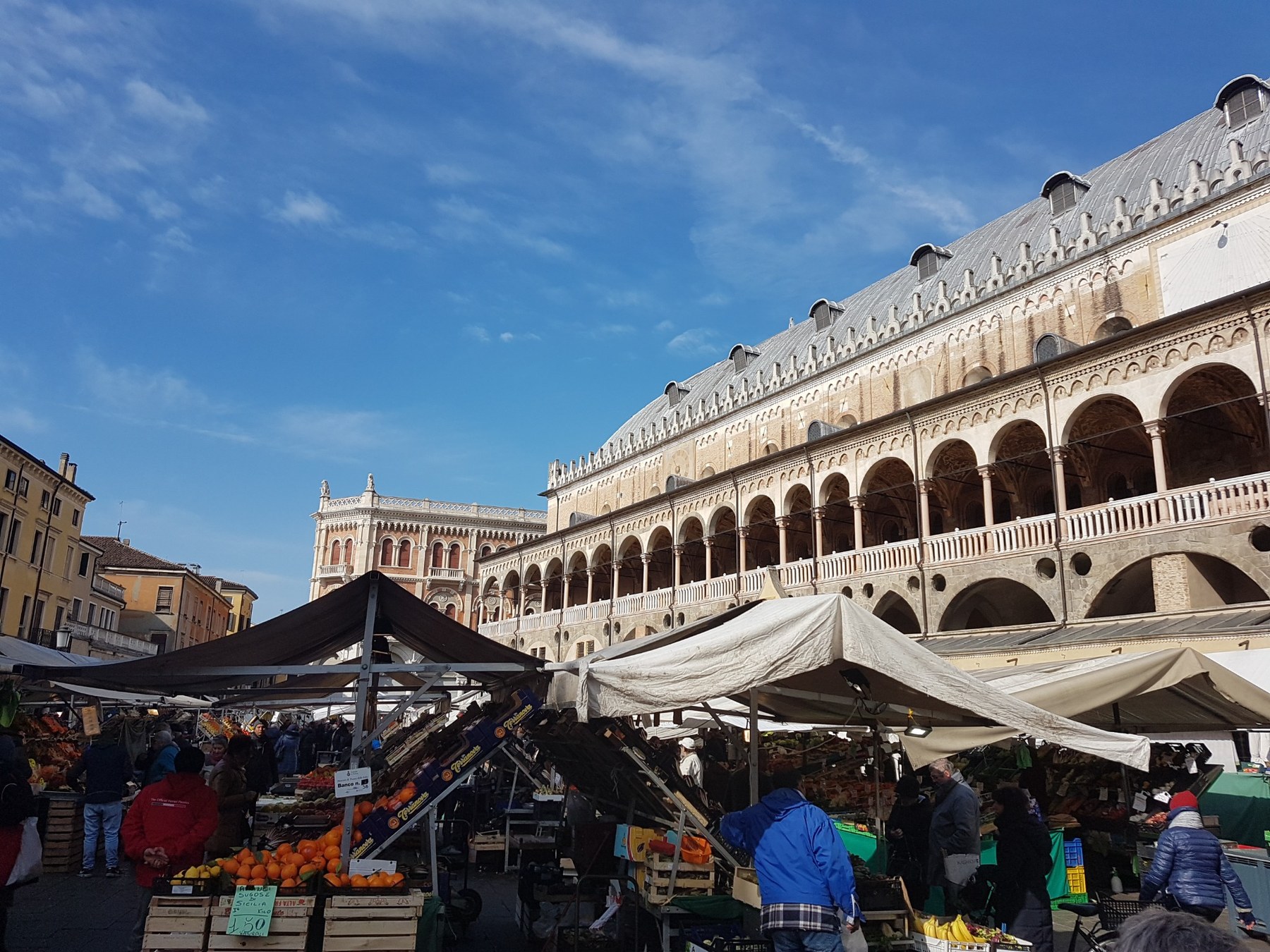
Markets at the Palazzo della Ragione
Padua's twin market squares, Piazza delle Erbe and Piazza della Frutta, flank the medieval Palazzo della Ragione and have hosted trade for centuries.
The two squares take their names from what was historically traded there — erbe (vegetables) and frutta (fruit) — and still host a daily produce market beneath the arcaded ground floor of the Palazzo della Ragione, one of Europe's largest surviving medieval halls. It remains a working market rather than a curated food experience.
The arcades of the Palazzo della Ragione itself, still lined with shops as they were historically.
Piazza delle Erbe and Piazza della Frutta, historic centre.
Euganean Hills wines
The volcanic Colli Euganei just southwest of Padua produce a range of DOC wines, from dry whites to Moscato-based sweet styles.
The Colli Euganei are a cluster of volcanic hills rising from the Veneto plain, their soils suited to varieties including Garganega, Moscato Giallo and Merlot; the area's wines carry the Colli Euganei DOC and DOCG designations and are commonly served in Padua's restaurants and wine bars without needing a dedicated trip to the hills.
Colli Euganei on a wine list, rather than more generic Veneto labels.
Wine bars and restaurants across Padua.