Food & Drink
Taste what Modena does differently
Traditional balsamic vinegar, tortellini and Lambrusco give Modena a food identity all of its own.
- Traditional balsamic vinegar
- Tortellini
- Lambrusco
Italy
Small city. Serious food.
Bologna gets the weekend crowds. Florence gets the headlines. Modena sits quietly between them — a compact Italian city with extraordinary food, beautiful architecture and enough to explore without needing a car.
It's the sort of place that works brilliantly when you don't have two weeks.
4 days is ideal for Modena.
Food & Drink
Modena sits in one of Italy's great food regions, but its identity is more specific than simply 'Emilian food'. This is the home of traditional balsamic vinegar, a city of tortellini and rich handmade pasta, surrounded by producers whose ingredients have shaped the cooking of the region. The pleasure of eating in Modena comes from understanding what you're being served — and knowing which things are worth seeking out.
Must tryAceto Balsamico Tradizionale di Modena DOP
Don't missA tasting that lets you compare different ages or styles.
Wendelse tipDon't judge traditional balsamic by the inexpensive vinegar you may already have at home. They are very different products.
Must try
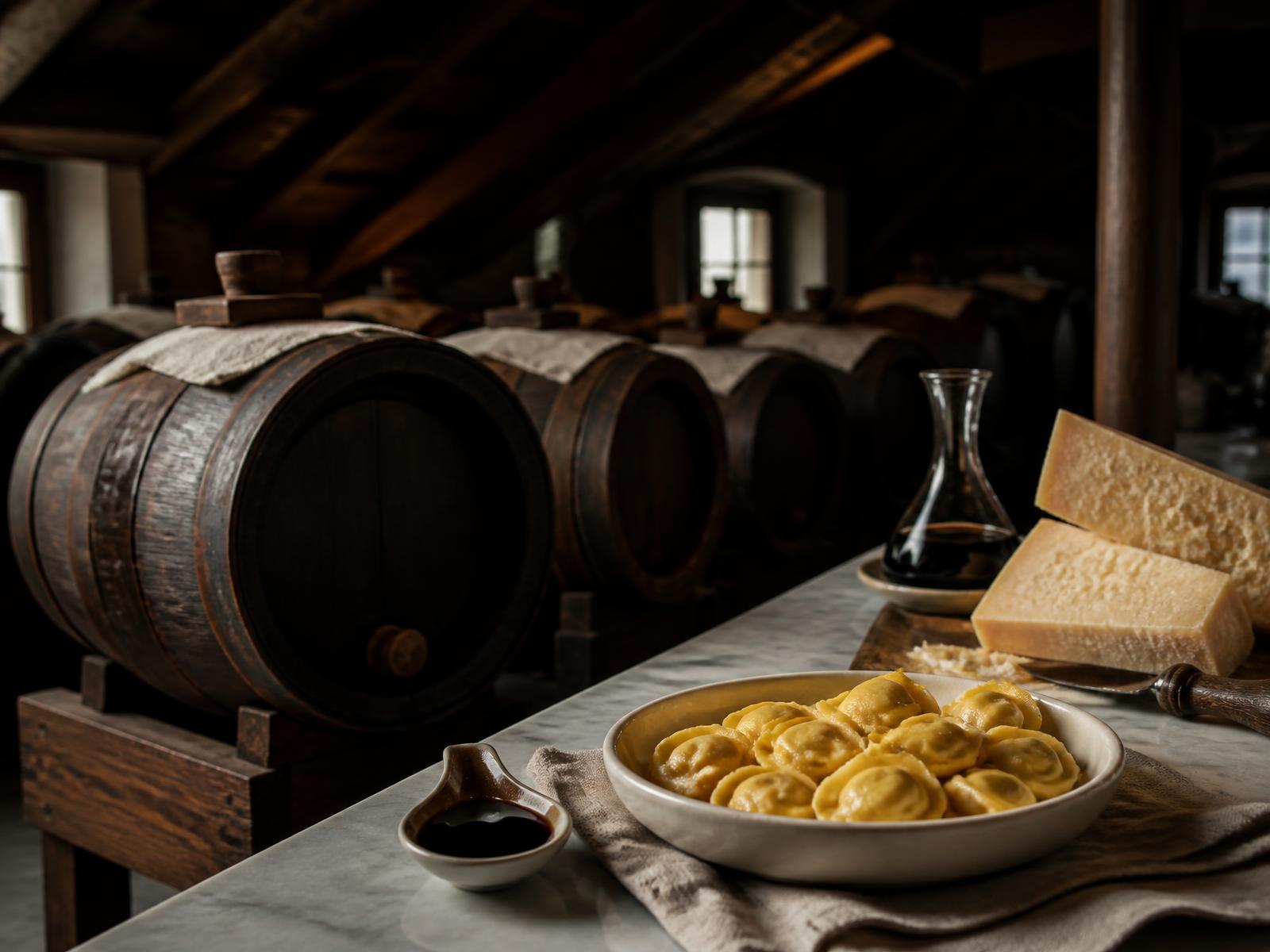
The protected traditional balsamic vinegar of Modena: cooked grape must, aged for years in a series of wooden barrels, and nothing else.
Grapes are pressed and the must is cooked down, then aged in a battery of barrels of different woods and decreasing size, with small amounts moved between them as the liquid concentrates and evaporates over many years. The result is dense, glossy and complex — sweet and sharp at once — and utterly different from the thin, inexpensive vinegar sold as 'balsamic' almost everywhere. Ordinary commercial balsamic vinegar of Modena is a separate, far younger and much larger-scale product; only the traditional DOP version comes from this slow barrel ageing.
It is the product most specifically tied to Modena itself, rather than to Emilia in general, and the reason many food travellers come here at all.
The balance between sweetness, acidity, concentration and the character created by long ageing.
In very small quantities — a few drops from a spoon, or over Parmigiano Reggiano — because the flavour is concentrated and the product is made slowly and in small volumes. It is a condiment to finish a dish, not a dressing to pour.
Wendelse tip: Don't judge traditional balsamic by the inexpensive vinegar you may already have at home. They are very different products.
Small handmade filled pasta parcels, traditionally served in broth — central to Modena's cooking and to Emilian cooking more widely.
The filling is typically pork and cured meats with Parmigiano Reggiano, wrapped in thin egg pasta and shaped very small by hand. Modena and Bologna both claim deep traditions around tortellini, and the exact origin is disputed rather than settled; recipes and sizes vary between the two cities and between households. What is consistent is the traditional serving: in brodo, in a well-made meat broth, rather than under a heavy sauce.
It's the region's defining pasta, and Modena is one of the places where it is still eaten in its traditional form.
Small handmade pasta parcels served in a deeply flavoured broth.
Must try: Tortellini in brodo
As a first course, with grated Parmigiano Reggiano alongside.
Wendelse tip: If you've only eaten tortellini with a heavy sauce, try them the traditional Emilian way in broth.
Pillows of dough fried until puffed and golden, served warm with cured meats — casual, everyday Emilian eating at its best.
The dough is rolled thin, cut into diamonds and fried, so each piece puffs up hollow and light. It arrives hot and is meant to be torn open and filled or wrapped with whatever salumi is on the table. Names vary across Emilia — you may also see it as torta fritta in the Parma area — but the idea is the same.
Some of Modena's most enjoyable food isn't elaborate, and this is the clearest example.
Order it as a starter to share, and eat it while it's still hot — it loses its lightness quickly.
Try it with: Local cured meats, and soft cheeses such as squacquerone or stracchino where they're offered.
Wendelse tip: This is an easy thing to actually order: ask for gnocco fritto with a plate of mixed salumi and you have a very good, very local start to a meal.
Small round breads from the Modena Apennines, cooked in discs and split open to be filled.
The terminology is genuinely inconsistent: strictly, the tigella is the terracotta disc used to cook them and crescentina is the bread, but in everyday use — including on menus in and around Modena — both names get applied to the bread itself. Don't expect one universal convention; ask what the kitchen means if you're unsure.
They belong specifically to the Modena hills, and they're one of the most sociable things to order.
Must try: A basket of warm tigelle with a spread of fillings to share
Split each one while it's warm and fill it — traditionally with cunza (a lard, garlic and rosemary spread), cured meats, or soft and hard cheeses.
Wendelse tip: Order them for the table rather than as an individual dish. They're designed to be assembled and passed around.
A large fresh pork sausage, slowly boiled and served hot in slices — a Modena speciality with protected geographical status.
It's made from pork including rind, which gives the cooked sausage its soft, gelatinous texture, and it's seasoned rather than heavily spiced. It's cooked slowly and eaten hot, traditionally with lentils, mashed potato or polenta.
It carries Modena's name and shows a different side of the city's cooking from the pasta and the vinegar.
Something you might not know: It's strongly associated with the winter months and with New Year in particular — so it isn't necessarily on every menu year-round. Treat finding it as a seasonal pleasure rather than an expectation.
Hot, in thick slices, as a main course.
The same style of seasoned pork mixture as cotechino, but stuffed into a boned pig's trotter rather than a casing.
Zampone Modena carries protected geographical status of its own. The trotter skin acts as the casing, which makes it visually distinctive and gives the cooked meat a slightly different texture from cotechino. It is a festive dish more than an everyday one, and shares cotechino's winter and New Year associations.
It's a piece of Modena's culinary identity that has travelled less widely than balsamic vinegar or tortellini.
Hot, sliced, usually with lentils — most likely to appear in the colder months.
The great cheese of the region, produced across a defined area that includes the province of Modena.
This is a wider regional product rather than a Modenese one: the permitted zone covers Parma, Reggio Emilia, Modena and parts of Bologna and Mantua, and dairies in the Modena countryside are part of it. In Modena it turns up constantly — grated over pasta, in tortellini fillings, and eaten in broken pieces with a few drops of traditional balsamic.
Ageing, and how much drier and more savoury an older wheel tastes.
In broken pieces at room temperature, ideally with traditional balsamic vinegar — the local pairing.
Dishes
A flexible way to translate all of this into a meal — not a checklist, and certainly not something to attempt in one sitting.
Start with gnocco fritto or crescentine and local cured meats. For pasta, tortellini in brodo. For a main, a genuine Modenese speciality such as cotechino if the kitchen has it and the season suits — otherwise a traditional braised or roasted dish. Then Parmigiano Reggiano, ideally with a few drops of traditional balsamic. To drink, a local Lambrusco, preferably secco.
Wendelse tip: Spread it across the trip. Two or three of these in one meal is plenty.
What to drink
The sparkling red wine of the Modena area — a family of grapes and appellations, not a single style.
Lambrusco's heartland runs across the Modena and Reggio Emilia provinces, and the Modena area alone includes distinct denominations: Lambrusco di Sorbara, pale and high-acid; Lambrusco Grasparossa di Castelvetro, darker and more tannic from the hills south of the city; and Lambrusco Salamino di Santa Croce, somewhere between the two. Bottles range from bone dry (secco) through amabile to noticeably sweet, and the frizzante fizz is part of the point: it cuts through rich pasta, fried dough and cured pork in a way still wines don't.
It is the wine Modena's food was built alongside, and the one most often written off on the basis of a single sweet bottle bought elsewhere.
The denomination and whether the bottle is secco — those two things tell you far more than the word Lambrusco alone.
Must try: A local Lambrusco with a traditional Modenese meal.
Lightly chilled, with salumi, gnocco fritto or a plate of filled pasta.
Wendelse tip: If your last experience of Lambrusco was a sweet supermarket bottle, start again here.
A dark, bittersweet walnut liqueur with deep roots in the Modena countryside, made from green walnuts picked while still unripe.
After dinner, in a very small glass.
Authentic experiences
An acetaia is where traditional balsamic vinegar is aged: a room, often at the top of a house or farm building, holding batteries of wooden barrels in decreasing sizes. A visit walks you through the cooked must, the different woods, the yearly topping-up between barrels, and finishes with a tasting of vinegars at different ages.
The product only makes sense once you've seen the barrels and understood how many years separate them. Many acetaie are still family-run, with batteries passed down through generations, which explains both the small quantities and the price.
1–2 hours including tasting · Morning or early afternoon · Booking required
A guided walk through the centre linking the market, traditional shops and a few tastings, with the products explained as you go.
It's the fastest way to get your bearings on a first day, and it makes the rest of the trip's eating more deliberate.
2–3 hours · Morning · Booking required
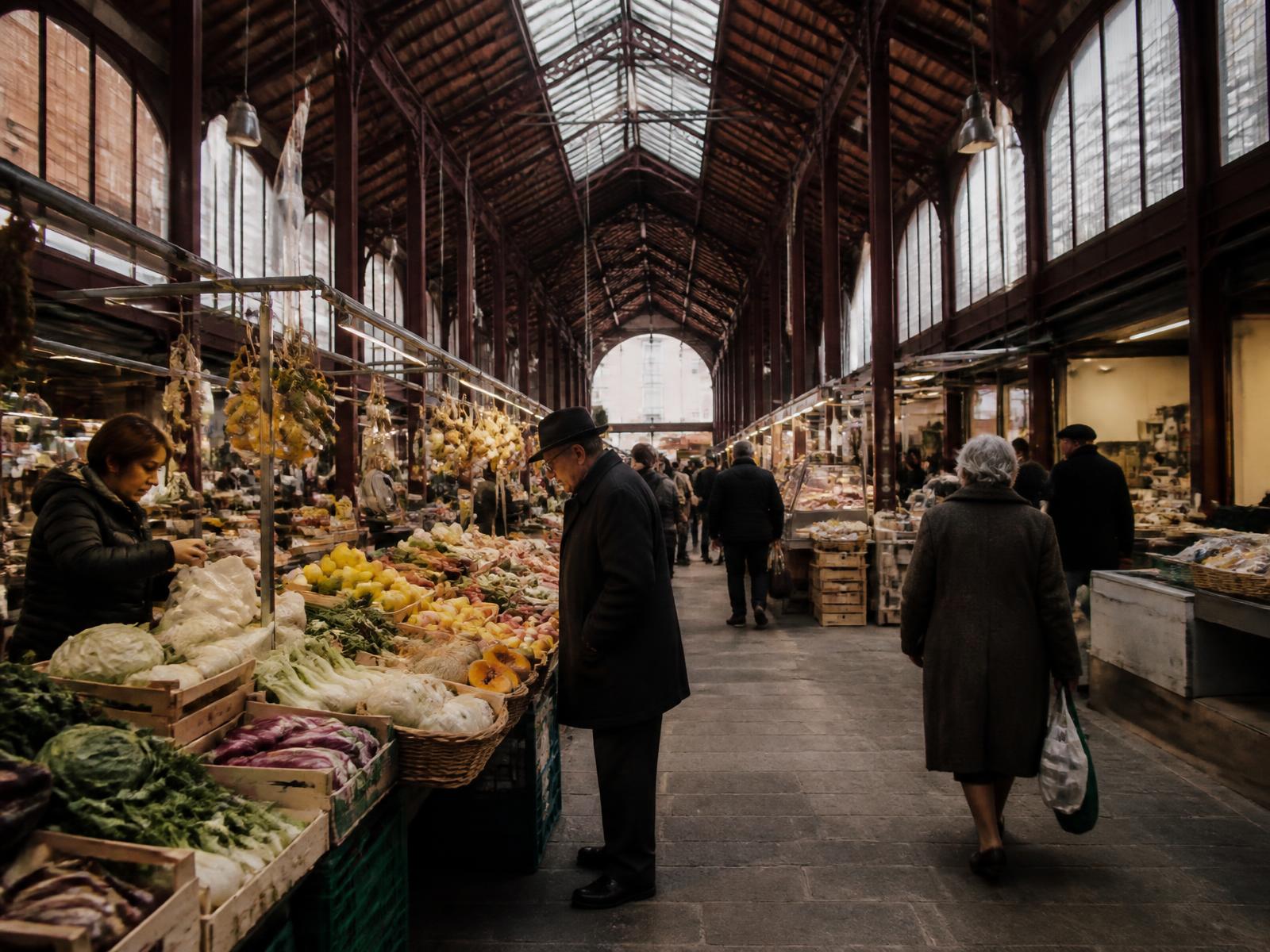
An unhurried wander through the covered market, looking at what's on the counters rather than shopping to a list.
It grounds everything else you eat: you see the raw ingredients before you meet them on a plate.
45 minutes to an hour · Morning
A long meal in a traditional trattoria: gnocco fritto or crescentine with salumi, tortellini in brodo, a local speciality if the season allows, and Parmigiano Reggiano to finish.
The individual products are interesting; the sequence is what shows you how Modena actually eats.
2 hours or more · Dinner, or a long lunch
A visit to a producer in the hills or plains around the city, tasting across styles rather than a single bottle.
Sorbara and Grasparossa side by side make the point immediately: Lambrusco is a category, not a flavour.
1–2 hours, longer with travel · Afternoon · Booking required
A hands-on session rolling egg pasta and shaping tortellini, usually with a cook who makes them daily.
Shaping tortellini by hand explains why they're small, why they're expensive to make properly, and why the broth matters.
2–3 hours · Morning · Booking required
Where to experience it
Modena's historic covered market in the centre, under an iron and glass roof — produce, cheese, cured meats, fish and pasta counters in one place.
A market is the quickest way to understand what a city actually eats: what's in season, which cheeses and cured meats are everyday rather than special, and how much of Modena's cooking depends on fresh pasta made locally. It's also the least expensive way to see several of the region's products side by side before you commit to a restaurant.
Wendelse tip: Use it as somewhere to understand what Modena eats, not simply somewhere to photograph.
Mercato Albinelli · Morning, when the counters are fully stocked and locals are shopping.
A rhythm rather than a schedule — the emphasis is learn, taste and explore, not eat continuously.
Nothing here is booked or timed. Move the parts around to suit your dates.
Leave room for the parts of Modena that have nothing to do with food.
Local tips
Good to know
Art & Architecture
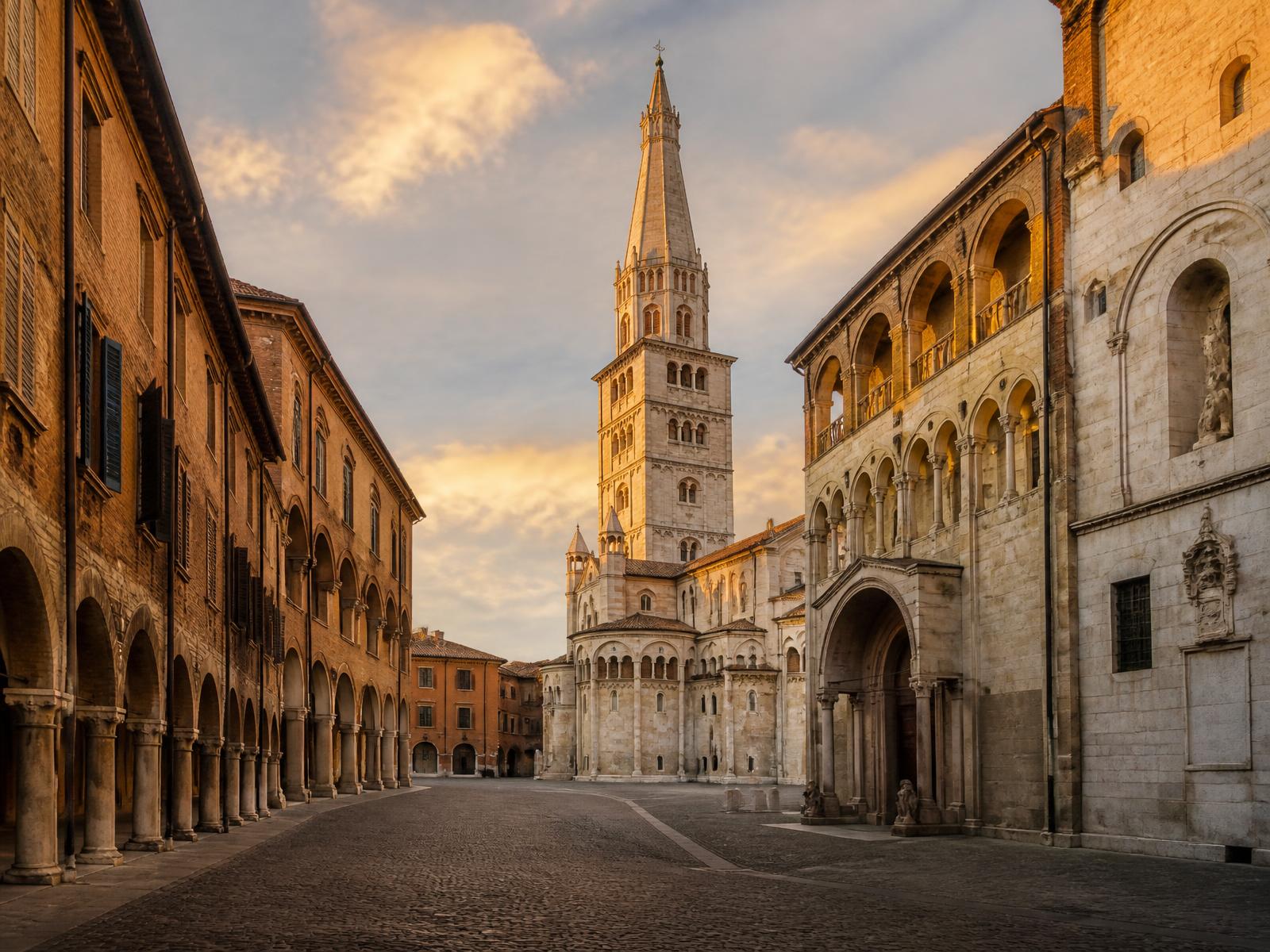
Modena makes architecture unusually easy to understand. Three of its defining sights — the Cathedral, Ghirlandina Tower and Piazza Grande — sit together at the heart of the city and form a UNESCO World Heritage Site. But don't just photograph the square and move on. The real interest is in the details: extraordinary Romanesque sculpture, strange medieval creatures, carved stories, a soaring civic tower and the relationship between religious and civic life that has shaped this space for centuries.
Four layers explain why different parts of Modena look so different. Romanesque Modena, begun in 1099, is the Cathedral and the base of its tower — heavy stone, arcaded galleries and sculpture built into the walls. Medieval civic Modena is Piazza Grande and the Palazzo Comunale: the square where the church and the commune faced each other. Este-era Modena arrived when the city became a ducal capital in the seventeenth century, and it looks completely different — Baroque scale, symmetry and the enormous Palazzo Ducale. Later Modena, including the contemporary city and its motor-industry culture, sits further out again. Walk ten minutes and you change period.
Must tryWalk a full circuit of the Cathedral exterior before you go inside.
Don't missThe medieval sculpture on the Cathedral exterior.
Wendelse tipModena's essential architecture is concentrated in one place. Use the time you save by going slower, not by adding more buildings.
Something you might missLook up around the Cathedral and medieval Modena becomes considerably stranger — the carved figures and creatures are easy to walk straight past.
Must see
The Romanesque cathedral at the heart of the city, begun in 1099 under the architect Lanfranco with sculpture by Wiligelmo.
Lanfranco laid out the building and Wiligelmo carved it, and the two worked as one project rather than in sequence. The façade is banded in pale stone with a rose window and a porch carried on lions, and around the exterior run carved panels and reliefs set into the wall itself. Inside, the character is sober and vertical — brick and stone, a raised presbytery over the crypt, and far less decoration than the outside prepares you for. The Cathedral, the Torre Civica (Ghirlandina) and Piazza Grande are inscribed together as a single UNESCO World Heritage Site.
The Cathedral is important because architecture and sculpture were conceived together. You aren't simply looking at a medieval church decorated afterwards — the carvings are part of how the building tells its story.
Wiligelmo's reliefs are among the earliest large-scale narrative sculpture of the Italian Romanesque, and they are still on the building they were made for rather than gathered into a museum.
Look for: The extraordinary figures, animals and carved stories around the building.
Don't miss: The medieval sculpture on the Cathedral exterior.
Something you might otherwise miss: The metopes — small carved panels of hybrid and half-human creatures set high on the building. Their meaning is genuinely uncertain and scholars disagree, which is part of the pleasure. Some sculptures on Modena's cathedral are copies with the originals preserved indoors, so don't assume every carving you see outside is the twelfth-century stone.
Wendelse tip: Walk all the way around the Cathedral. Some of the most interesting details aren't on the main façade.
Romanesque, begun 1099 · 45–60 minutes for the interior and a full exterior circuit; longer if sculpture is why you came · Morning, when the square is quiet and the low light picks out the carving.
The Cathedral's bell tower and Modena's civic tower — the Torre Civica — rising beside the church and visible from across the city.
The lower part belongs to the same Romanesque campaign as the Cathedral: square, solid, articulated with pilasters and small openings. Higher up the tower changes, with the openings growing and the upper stage and spire built in a later Gothic manner. That break is legible from the ground once you know to look for it, and it turns the tower into a diagram of the building periods it passed through. It served the commune as much as the church, holding the bells that ordered civic life.
It is both an architectural landmark and a civic symbol: the tower belonged to the city's public life, not only to the Cathedral beside it, and Modena has been identified by its silhouette for centuries.
Look for: How the openings change as the tower rises — narrow and sparse below, larger and more elaborate above.
Don't miss: The point where the Romanesque lower tower gives way to the later upper stage.
Wendelse tip: Look at the tower from Piazza Grande before getting closer — its changing proportions are easier to understand from a little distance.
Romanesque base with a later Gothic upper stage · 20–30 minutes at ground level
The square between the Cathedral, the Ghirlandina and the Palazzo Comunale — the room that belongs to the city.
Piazza Grande is not a leftover space between monuments. It was the working centre of medieval Modena, where markets, assemblies, justice and public announcements happened, with the church on one side and the commune's own building on the other. That confrontation is the point: the square holds the religious and civic halves of the city in a single view, which is why it is inscribed as part of the UNESCO site rather than treated as a setting for one.
It explains how Modena actually worked as a city. Understand the square and the Cathedral and tower stop being separate attractions.
Look for: The Preda Ringadora, the old stone platform used for public speaking, and the way the Palazzo Comunale's arcade faces the Cathedral across the open space.
Wendelse tip: Spend unstructured time here rather than crossing it. Sit for twenty minutes and the ensemble makes far more sense.
Medieval civic space · 20–30 minutes, more if you stop for a coffee · Early morning or early evening
Modena's town hall, running along one side of Piazza Grande behind a long arcade.
The building grew over centuries from a group of medieval civic structures into the unified frontage you see now, with its clock tower and its portico giving shelter along the edge of the square. It is deliberately less spectacular than the Cathedral opposite, and that contrast is what makes it useful.
It gives the square its civic half. Without it, Piazza Grande reads as a cathedral forecourt rather than the shared space of church and commune.
Look for: The arcade, and how it draws people along the edge of the square rather than across it.
10 minutes from outside
The vast ducal palace of the Este family, facing the open expanse of Piazza Roma a short walk north of the Cathedral quarter.
When the Este dukes lost Ferrara at the end of the sixteenth century, Modena became their capital, and the city was rebuilt to suit that role. The palace is the clearest result: a long, monumental Baroque façade organised around a central entrance, ordered and symmetrical in a way nothing in the medieval centre is. Piazza Roma in front of it is part of the architecture rather than a separate site — the open ground is what allows the façade's scale and symmetry to register. The building has long been in institutional use rather than serving as a museum of itself, so treat the exterior and the square as the experience.
Walk from Piazza Grande to Palazzo Ducale and Modena changes period surprisingly quickly. This is the ducal city rather than the medieval one, and seeing both explains the shape of the centre.
Look for: The symmetry of the façade, and how differently it treats the street compared with the arcaded medieval centre you just walked through.
Baroque, from the seventeenth century · 20–30 minutes including the square
A large Gothic church west of the centre, worth a short detour if you have already given the UNESCO ensemble the time it deserves.
It shows a different medieval idiom from the Cathedral — Gothic rather than Romanesque — within an easy walk.
15–20 minutes
Look closer
Carved narrative panels set into the Cathedral wall, not applied decoration.
They are among the earliest large-scale narrative sculpture of the Italian Romanesque, and they are readable up close in a way photographs flatten.
Across the Cathedral façade, at roughly eye to head height.
Small panels of hybrid and half-human creatures set high on the building.
Their meaning is disputed, which makes them more interesting rather than less. Some are copies, with originals preserved indoors.
Above you, around the exterior — you have to look up to find them.
Doorways framed by carved columns, animals and figures rather than plain stone.
The doorways are where architecture and sculpture most obviously become the same thing.
The main west portal and the side entrances as you walk around.
The join between the Romanesque lower tower and the later upper stage.
It shows the building's construction history in a single glance.
Best read from across Piazza Grande rather than from the tower's base.
The church presents a long flank to Piazza Grande, not just its façade.
The relationship between building and public space is the reason the whole ensemble is listed together.
Standing in the middle of the square, looking at the side of the Cathedral.
Baroque order and symmetry, on a scale nothing else in the centre attempts.
It marks the moment Modena stopped being a medieval commune and became a ducal capital.
From the far side of Piazza Roma.
One continuous route through the centre, ordered so the medieval city comes first and the ducal city arrives as a deliberate contrast at the end.
1. Piazza Grande15–20 min
Start here and don't rush. Read the Cathedral, tower and Palazzo Comunale together before entering anything.
2. Modena Cathedral exterior25–30 min
A full circuit of the building, looking at the reliefs, portals and the metopes above you.
3. Modena Cathedral interior20–30 min
Sober, vertical and much plainer than the outside — the crypt and raised presbytery are the character.
4. Ghirlandina Tower15–20 min
At the base, then step back into the square to read the change between the lower and upper sections.
5. Palazzo Comunale and the surrounding streets15 min
The civic side of the square, then the arcaded lanes running off it.
6. Historic centre20–30 min
Walk north without a fixed route. This is the transition between the two Modenas.
7. Piazza Roma10 min
Stop in the open space before approaching the palace — the scale needs distance.
8. Palazzo Ducale15–20 min
The Baroque ducal city, from the exterior.
What to look forSculpture on the Cathedral, the tower's change of style, and how completely the architecture changes between Piazza Grande and Piazza Roma. Optional additions: the Church of San Francesco, or a longer wander through the arcaded centre.
Total Short version: Piazza Grande, Cathedral exterior and interior, Ghirlandina — around 2 hours. Full version: the whole route with breaks — around half a day. · Morning for the Cathedral, late afternoon for the square · easy
More time should mean a richer experience, not a longer checklist. This day deliberately slows down rather than adding buildings.
If you only have half a day, keep Piazza Grande, the Cathedral inside and out, and the Ghirlandina, and drop the rest without regret.
Good to know
Why Wendelse likes it
This is Emilia-Romagna, so eating well isn't difficult. Traditional balsamic vinegar, fresh pasta, parmesan and some of Italy's great culinary traditions all have a home here.
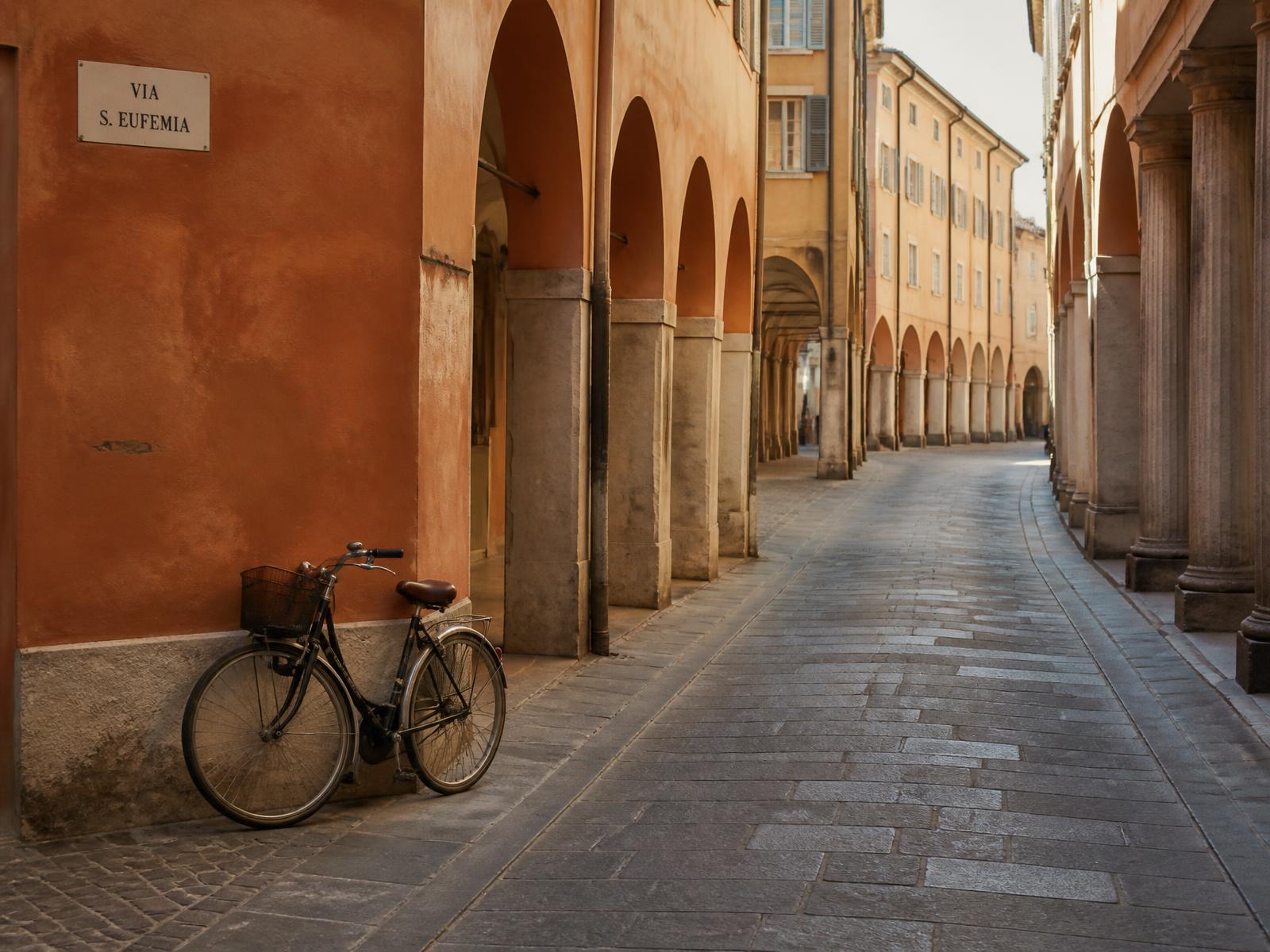
The historic centre is compact and rewarding to explore on foot, centred around Piazza Grande, Modena Cathedral and the Ghirlandina.
You don't need a car to enjoy Modena. The city is manageable, walkable and well suited to a short break.
Modena feels distinctly Italian without feeling like you've simply arrived at another major tourist capital.
Birmingham · 6–9 November · 4 days
Built around your dates and what you said you're in the mood for. The journey itself isn't checked until you choose dates in Results.
Friday · 6 November
Arrival day
Nothing else planned. That's deliberate.
Saturday · 7 November
Weekend
Keep the afternoon free — wander, sit somewhere, do nothing.
Sunday · 8 November
Weekend
Nothing else planned. That's deliberate.
Monday · 9 November
Departure day
Leave gaps between plans — nothing here needs rushing.
Prototype itinerary. Activity availability is illustrative, not live opening hours.
Don't miss
Food & Drink
Traditional balsamic vinegar, tortellini and Lambrusco give Modena a food identity all of its own.
Art & Architecture
Modena's historic centre brings together its Romanesque cathedral, extraordinary medieval sculpture and one of Italy's great civic squares.
Culture & Atmosphere
Modena's arcaded streets, cafés, market and evening passeggiata make the compact centre particularly enjoyable to explore without a plan. Motor Valley sits just outside the city for anyone drawn to Italian car culture.
Choose your dates and we'll check real flights and the journey from Birmingham.
Check a journey for your dates →Traveller fit
Discover the food traditions of Emilia-Romagna.
See the city beyond the guidebook highlights.
Go beyond the tourist version of Italian food.
Where to stay
Best for first-time visitors
Walk everywhere, with easy access to restaurants and attractions.
Modena
4 days · Food · Architecture · Walkable
Prototype placeholders — nothing is connected to a booking service yet.