Lucerne
Switzerland
The lake and mountains are not background scenery.
Lucerne's old town is compact enough to explore without much planning: cross the Chapel Bridge, wander the painted streets and follow the Reuss until something catches your attention.
But the reason Lucerne works so well for a few days is what happens beyond the old town. The lake begins almost at the station and the mountains sit beyond it. Give the historic centre its time, then get onto the water or into the landscape. One good old-town wander is enough before the lake starts demanding your attention.
4 days is ideal for Lucerne.
Art & Architecture
The water isn't scenery. It's part of the architecture.
Lucerne is almost too easy to look at. Lake. Mountains. Painted façades. Wooden bridge. It's easy to turn the architecture into decoration for the view. Instead, watch what the buildings do with water. The medieval city used bridges as movement and defence. Churches present themselves directly to the Reuss. Streets and squares repeatedly open onto the river. Centuries later, Jean Nouvel's KKL deliberately brought water into the composition of a contemporary cultural building beside the lake.
Water isn't the backdrop to Lucerne. Again and again, it becomes part of how the architecture works.
Don't missCross the Reuss more than once. Lucerne changes when you keep looking back at the bank you've just left.
Wendelse tipChapel Bridge is busiest when everybody wants the same photograph. If the bridge itself feels overwhelmed, step away and look at what it connects.
Must see
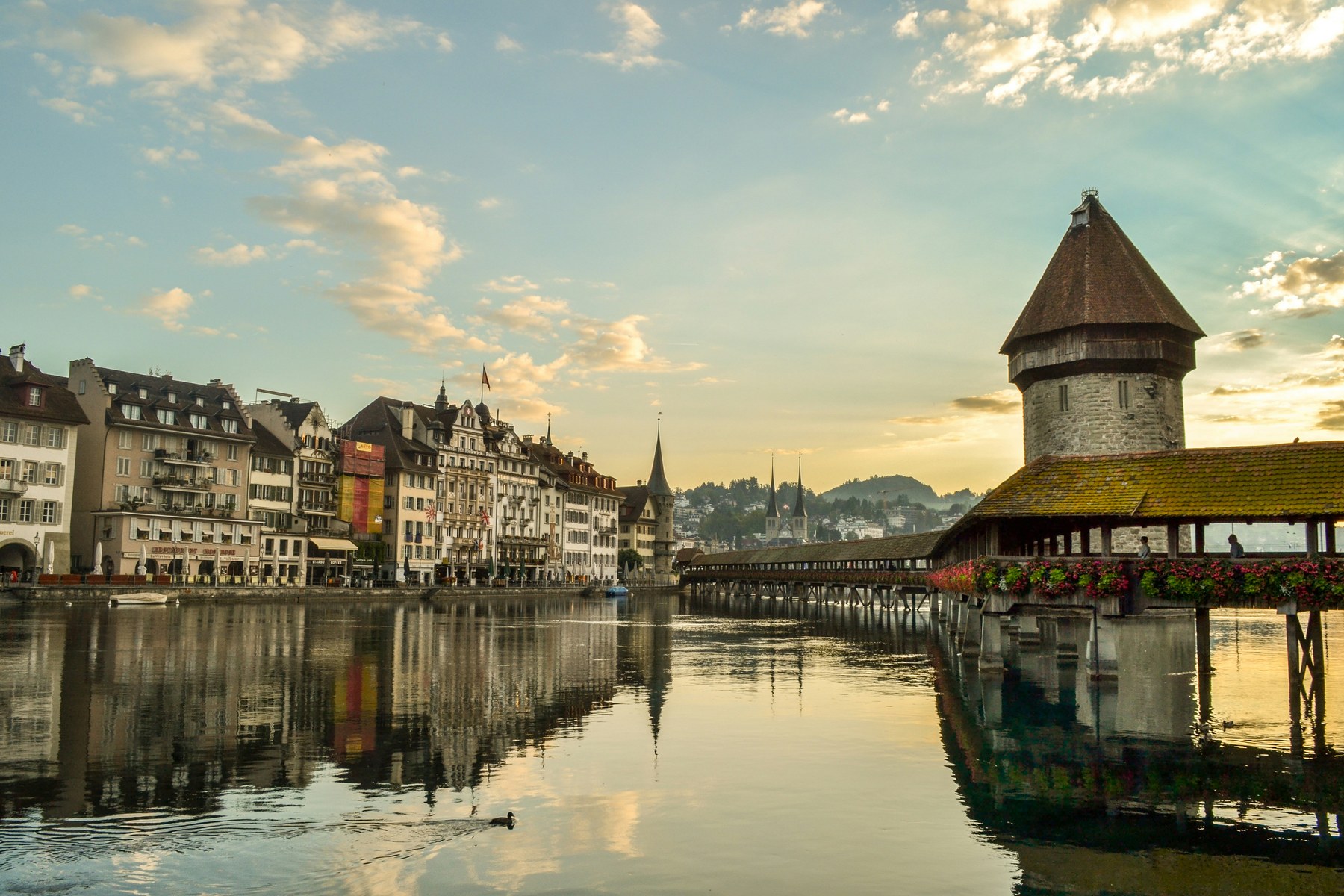
Chapel Bridge, Water Tower and the Reuss
Start by forgetting that this is Switzerland's most famous postcard.
The Chapel Bridge was infrastructure. It crossed the Reuss, connected parts of the city and formed part of Lucerne's medieval fortification system. Together with the Spreuer Bridge and town walls, it belonged to a defensive city rather than to a picturesque tourist composition.
That function helps explain its diagonal relationship with the river. Then look up. The painted panels beneath the roof turn movement across the bridge into something more than transit, adding a historical narrative to the structure. The bridge you walk today also carries a much more recent history. A devastating fire in 1993 destroyed a large part of it; the damaged sections were rapidly rebuilt and the bridge reopened the following year. Don't let that make you dismiss it as a reconstruction. It makes the bridge another example of a city deciding that working historic infrastructure still mattered enough to restore.
Look for: The riverbanks at either end. The bridge makes more sense when you see what it joins.
Musegg Wall and the edge of the old town
Go uphill.
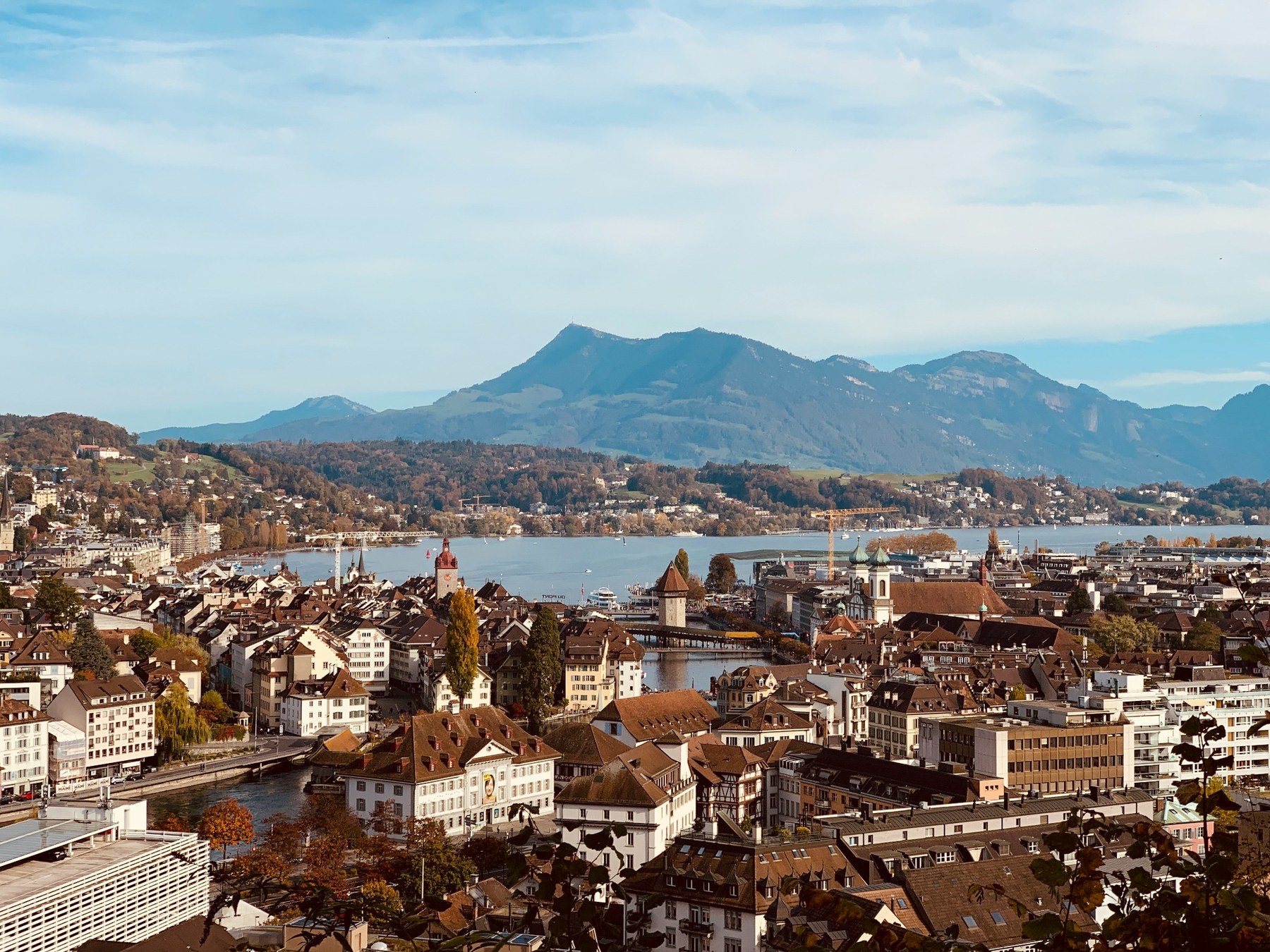
Lucerne's medieval fortifications developed as two defensive systems. The inner line included town walls and the wooden river crossings; the outer line climbed the sandstone ridge above the old town. The surviving Musegg Wall belongs to that outer system.
Seen from below, its towers give Lucerne a medieval skyline. Seen from the wall, the relationship reverses. Now you can look down over the old town, river and lake and understand why the ridge mattered defensively. Don't treat the towers as nine separate attractions. Read the wall as a line across the ridge, not as a collection of towers. A wall following higher ground makes the city's former edge legible in a way that isolated towers never could.
Look for: How abruptly dense old-town fabric gives way as the fortification climbs above it.
KKL Luzern
Then cross several centuries at once.
Jean Nouvel's KKL sits beside the lake and railway station with an enormous projecting roof that seems almost detached from the building beneath it. Don't approach it as the obligatory piece of modern architecture in an otherwise historic city.
Look at the water. Nouvel divided the complex into distinct volumes and allowed water to enter between them in channels. The lake therefore doesn't simply sit outside the building as a view. It is drawn into the composition. The vast roof then pulls the separate elements together, its underside catching reflected light from the water below. That relationship with the water is why the KKL belongs here. Its architectural language has almost nothing in common with the medieval bridges. Its instinct to make water part of the experience does.
Details to notice
Six hundred years apart, the same problem
Don't take this as a claim that Jean Nouvel was copying medieval Lucerne.
He wasn't. But put the Chapel Bridge and KKL in the same day and an interesting comparison appears. The medieval bridge makes the river useful. It carries people across it and once formed part of the city's defensive system.
The KKL faces a very different architectural problem: how to place a major contemporary cultural building beside one of Europe's most visually dominant lake settings without treating the water as something merely to look at through glass. Its answer also refuses to leave the water outside. The building reaches over it, reflects it and allows it between its separate volumes. The buildings are centuries apart and solve completely different practical problems. But both are better understood once you stop treating Lucerne's water as scenery.
Look closer
The old town wears its pictures outside
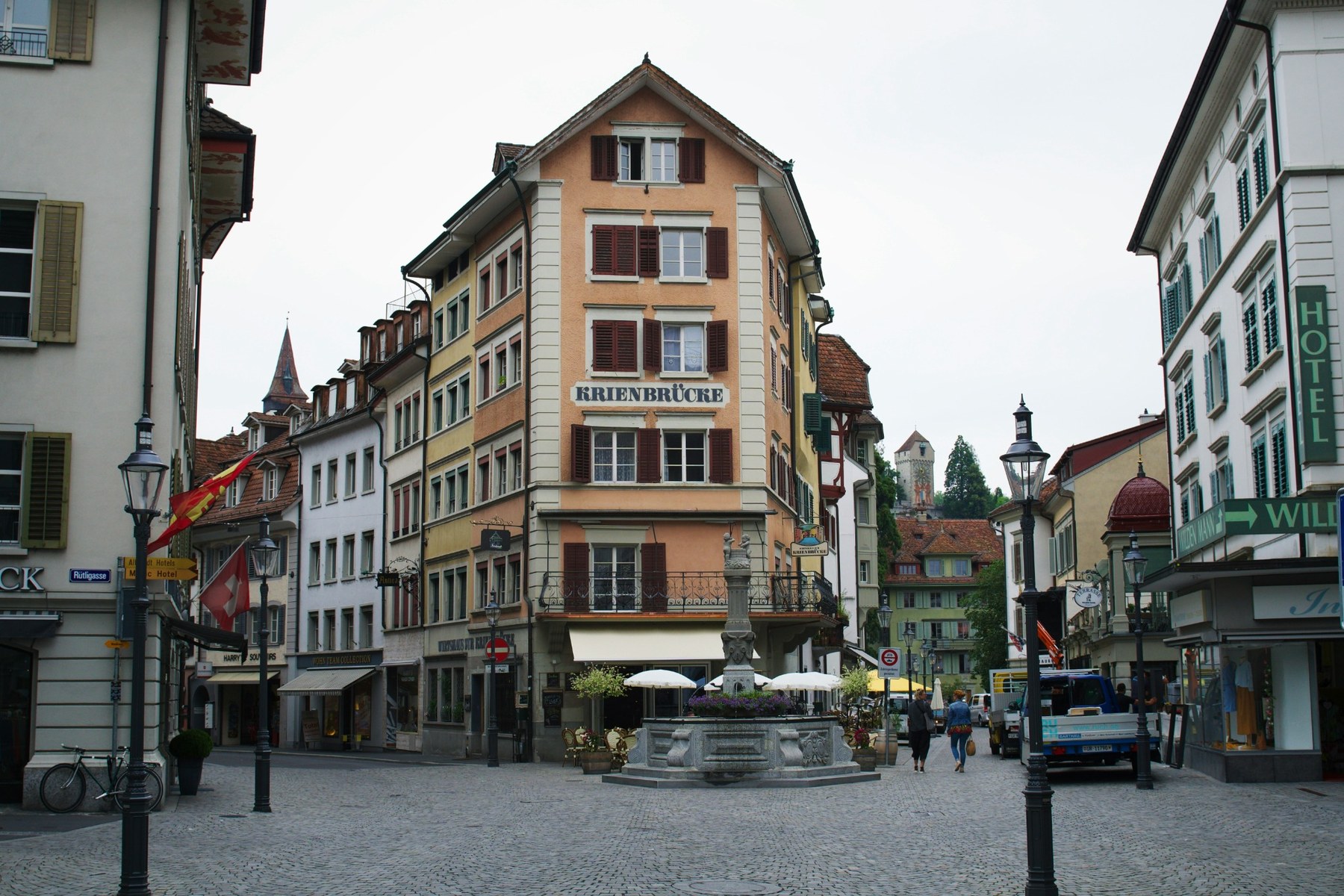
Move away from the river into Weinmarkt, Kornmarkt and the surrounding streets.
Some of Lucerne's historic façades are painted so elaborately that the buildings can start to look like illustrations of themselves. Don't just register them as colourful. Look at how painting changes an ordinary wall.
Windows, architectural divisions and figurative scenes become part of one public surface. Decoration isn't confined to a church interior or museum room; it faces directly into the square. That gives the old town a visual richness very different from the stone fortifications above it.
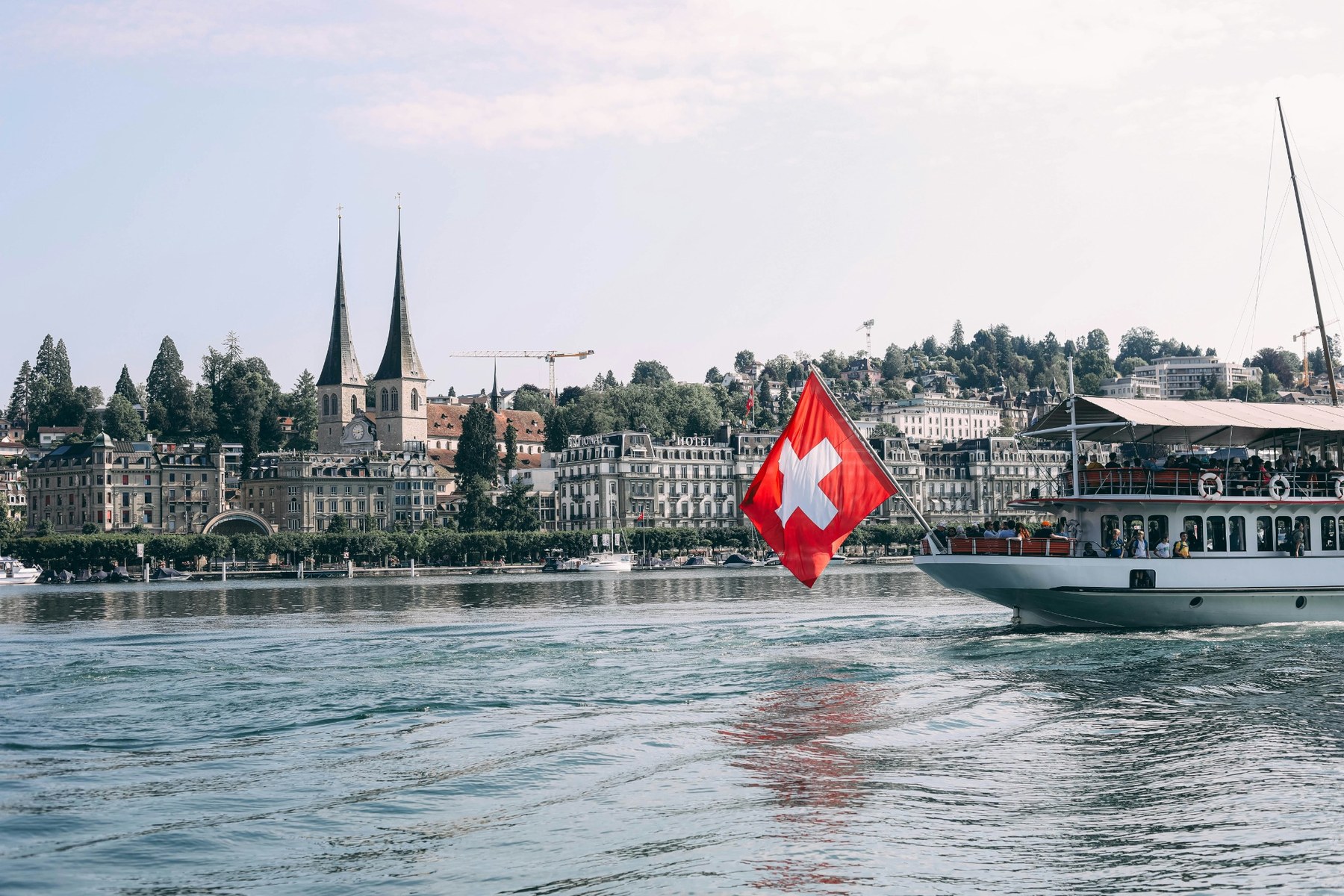
Look at the Jesuit Church from the other bank first
Lucerne's Jesuit Church is an important Baroque building, begun in the seventeenth century directly beside the Reuss.
Before going inside, cross the river. Its pale façade and twin towers make much more sense when seen as part of the riverbank rather than isolated as a church front.
Then enter. The contrast between the relatively contained riverside exterior and the decorative interior is stronger because you've already understood where the building sits in the city. The river gives the church an urban façade.
A suggested walk
Cross the river more than once
Start at the KKL.
Stand beneath the enormous roof and look towards the old city across the water. Then head for Chapel Bridge and cross the Reuss. Don't rush through the bridge. Notice the roof, paintings and Water Tower, but also keep looking towards both banks. Move into the old-town squares before climbing towards the Musegg Wall. From higher ground, find the river again. Then descend towards the Spreuer Bridge and cross back to the left bank. Continue towards the Jesuit Church and look across the Reuss once more.
The route keeps changing your relationship with the same small city. Modern lakefront becomes medieval crossing. River becomes street edge. Fortification becomes viewpoint. Another bridge returns you to the opposite bank. Lucerne isn't architecturally interesting because it has a famous wooden bridge. It's interesting because the city keeps making you negotiate the water.
Why Wendelse likes it
Chapel Bridge, the Reuss and the old town
Treat the bridge as the start of a wider walk rather than a photograph. Follow the river and let the painted streets lead.
Spreuer Bridge and the Musegg wall
Best combined: the quieter bridge, then the wall and towers above the old town.
Get onto Lake Lucerne
A boat is not an excursion here — it is the most natural way to understand where the city sits.
One mountain, not three
Pilatus or Rigi, chosen by the weather on the day. Two mountain days turns the trip into logistics.
The Lion Monument
A short stop. It earns ten minutes, not an hour.
The KKL and lakeside culture
Worth attention if architecture or concerts interest you. Entirely skippable if not.
Birmingham · 6–9 November · 4 days
A suggested shape for your days.
Built around your dates and what you said you're in the mood for. The journey itself isn't checked until you choose dates in Results.
Friday · 6 November
Arrive & settle in
Arrival day
- Afternoon
- Arrive and check in.
- Chapel Bridge, the Reuss and the old town — Cross the bridge, follow the river and let the painted streets set the route.
- Lion Monument and the KKL — A short stop at the monument, and the lakeside KKL if architecture or concerts appeal.
Nothing else planned. That's deliberate.
Saturday · 7 November
Your big exploring day
Weekend
- Morning
- One mountain day — Pilatus or Rigi, chosen on the day according to the weather.
- Afternoon
- Out onto Lake Lucerne — A boat is the most natural way to understand where the city actually sits.
Leave gaps between plans — nothing here needs rushing.
Sunday · 8 November
Take Lucerne at your own pace
Weekend
- Afternoon
- Spreuer Bridge and the Musegg wall — The quieter bridge and the towers above the old town, best taken together.
- Evening
- Central Swiss comfort food — Luzerner Chügelipastete or one good regional meal — sometimes with the setting winning over the menu.
Nothing else planned. That's deliberate.
Monday · 9 November
One last morning
Departure day
- Morning
- Breakfast, then a last walk through town.
- Afternoon
- Lunch, then the journey home.
Leave gaps between plans — nothing here needs rushing.
Prototype itinerary. Activity availability is illustrative, not live opening hours.
Getting there
Choose your dates and we'll check real flights and the journey from Birmingham.
Check a journey for your dates →Traveller fit
Is Lucerne your kind of place?
- Food
- ★★★★☆4 out of 5
- History
- ★★★★☆4 out of 5
- Architecture
- ★★★★★5 out of 5
- Walkability
- ★★★★★5 out of 5
- Outdoors
- ★★★★★5 out of 5
- Atmosphere
- ★★★★★5 out of 5
Things worth doing
A first day that works
Chapel Bridge, the Reuss and the old town, Spreuer Bridge, the Musegg wall if you have the energy, then the lake.
If you have a second day
Let the weather decide: one mountain, or a substantial day on the lake.
Extra time
Another boat, more lakefront, the KKL or a museum — and change the plan if the weather improves.
Wendelse tip
Choose one mountain. Lucerne is better when the trip has room to change with the weather.
Where to stay
Stay between the station, lake and old town
Best for easy access to both city and landscape
Boats, trains and the historic centre are all within a few minutes' walk of each other.
Ready to make it a trip?
Lucerne
4 days · Outdoors · Architecture · Walkable · Culture
Prototype placeholders — nothing is connected to a booking service yet.