WendelseShort breaks, reconsidered
Guimarães, Portugal

Guimarães

Portugal

Portugal's origin story in a city you can actually relax in.

Guimarães carries a lot of national history, but it doesn't feel like a history textbook when you're there.

The castle and palace give the headline story; the pleasure comes from how quickly you can step back into compact squares and medieval streets.

4 days is ideal for Guimarães.

Food & Drink

Food & Drink

Guimarães's own contribution is a convent pastry, Torta de Guimarães, alongside the wider Minho repertoire of pork, kale soup and green wine that the city shares with the rest of the region.

Guimarães expresses the Minho through robust savoury cooking and Vinho Verde, with its own convent-pastry tradition, Torta de Guimarães, as the clearest local distinction.

Must try

Torta de Guimarães

A crescent-shaped convent pastry filled with chila (fig-gourd jam), egg and almond.

Made with a hand-worked pastry rolled thin and greased with pork fat left over from making rojões, then wrapped around a filling of chila jam, egg and ground almonds and shaped into a half-moon rather than the flat torta shape the name suggests. Guimarães accounts trace the original recipe to nuns at the Convento de Santa Clara.

A thin, slightly greasy pastry shell rather than a dry biscuit crust, with a moist, dense filling.

Established confeitarias in the historic centre.

Toucinho-do-céu

A dense almond and egg-yolk convent cake whose name means 'bacon from heaven'.

Egg yolks, sugar and ground almonds are baked into a rich, moist cake; the name is a legacy of convent kitchens across Portugal that once used pork fat to grease the tins. It is one of the two convent sweets, alongside Torta de Guimarães, most associated with the city's confeitarias.

A moist, close-textured slice rather than a light sponge.

The same confeitarias that sell Torta de Guimarães.

Caldo verde

A potato broth with finely shredded couve galega kale and a slice of chouriço, from the wider Minho.

Potatoes are boiled and mashed into the cooking water to form the base, then very finely shredded kale is stirred in at the last minute so it barely cooks, and a slice of chouriço and a dash of olive oil finish the bowl. It is a Minho staple served at everyday meals and local festivals alike.

Kale cut into hair-thin ribbons rather than coarse strips.

Most traditional restaurants in the centre.

Rojões

Cubes of pork marinated in wine and garlic, then fried, a Minho dish tied to the autumn pig-slaughter.

Pork is marinated for hours in white wine, garlic, bay leaf and paprika before being fried in its own fat, traditionally served with tripas (potatoes stewed or fried), roasted chestnuts or blood sausage. It is closely associated with São Martinho celebrations in November across the Minho.

Well-rendered, crisp pieces rather than pale, boiled-looking meat.

Traditional Minho restaurants, especially in autumn.

Vinho Verde

The young, lightly sparkling white wine of the Minho, low in alcohol and served well chilled.

Made from grapes such as Alvarinho and Loureiro grown across the Minho region, Vinho Verde is bottled and drunk young, with a slight natural fizz and high acidity suited to the region's fried and pork-heavy dishes.

A pale, often slightly effervescent glass, poured cold.

Any traditional restaurant or tasca in the city.
Good to know

  • Opening days and named businesses change: verify any business-level recommendation at trip time.

Art & Architecture

Don't stop when you've found medieval Portugal

Guimarães makes it very easy to tell one story. Castle. Afonso Henriques. Birth of Portugal. Medieval streets. All of that matters.

But if you stop there, you miss what makes the city's architecture more unusual: the historic centre records a medieval settlement continuing to change through later houses, civic spaces and building types, while the Couros district extends that story into production and industry. Guimarães didn't finish when Portugal began.

Don't missKeep walking after the medieval centre feels complete. Couros changes the story.

Wendelse tipThe castle and palace sit at one end of the architectural narrative, not above everything else in the hierarchy.

Must see

Castle and Paço dos Duques

Treat the two together, but don't pretend they're the same period or same kind of building.

The castle represents the fortified northern pole around which early Guimarães developed. Nearby, the fifteenth-century Paço dos Duques belongs to a later aristocratic world and introduces a very different scale of residence.

Moving between them is more useful than deciding which is the bigger attraction. One is about enclosure, defence and early political power. The other is about how elite residence itself became monumental. Then leave them. Guimarães becomes more interesting once the national-origin story stops dominating every building.

Largo da Oliveira and Praça de Santiago

This is where the historic centre starts feeling inhabited rather than commemorative.

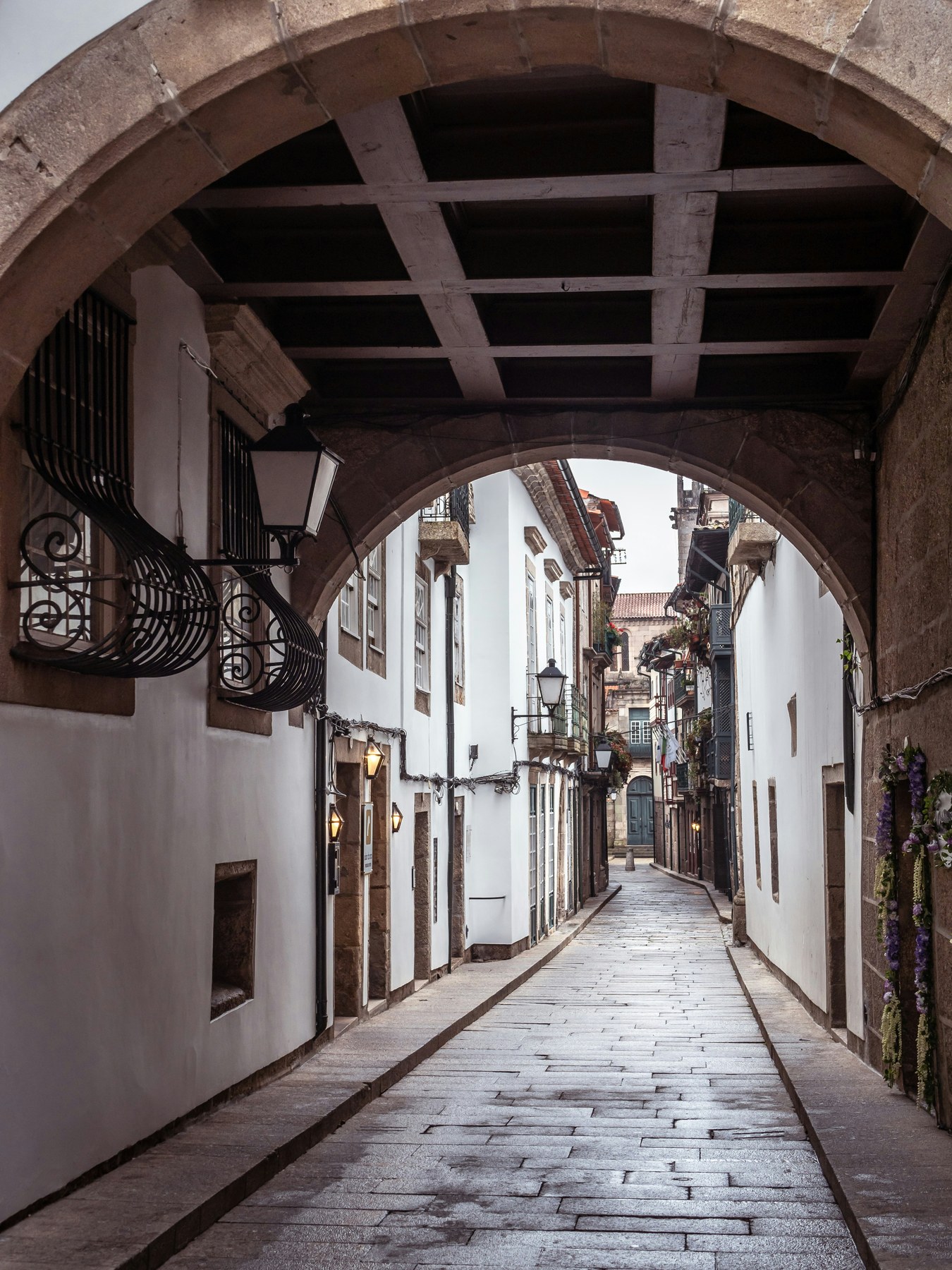
The adjoining spaces are irregular, enclosed by buildings of different dates and connected through narrow streets and arches. Ground floors remain active; upper storeys lean into the spaces with balconies, windows and timber elements.

Don't hunt for a single perfect façade. Stand in one square, move through to the other and notice how little architecture is required to make the space change character. These are civic rooms made by accumulation.

Couros

Couros is essential because it prevents Guimarães becoming a medieval stage set.

For centuries this district was associated with leather working. Granite tanning tanks, water channels and buildings connected with production survive within an area that developed beyond the medieval core.

Look down as much as up. Water infrastructure and tanning tanks tell you what buildings here were for. This is architecture shaped by work rather than court or church. Its inclusion in the expanded World Heritage property matters because Guimarães' story is explicitly one of a medieval settlement evolving into a later residential and productive town.

Look closer

Granite below, lighter construction above

A characteristic historic Guimarães building technique combines a granite ground floor with timber-framed construction above.

Once you know to look for it, the apparent harmony of the historic centre becomes more technically interesting.

The heavy lower structure and lighter upper storeys are doing different jobs. Don't assume every painted upper façade is solid masonry simply because the ground floor is stone.

The houses changed without the streets starting again

Guimarães retained much of its medieval urban layout while its buildings continued evolving.

That means later houses and civic buildings occupy an older street framework.

Look for the mismatch: narrow or irregular routes inherited from the medieval town supporting façades and domestic forms belonging to much later centuries.

Couros was built around water and work

In the leather-working district, water isn't ornamental.

Channels supplied an industrial process, while granite tanks and utilitarian structures supported tanning and drying.

That gives Couros a completely different architectural logic from the polished historic squares uphill.

A suggested walk

From foundation story to working town

Start at the castle. Pass the Paço dos Duques and head down Rua de Santa Maria towards the historic centre.

The route itself helps: fortified and aristocratic architecture gives way to houses, then to the civic life around Praça de Santiago and Largo da Oliveira. Most architecture guides could stop there. Don't. Continue south towards Couros.

The monumental story thins out and traces of work take over: channels, tanks, industrial structures and buildings whose value comes from what happened in and around them rather than from a grand façade. That final section changes the meaning of the walk. You haven't travelled from important Guimarães to secondary Guimarães. You've moved from the city's foundation story to the evidence that it kept living.

Why Wendelse likes it

Getting around

Walk in the historic centre. The cable car/funicular connection to Penha is useful because it creates a genuine second landscape without a car.

Rhythm and pacing

History in the morning, squares and cafés afterwards. Use Penha when visibility is good instead of because it sits on day two of a fixed itinerary.

Don't overdo it

Don't spend the entire break inside medieval monuments. There's no need to go to Penha in poor visibility just to complete the list.

Season and timing

Penha is weather-dependent. Religious/heritage opening patterns should be checked for the actual dates.

Birmingham · 6–9 November · 4 days

A suggested shape for your days.

Built around your dates and what you said you're in the mood for. The journey itself isn't checked until you choose dates in Results.

Friday · 6 November

Arrive & settle in

Arrival day

Afternoon
  • Arrive and check in.
  • Guimarães Castle — Guimarães Castle is one of the strongest ways to understand Guimarães without turning the day into a checklist.

Nothing else planned. That's deliberate.

Saturday · 7 November

Your big exploring day

Weekend

Morning
  • Palace of the Dukes — Palace of the Dukes is one of the strongest ways to understand Guimarães without turning the day into a checklist.
Afternoon
  • UNESCO centre and squares — UNESCO centre and squares is one of the strongest ways to understand Guimarães without turning the day into a checklist.

Leave gaps between plans — nothing here needs rushing.

Sunday · 8 November

Take Guimarães at your own pace

Weekend

Afternoon
  • Minho lunch or dinner — Minho lunch or dinner is one of the strongest ways to understand Guimarães without turning the day into a checklist.
Evening
  • Penha viewpoint / cable-car area — Penha viewpoint / cable-car area is one of the strongest ways to understand Guimarães without turning the day into a checklist.

Nothing else planned. That's deliberate.

Monday · 9 November

One last morning

Departure day

Morning
  • Breakfast, then a last walk through town.
Afternoon
  • Lunch, then the journey home.

Leave gaps between plans — nothing here needs rushing.

Prototype itinerary. Activity availability is illustrative, not live opening hours.

Don't miss

Even if it's not what you came for.

Food & Drink

Taste Guimarães properly

Guimarães expresses the Minho through robust savoury cooking and Vinho Verde, with its own convent-pastry tradition, Torta de Guimarães, as the clearest local distinction.

  • Torta de Guimarães
  • Toucinho-do-céu
  • Caldo verde
Explore Food & Drink →

Art & Architecture

What makes Guimarães look like Guimarães

Guimarães' UNESCO centre is valuable because its medieval morphology and traditional building techniques remain coherent: granite, timber, iron balconies, narrow streets and noble houses lead naturally to castle and palace.

  • Guimarães Castle
  • Palace of the Dukes of Braganza
  • Largo da Oliveira
Explore Art & Architecture →

Getting there

Choose your dates and we'll check real flights and the journey from Birmingham.

Check a journey for your dates →

Traveller fit

Is Guimarães your kind of place?

Food
★★★★★5 out of 5
History
★★★★★5 out of 5
Architecture
★★★★★5 out of 5
Walkability
★★★★★5 out of 5
Outdoors
★★★☆☆3 out of 5
Atmosphere
★★★★★5 out of 5

Things worth doing

A first day that works

Castle/Palace area; walk into historic centre; unhurried lunch; squares and unstructured afternoon.

If you have a second day

Penha if weather is good; otherwise deeper centre/museum time. Return for a slow evening.

An extra day, or bad weather

If you're staying a third day, you can combine very comfortably with Braga if desired, but Guimarães deserves at least one unhurried evening of its own.

Where to stay

Stay in or beside the UNESCO historic centre

Best for medieval history and food

The centre is compact and atmospheric after day visitors leave; the main monuments remain walkable.

Ready to make it a trip?

Guimarães

4 days · History · Architecture · Food · Walkable · Culture

Prototype placeholders — nothing is connected to a booking service yet.

← Back to your Wendelse