WendelseShort breaks, reconsidered
Córdoba, Spain

Córdoba

Córdoba

Spain

The Mezquita is the anchor, not the whole city.

Córdoba's Mezquita-Catedral is one of those places worth structuring a day around. But once you've seen it properly, don't spend the rest of the trip hunting for monuments of equal importance.

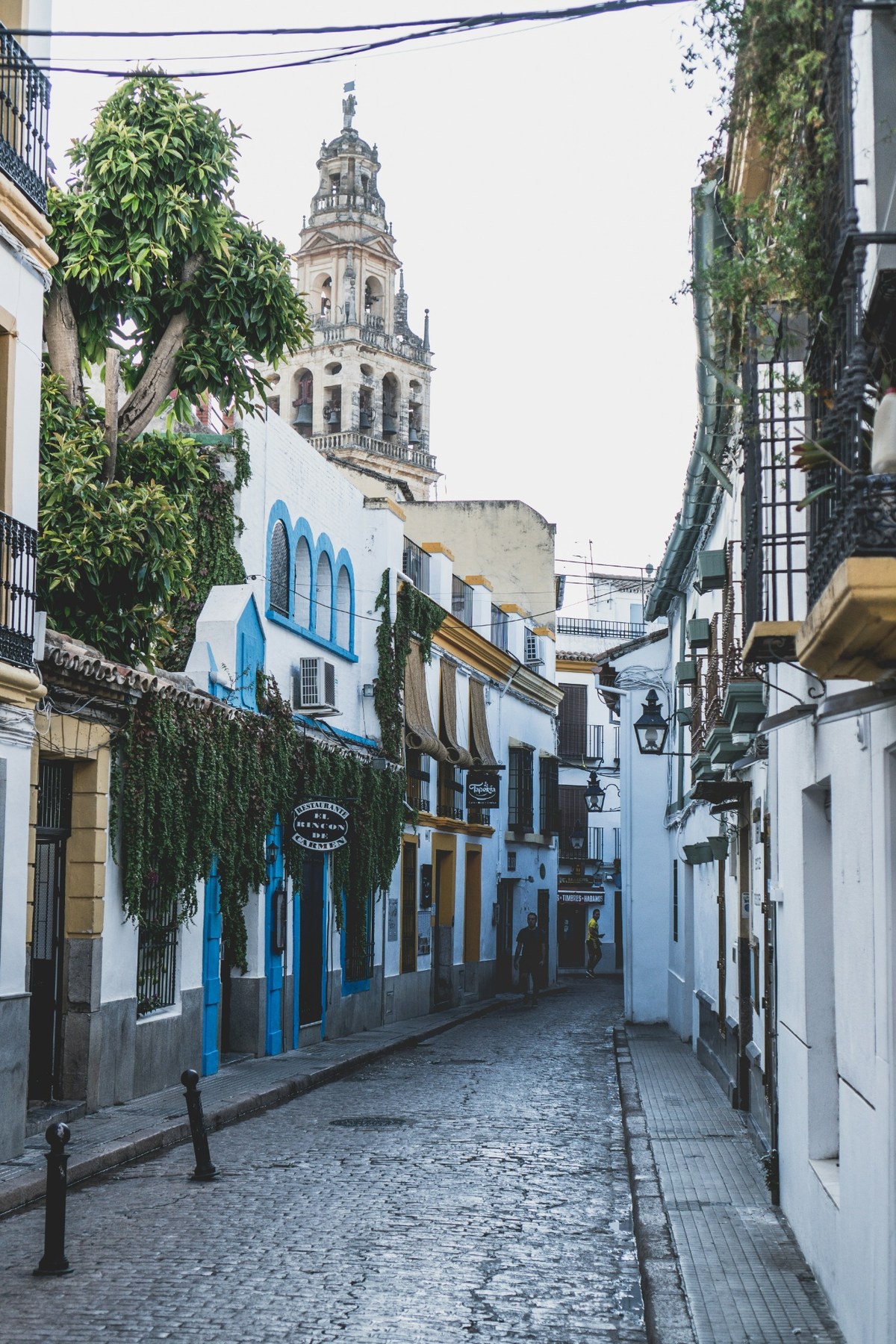
The old Jewish quarter, patios, Roman bridge and ordinary lanes give the city its texture.

4 days is ideal for Córdoba.

Food & Drink

Food & Drink

Córdoba's best-known dishes are built around heat: salmorejo and mazamorra are cold, thick and eaten with a spoon, while the fried and braised classics belong to cooler months. Aubergine is served with miel de caña — cane syrup, closer to a light molasses than bee honey — and the local wines come from Montilla-Moriles, just south of the city.

Córdoba's cuisine is Andalusian but locally specific: chilled salmorejo, fried and rolled pork, aubergine with cane syrup, olive oil and Montilla-Moriles wines echo both heat and layered history.

Must try

Salmorejo cordobés

Córdoba's own cold tomato cream — thicker and richer than gazpacho, and eaten with a spoon.

Tomatoes, day-old bread, garlic and a generous amount of olive oil are blended until the mixture is thick enough to hold a spoon upright, then served cold and finished with chopped hard-boiled egg and strips of jamón. The bread and oil are the point: a filling meal made from very little, in a city where summer afternoons regularly pass 40°C.

It is the clearest example of Córdoba cooking around its climate rather than against it, and the city treats it as an everyday dish rather than a summer speciality.

A dense orange-pink texture rather than a pourable soup, with the egg and jamón added on top rather than blended in.

It appears on most traditional menus as a starter, and at many bars as a small tapa portion.

Traditional taverns in the old town and around the Mercado Victoria.

Flamenquín

Pork loin wrapped around jamón, breadcrumbed and deep-fried into a long golden roll.

A thin sheet of pork loin is rolled around serrano ham, coated in breadcrumbs and fried, then sliced or served whole with chips and alioli. It is substantial and unfussy, and it belongs to Córdoba province rather than Andalusia at large — the town of Bujalance is the usual claimant.

It is the counterweight to all the cold dishes, and proof that Córdoba's food is not only about surviving the heat.

A thin, crisp crumb and a visible spiral of ham when cut, rather than a uniform processed cylinder.

Ask for it as a ración to share, or as a smaller tapa portion where the bar offers one.

Wendelse tip: It is large. One between two, alongside something cold, makes a full lunch.

Neighbourhood bars away from the Mezquita.

Rabo de toro

Oxtail braised for hours in wine until it falls off the bone.

Oxtail is browned and then stewed slowly with onion, carrot, bay and red wine — often Montilla — until the meat collapses and the sauce turns glossy from the gelatine in the joints. It usually arrives with potatoes to catch the sauce. The dish carries a bullfighting association in Córdoba's history, though the meat today is ordinary beef.

It is the city's cold-weather dish, and the heavier, older side of Andalusian cooking that tourist menus tend to skip.

Meat still on the bone segments and a sauce reduced and sticky rather than thin and floury.

Wendelse tip: Much better suited to autumn and winter than to high summer.

Long-established taverns in the historic centre, most of which keep it on year-round.

Berenjenas con miel

Aubergine fried in thin strips and finished with cane syrup.

Aubergine is sliced thin, sometimes soaked in milk, floured and fried until crisp, then drizzled with miel de caña — sugar-cane syrup, darker and less floral than bee honey. The salt-and-sweet combination is an inheritance from Andalusia's Moorish kitchen, and the aubergine arrived in Spain by the same route.

It is the easiest thing to eat that connects directly to the history the Mezquita is telling a few streets away.

Thin crisp strips or rounds, with the syrup poured at the table so they do not go soft.

Usually shared as a tapa at the start of a meal rather than as a dessert.

Wendelse tip: Eat it hot; it loses most of its appeal once it cools.

Tapas bars through the Judería and the San Basilio patio district.

Mazamorra

The white, almond-based ancestor of salmorejo, made without tomato.

Almonds, bread, garlic, olive oil and vinegar are ground into a pale cold cream and served with grapes, apple or salt cod. It predates the arrival of the tomato in Spain, which makes it, in effect, what Córdoba ate before salmorejo existed. It appears less often on menus and is frequently treated as a house speciality.

Finding it is a small piece of food archaeology: the same technique as salmorejo, several centuries earlier.

A genuinely almond-forward flavour rather than a bread-thickened blank.

Wendelse tip: Worth asking whether it is on today, as it tends to be made in small quantities.

Traditional taverns and the modern Andalusian kitchens that have revived it.

Montilla-Moriles wine

Córdoba's sherry-style wines, made from Pedro Ximénez and often unfortified.

The vineyards south of the city work in the same flor-aged styles as Jerez — fino, amontillado, oloroso and a famously dark sweet Pedro Ximénez — but the grapes ripen to enough natural sugar that the wines frequently need no fortification. The result is drier and lighter on the palate than the sherry comparison suggests.

It is the drink Córdoba's own food grew up around, and here it is poured as an everyday glass rather than a curiosity.

By the glass with tapas, chilled, which is how it is drunk locally.

Wendelse tip: Start with a dry fino before deciding whether you like the style; most visitors have only met the sweet end of it.

Old-town taverns with barrels behind the bar, or a bodega in the Montilla area if you have a spare half-day.
Good to know

  • Opening days and named businesses change: verify any business-level recommendation at trip time.

Art & Architecture

Start with the building that refuses to become one thing

Córdoba contains Roman, Islamic, Jewish and Christian histories, but listing those cultures in order makes the city sound tidier than it is. The Mosque-Cathedral is the better introduction because it refuses that tidiness. Roman and Visigothic material was reused in early Islamic construction; the mosque expanded repeatedly; after the Castilian conquest in 1236 it became a cathedral; later Christian interventions were built inside it rather than wiping the earlier structure away.

Córdoba's architecture is often strongest where one way of building has had to live with another.

Don't missGive the Mosque-Cathedral enough time that the repetition starts to work on you. Walking through columns is more important than rushing between named features.

Wendelse tipThen pay attention to ordinary houses. The shift from an extraordinary public interior to small private courtyards is part of Córdoba's architectural character.

Must see

Mosque-Cathedral

Nothing else in Córdoba needs equal billing.

The first impression is repetition: columns and red-and-pale double arches continuing further than your eye expects. Many early columns and capitals were reused from Roman and Visigothic buildings, so even the apparently repeated forest isn't actually uniform.

Successive Islamic rulers enlarged the mosque over centuries. After 1236 it became a Christian cathedral, and the most consequential later intervention inserted a Renaissance cathedral structure into the existing prayer hall. Don't reduce that to “mosque outside, cathedral inside”. The building is stranger than that. Walk away from the Christian intervention until the columns take over again, then approach it from within the former mosque. The change in height, light and spatial direction is much more revealing than simply standing beneath the later crossing.

Look for: Columns that don't quite match one another. Reuse is built into the earliest fabric.

Something you might otherwise miss: The building's size is difficult to grasp from one position. Let yourself lose the exit for a while.

The Córdoba courtyard

The patio isn't just a photogenic feature added to a white house.

Traditional Córdoba housing repeatedly turns inward around a central courtyard. The patio provides light and air and makes water and planting part of domestic life.

That means the architectural experience often begins with a blank or restrained street wall and improves once you cross the entrance. Visit a house where the courtyard remains legible as part of the building rather than treating the patios only as flower displays. Notice doors, stairs, galleries, wells or fountains and how rooms depend on the open centre.

The Roman Bridge and the river

Cross the Guadalquivir.

The bridge belongs to Córdoba's long history, but its most useful role for a short-break visitor is simpler: it gets you outside the dense historic centre and lets you turn around.

From the south bank the Mosque-Cathedral stops being an interior experience and becomes part of a city built beside a river. The relationship matters historically too: Córdoba occupied an important crossing and trading position. Go towards the Calahorra, then look back before returning.

Details to notice

One building, several Córdobas

Don't try to identify every architectural period inside the Mosque-Cathedral.

Instead, notice three things. First, repetition: the building creates space by extending a system rather than directing you towards one distant end. Second, difference inside repetition: reused columns, later extensions and changing decorative richness mean the apparent uniformity breaks down as you look harder. Third, interruption: the Christian cathedral changes the scale and orientation without making the earlier building disappear.

That is enough. The building makes Córdoba's larger historical point without requiring a lecture: different cities have occupied the same place, and the later one repeatedly had to decide what to do with what was already there.

Look closer

Reuse inside the Mosque-Cathedral

The famous arches can make the building look more regular than it is.

Look down at the columns and capitals. Different dimensions and forms reveal the incorporation of earlier architectural material.

The building's history of reuse begins before the later cathedral was inserted into it.

Street outside, courtyard inside

Córdoba often withholds domestic architecture from the street.

Watch what happens when a doorway opens: a narrow lane can give almost no indication of the planted, lit space immediately behind the wall.

That contrast—compressed public street and inward domestic centre—is one of the simplest ways to understand the historic city.

Why Wendelse likes it

Getting around

Walk in the historic centre. Distances are short, streets are part of the experience and shade matters. Taxis or buses are useful for specific outer journeys, not as the default between central sights.

Rhythm and pacing

Start early, especially in warmer months. Córdoba rewards a long lunch and a slower afternoon. Come back out when the heat eases.

Don't overdo it

Don't spend the whole visit photographing flower patios without noticing whether they are actually open or seasonal. There's no need to reduce the Mezquita to a quick photo stop.

Season and timing

Heat materially changes the day. Patio access and festival periods are seasonal/date-sensitive.

Birmingham · 6–9 November · 4 days

A suggested shape for your days.

Built around your dates and what you said you're in the mood for. The journey itself isn't checked until you choose dates in Results.

Friday · 6 November

Arrive & settle in

Arrival day

Afternoon
  • Arrive and check in.
  • Alcázar and gardens — Alcázar and gardens is one of the strongest ways to understand Córdoba without turning the day into a checklist.

Nothing else planned. That's deliberate.

Saturday · 7 November

Your big exploring day

Weekend

Morning
  • Mezquita-Catedral — Mezquita-Catedral is one of the strongest ways to understand Córdoba without turning the day into a checklist.
Afternoon
  • Patio and old-quarter walk — Patio and old-quarter walk is one of the strongest ways to understand Córdoba without turning the day into a checklist.

Leave gaps between plans — nothing here needs rushing.

Sunday · 8 November

Take Córdoba at your own pace

Weekend

Afternoon
  • Cordoban tavern lunch — Cordoban tavern lunch is one of the strongest ways to understand Córdoba without turning the day into a checklist.
Evening
  • Roman Bridge at dusk — Roman Bridge at dusk is one of the strongest ways to understand Córdoba without turning the day into a checklist.

Nothing else planned. That's deliberate.

Monday · 9 November

One last morning

Departure day

Morning
  • Breakfast, then a last walk through town.
Afternoon
  • Lunch, then the journey home.

Leave gaps between plans — nothing here needs rushing.

Prototype itinerary. Activity availability is illustrative, not live opening hours.

Don't miss

Even if it's not what you came for.

Food & Drink

Taste Córdoba properly

Córdoba's cuisine is Andalusian but locally specific: chilled salmorejo, fried and rolled pork, aubergine with cane syrup, olive oil and Montilla-Moriles wines echo both heat and layered history.

  • Salmorejo cordobés
  • Flamenquín
  • Rabo de toro
Explore Food & Drink →

Art & Architecture

A hall of nine hundred columns, and a town that faces inwards

Reused Roman shafts under two tiers of red-and-white arches, a Renaissance cathedral cut through the middle, and lanes of houses that keep their light in the courtyard.

  • The Mosque-Cathedral
  • Courtyard houses
  • The view back from the bridge
Explore Art & Architecture →

Getting there

Choose your dates and we'll check real flights and the journey from Birmingham.

Check a journey for your dates →

Traveller fit

Is Córdoba your kind of place?

Food
★★★★★5 out of 5
History
★★★★★5 out of 5
Architecture
★★★★★5 out of 5
Walkability
★★★★★5 out of 5
Outdoors
★★☆☆☆2 out of 5
Atmosphere
★★★★★5 out of 5

Things worth doing

A first day that works

Mezquita-Catedral early; Judería; lunch; rest; river and Roman Bridge later; relaxed evening.

If you have a second day

Alcázar/patios according to interest and season; explore beyond the tightest tourist streets; make food part of the day instead of another attraction.

An extra day, or bad weather

With another day, you can slow down further or consider Medina Azahara if you want deeper history and the practical connection works.

Where to stay

Stay in or beside the historic centre

Best for history and architecture

The UNESCO core is intensely walkable; a central stay keeps evening streets and the major monuments close.

Ready to make it a trip?

Córdoba

4 days · History · Architecture · Food · Culture · Walkable

Prototype placeholders — nothing is connected to a booking service yet.

← Back to your Wendelse