WendelseShort breaks, reconsidered
Carcassonne, France

Carcassonne

France

Stay after the day-trippers leave.

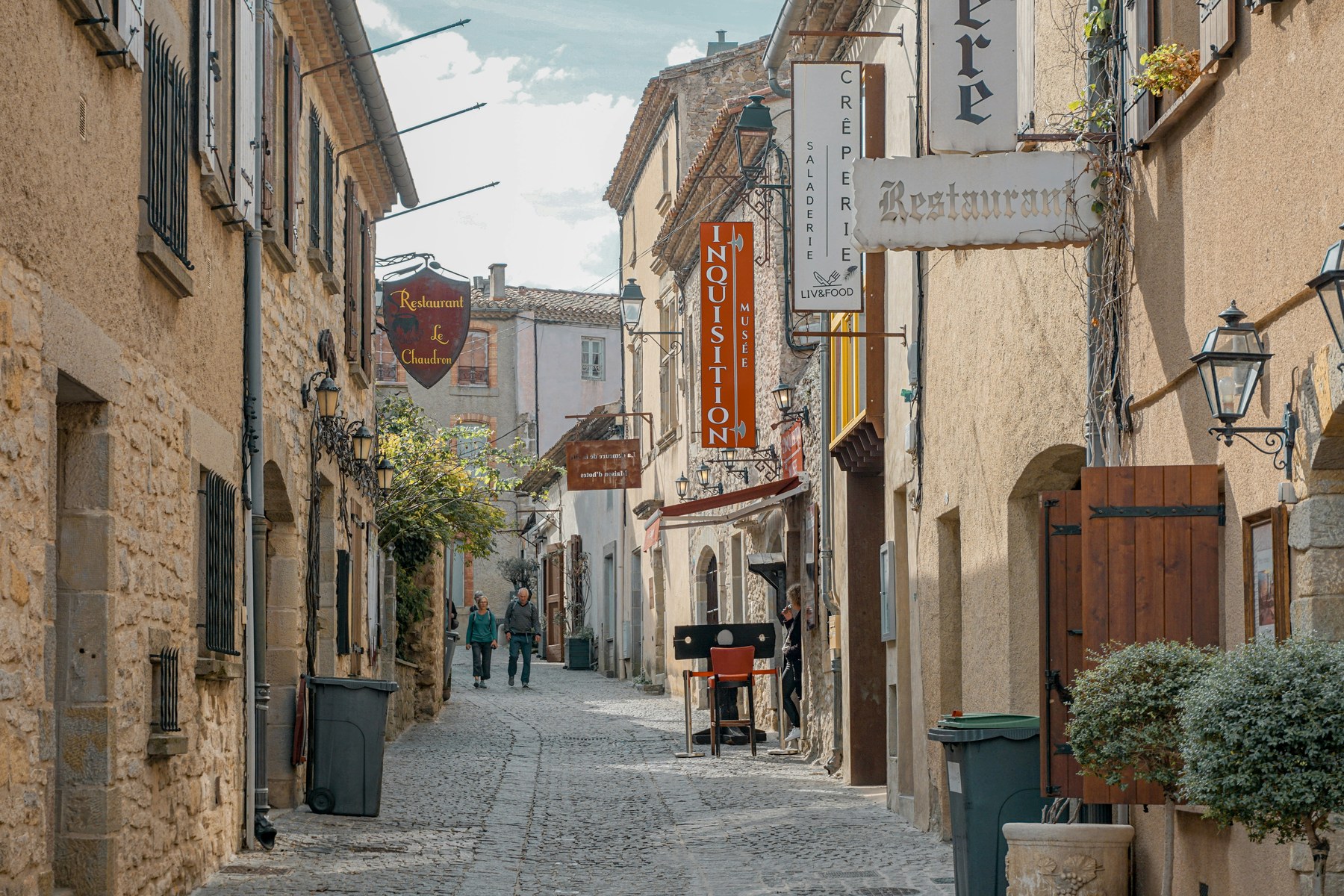
Carcassonne's fortified Cité is the obvious reason to come, and it is spectacular. The key recommendation is not to pretend otherwise — but also not to leave as soon as you've walked the walls.

The experience changes once day visitors thin out, and the lower town gives the trip somewhere ordinary to breathe.

4 days is ideal for Carcassonne.

Food & Drink

Food & Drink

Cassoulet is the dish everyone will tell you to eat. Have it once, preferably when the weather and your appetite make a slow, heavy bean-and-meat dish appealing. Then move on. Regional wine and simpler southern French meals prevent the food guide becoming one casserole repeated.

Carcassonne's table is inland Languedoc: cassoulet is the anchor, supported by charcuterie, olives, mountain cheeses, truffles and robust nearby wines.

Must try

Cassoulet de Carcassonne

A slow-cooked bean and meat casserole; Carcassonne's version adds partridge or mutton to the standard duck and sausage.

White haricot beans are cooked for hours with pork skin, Toulouse sausage and confit duck or goose, in a shallow earthenware dish (a cassole, which gives the dish its name) that lets a crust form on top as it bakes — traditionally broken and re-formed several times during cooking. Carcassonne, Toulouse and Castelnaudary each claim a distinct version; the local Carcassonne recipe is notable for sometimes including partridge or mutton alongside the duck.

A visible baked crust rather than a wet stew, and beans that hold their shape instead of collapsing into mush.

Lucques olives

A pale green, curved, almond-shaped olive grown mainly around the Languedoc.

Lucques are picked while still green and unripe, then cured to keep their crisp texture and mild, buttery flavour rather than the sharper brine of black olives. Their crescent shape sets them apart from rounder table olives, and they're a Languedoc speciality rather than something grown widely elsewhere in France.

Fricandeau and dry-cured charcuterie

A regional dry pork pâté-terrine, part of a broader Languedoc charcuterie tradition.

Fricandeau is a coarse pork liver and meat terrine flavoured with garlic and spices, sliced and served cold as a starter — distinct from the fricandeau veal dish found elsewhere in France. It sits alongside other dried and cured pork products from the Montagne Noire and Corbières foothills, where curing was a practical way to preserve meat through the year.

Languedoc-style snails (cargolade)

Small land snails, often grilled or stewed with garlic, ham and herbs.

Snails gathered after rain in the vineyards and garrigue scrubland are a long-standing rural food in the Aude. Locally they are often cooked "à la carcassonnaise" — simmered with tomato, ham, garlic and sometimes anchovy — rather than the buttery Burgundy style more familiar outside France.

Pyrenean sheep's-milk cheese

Firm, nutty tomme-style cheeses from the Montagne Noire and Pyrenean foothills south of the city.

The hills within reach of Carcassonne produce firm pressed cheeses, generally sheep's or mixed milk, in the same broad family as Pyrenean tommes further south. They are milder and less pungent than the area's cured meats, and typically appear as a cheese-board finish rather than a stand-alone dish.

Corbières and Minervois wine

Robust reds from the sun-baked hills that ring Carcassonne on three sides.

Corbières and Minervois are both AOC zones within sight of the city, planted mainly with Carignan, Grenache and Syrah on poor, stony soil that keeps yields low and flavours concentrated. The wines are typically full-bodied reds built for the region's heavier food — cassoulet and cured meats — rather than delicate pairing wines.

Good to know

  • Opening days and named businesses change: verify any business-level recommendation at trip time.

Art & Architecture

The Middle Ages were restored here

Carcassonne presents an unusual problem. The fortifications are genuinely medieval, built over even earlier defences and surviving with extraordinary completeness. They are also inseparable from a huge nineteenth-century restoration campaign led by Eugène Viollet-le-Duc.

Neither fact cancels the other. In fact, holding both at once is the most interesting way to see the Cité.

Don't missSpend less time asking “Is this original?” and more time asking what has survived, what was restored and what idea of the Middle Ages the restoration was trying to recover.

Wendelse tipThe souvenir streets are not the architectural story. Get to the walls.

Must see

The double fortifications

Carcassonne's architecture is the defensive system itself.

Two rings of walls surround the Cité, separated by the lices, the open space between them. Towers, gates, wall walks and changes in ground level turn defence into something you can physically move through.

Don't experience the ramparts only as a skyline from outside. Once you're between the walls, the logic becomes much clearer. An attacker breaching one enclosure had not finished the job. The second line remained. Parts of the inner circuit also incorporate late-Roman defences, meaning the medieval fortress was itself building on something older.

Look for: Changes in tower shape and masonry rather than assuming every metre belongs to the same campaign.

Château Comtal

The castle gives the defensive city an internal centre.

Built against the western side of the earlier ramparts and subsequently strengthened, it adds another controlled enclosure inside an already fortified town.

Walk it for relationships rather than rooms. Where can you see the outer walls? Where does the castle command movement? How many barriers sit between this point and the landscape beyond? Carcassonne becomes much less like a fantasy backdrop once you start treating it as a system for controlling access.

Details to notice

Authentic doesn't mean untouched

Carcassonne is useful because it makes a difficult conservation question impossible to avoid.

A monument can contain authentic medieval fabric and still owe much of its present appearance to later restoration. Viollet-le-Duc's nineteenth-century campaign was enormous. It repaired, reconstructed and completed damaged elements of the fortifications, and the work itself became influential in the history of architectural conservation.

So don't force Carcassonne into a choice between “real medieval city” and “nineteenth-century reconstruction”. It is both an exceptionally important medieval fortified city and a major monument of nineteenth-century restoration. The tension is the interesting part.

Look closer

Some of the wall is older than the Middle Ages

Sections of the inner rampart overlap clearly visible late-Roman defences.

Look for masonry and tower forms that interrupt the more familiar medieval image.

Carcassonne didn't begin with the castle you came to see. Fortification here was already old before the great medieval building campaigns.

Look at the roofs with suspicion

The pointed roofs on the towers are among Carcassonne's most recognisable features.

They are also closely associated with the nineteenth-century restoration. Viollet-le-Duc had to make choices about damaged upper walls, crenellations and roofing. Those choices helped create the coherent silhouette visitors now recognise instantly.

That doesn't make the walls fake. It makes the restoration visible.

Walk in the space between the walls

The lices are not simply a convenient path around the Cité.

They are part of the defensive architecture.

Walking there changes your understanding of the double enclosure because both walls are present at once: one pressing inward, the other controlling the outside.

A suggested walk

Walk between two versions of the Middle Ages

Make the fortifications the route.

Move through or around the double enclosure slowly enough to compare sections rather than simply completing a circuit. Look for late-Roman fabric inside the medieval system. Notice places where upper walls and roofs feel particularly complete. Walk the lices and experience the two lines of defence simultaneously.

Then step outside far enough to see the famous silhouette again. From a distance it will probably look more coherent than it felt close up. Up close, the layers are harder to ignore.

Why Wendelse likes it

Getting around

Walk between the Cité and Bastide if comfortable; the connection is part of understanding the town. Local transport can save effort, especially with luggage or heat, but isn't essential for most central exploration.

Rhythm and pacing

See the Cité early or late as well as during the busy middle of the day. If staying overnight, use that advantage.

Don't overdo it

Don't make every fortified feature a separate attraction. There's no need to eat cassoulet twice because it is famous.

Season and timing

Summer heat and peak crowds materially affect pacing. Fortress access/tickets should be checked for dates.

Birmingham · 6–9 November · 4 days

A suggested shape for your days.

Built around your dates and what you said you're in the mood for. The journey itself isn't checked until you choose dates in Results.

Friday · 6 November

Arrive & settle in

Arrival day

Afternoon
  • Arrive and check in.
  • Bastide Saint-Louis — Bastide Saint-Louis is one of the strongest ways to understand Carcassonne without turning the day into a checklist.

Nothing else planned. That's deliberate.

Saturday · 7 November

Your big exploring day

Weekend

Morning
  • Château Comtal — Château Comtal is one of the strongest ways to understand Carcassonne without turning the day into a checklist.
  • Cité walls and lanes — Cité walls and lanes is one of the strongest ways to understand Carcassonne without turning the day into a checklist.

Keep the afternoon free — wander, sit somewhere, do nothing.

Sunday · 8 November

Take Carcassonne at your own pace

Weekend

Afternoon
  • Cassoulet meal — Cassoulet meal is one of the strongest ways to understand Carcassonne without turning the day into a checklist.
Evening
  • Canal du Midi walk — Canal du Midi walk is one of the strongest ways to understand Carcassonne without turning the day into a checklist.

Nothing else planned. That's deliberate.

Monday · 9 November

One last morning

Departure day

Morning
  • Breakfast, then a last walk through town.
Afternoon
  • Lunch, then the journey home.

Leave gaps between plans — nothing here needs rushing.

Prototype itinerary. Activity availability is illustrative, not live opening hours.

Don't miss

Even if it's not what you came for.

Food & Drink

Taste Carcassonne properly

Carcassonne's table is inland Languedoc: cassoulet is the anchor, supported by charcuterie, olives, mountain cheeses, truffles and robust nearby wines.

  • Cassoulet de Carcassonne
  • Lucques olives
  • Corbières and Minervois wine
Explore Food & Drink →

Art & Architecture

What makes Carcassonne look like Carcassonne

The double-walled medieval Cité is spectacular, but Carcassonne makes more sense when connected on foot to the Pont Vieux, grid-planned Bastide Saint-Louis and the engineering landscape of the Canal du Midi.

  • Cité de Carcassonne ramparts
  • Château Comtal
  • Basilique Saint-Nazaire
Explore Art & Architecture →

Getting there

Carcassonne has its own airport: Carcassonne Airport

Choose your dates and we'll check real flights and the journey from Birmingham.

Check a journey for your dates →

Traveller fit

Is Carcassonne your kind of place?

Food
★★★★☆4 out of 5
History
★★★★★5 out of 5
Architecture
★★★★★5 out of 5
Walkability
★★★★★5 out of 5
Outdoors
★★★☆☆3 out of 5
Atmosphere
★★★★☆4 out of 5

Things worth doing

A first day that works

Cité early; walls/Château Comtal according to interest; lunch; rest; return later when crowds change.

If you have a second day

Walk down to Bastide Saint-Louis, market/squares, Canal du Midi area if appealing, then return to whichever side you preferred.

An extra day, or bad weather

If you stay longer, that time can be very slow. Carcassonne is strongest as a focused two-night break instead of an artificially packed long stay.

Where to stay

Stay between the Cité and Bastide

Best for medieval history

A position between the two centres makes the station, lower town and fortress manageable on foot.

Ready to make it a trip?

Carcassonne

4 days · History · Architecture · Food · Walkable · Culture

Prototype placeholders — nothing is connected to a booking service yet.

← Back to your Wendelse