Food & Drink
Taste Cádiz properly
Cádiz tastes of the Atlantic: fried fish, tiny shrimp fritters, marinated dogfish, sea anemones and almadraba tuna, with the sherry triangle immediately inland.
- Pescaíto frito
- Tortillitas de camarones
- Almadraba tuna
Cádiz
Spain
Walk until you reach the sea again.
Cádiz is less about a collection of heavyweight sights than the pleasure of being in a compact old city almost surrounded by water. Walk across it, reach the sea, turn a corner and find the Atlantic again.
The market, cathedral, watchtowers and beaches give structure, but the city itself is the main attraction.
4 days is ideal for Cádiz.
Food & Drink
Cádiz's food is built on its bay: a mix of small fried fish, shrimp fritters, dogfish and sea anemones that reflect an Atlantic fishing city, with the sherry-and-manzanilla triangle a short drive inland.
Cádiz tastes of the Atlantic: fried fish, tiny shrimp fritters, marinated dogfish, sea anemones and almadraba tuna, with the sherry triangle immediately inland.
Must try
An assortment of small fish and seafood, floured and fried in olive oil, traditionally eaten from a paper cone.
Small whole fish such as boquerones (anchovies) and pieces of squid or choco (cuttlefish) are dusted in a fine wheat flour and fried quickly in hot olive oil, producing a light, non-greasy crust. Cádiz Bay's abundant catch and long-standing frying tradition make this the city's default way of eating fish.
A thin, pale golden crust rather than a thick batter, and fish served hot and freshly fried.
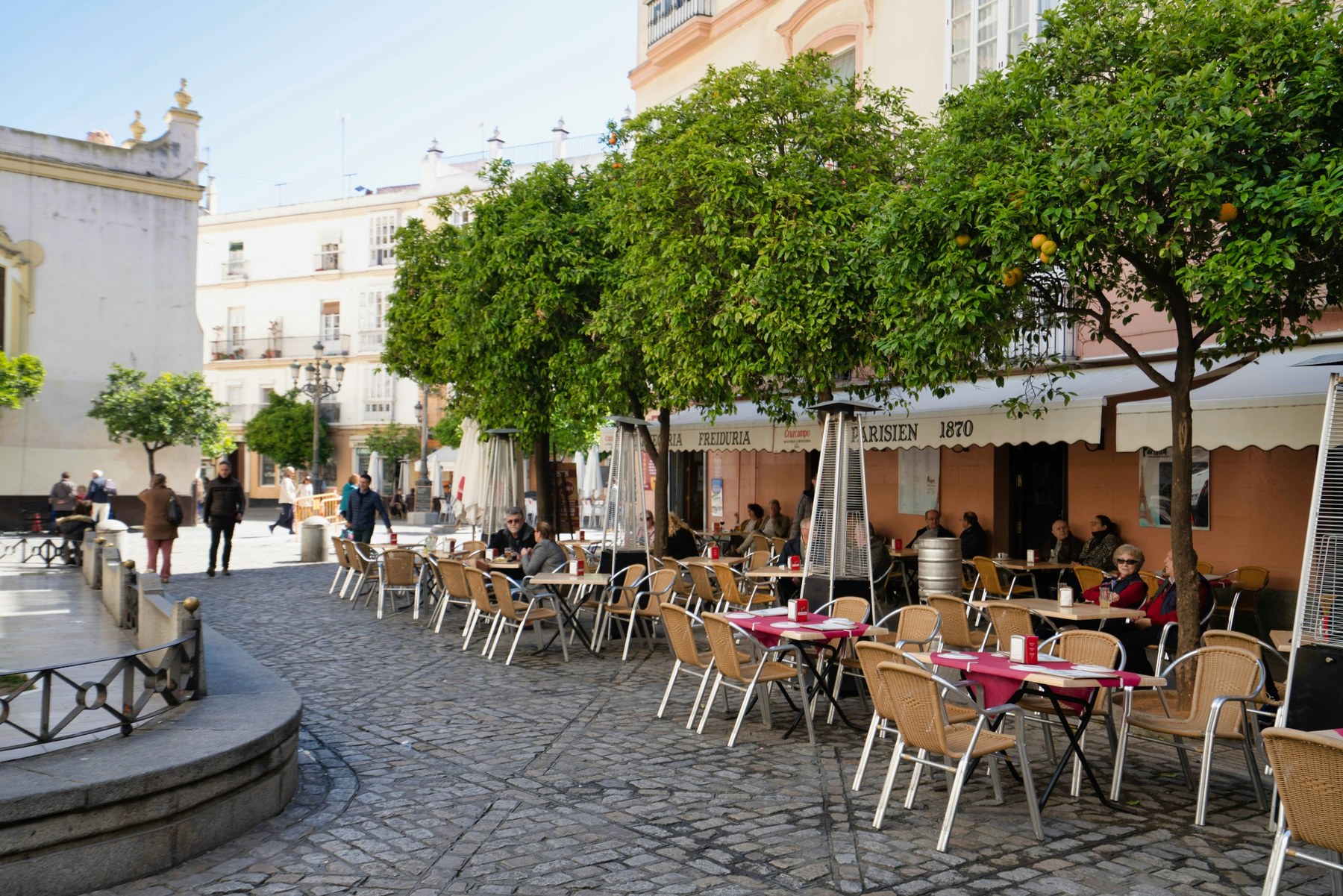
Freidurías (fry shops) and bars throughout the old town, often sold to take away.
Thin, lacy fritters made from a wheat and chickpea flour batter studded with whole tiny shrimp.
The batter, mixing wheat and chickpea flour with chopped onion and parsley, is spread thin in the pan and fried until crisp and lacy at the edges; the tiny grey shrimp used are cooked whole, shell included. The style is closely associated with Cádiz and neighbouring San Fernando rather than Andalusia generally.
A flat, crisp, almost see-through disc rather than a thick, fluffy fritter.
Bars and freidurías across the city, particularly near the bay.
Bluefin tuna caught using the ancient almadraba trap-net system off the coast near Barbate and Cádiz.
The almadraba technique channels migrating bluefin tuna into a fixed maze of nets during their spring passage through the Strait of Gibraltar, a method used along this coast since Phoenician times. Prized cuts such as the fatty ventresca (belly) are often served raw, seared or lightly grilled to let the fish speak for itself.
Menus that specify almadraba or ventresca rather than generic 'atún'.
Seafood restaurants in Cádiz, especially in spring during the tuna run.
Cubes of marinated dogfish, floured and fried, a classic Cádiz bar tapa.
Small pieces of cazón (a type of dogfish) are marinated in vinegar, garlic, oregano and cumin, then coated in flour and deep-fried into bite-sized golden cubes. It is one of the most common tapas in Cádiz's bars, distinct from the plain frito in its tangy, spiced marinade.
A firm, meaty texture rather than flaky white fish, with a clear vinegar-garlic tang.
Tapas bars throughout the old town.
Sea anemones, battered and fried whole, a distinctly Cádiz Bay delicacy.
Snakelocks sea anemones are gathered from the rocky shoreline, coated in a light batter and deep-fried whole. The result is crisp outside with a briny, almost iodine-like interior that is unlike any other fried seafood on the coast.
Freshly fried, still-hot portions; they lose their character quickly once cold.
Seafood bars along the bay, particularly in El Puerto de Santa María and Cádiz itself.
Dry, flor-aged wines from the sherry triangle just inland, drunk chilled alongside seafood tapas.
Manzanilla, made in Sanlúcar de Barrameda on the Atlantic coast, ages under a layer of flor yeast that gives it a distinct saline, slightly bitter edge; Cádiz sits within reach of the wider sherry triangle of Jerez, Sanlúcar and El Puerto de Santa María. Locally it is drunk cold, in small glasses, as an accompaniment to food rather than a stand-alone tasting.
A pale, dry glass served properly chilled, not the sweet cream sherries aimed at export markets.
Any traditional bar in Cádiz; a day trip to Sanlúcar or Jerez for bodega visits.
One of Spain's oldest covered markets, built in 1837 on the site of a former convent orchard.
Cádiz's city council commissioned the neoclassical market building in 1837, designed by Torcuato Benjumeda, after the site — near Plaza de las Flores — was acquired following the Mendizábal disentailment of church land. It remains a working fish and produce market, with several stalls now serving tapas and oysters to eat on the spot.
The fish hall in particular, where the morning's Bay catch is laid out before lunchtime restaurants buy from it.
Plaza de las Flores, in the historic centre.
Good to know
Art & Architecture
Cádiz is built on a thumb of land almost surrounded by Atlantic, and the shape of that thumb decided everything. The old town could not spread, so it went up and inward: tall houses on lanes narrow enough to stay shaded all day, opening every few hundred metres into a square that catches the wind. Walk in any direction for ten minutes and you hit water, usually with a sea wall between you and it. The buildings are mostly eighteenth-century, from the decades when Cádiz held the monopoly on trade with Spanish America and merchant families got very rich very quickly — which is why the palest, most elegant façades sit on lanes where the washing is strung overhead. It is a city of ordinary life inside grand fabric, and the light bouncing off limewash and ocean is half of what you will remember.
An eighteenth-century Atlantic merchant city compressed onto a peninsula: pale stuccoed houses with lookout towers on their roofs, sea walls and forts all the way round, and a huge cathedral that took so long to build it changed style halfway up.
Don't missThe lookout towers on the roofs of the merchant houses — once you spot one, you will see them everywhere.
Wendelse tipDo the sea-wall circuit early in your stay, not at the end. The old town's street plan makes sense once you know the shape of the edge it fits inside.
Something you might missHow few of the grand doorways lead to a single grand house. Look into the entrance halls as you pass: most open onto a small courtyard with stairs and several front doors, because the merchant palaces were subdivided long ago and are lived in by ordinary families.
Must see
Lookout towers built onto the roofs of merchant houses so owners could watch the bay for their own ships coming in.
Around 134 of these survive across the old town, and they are the local building type. A merchant's house combined trade and home in one building — storage and business below, family rooms above — and then a tower on the roof, sometimes flagged, from which the bay could be watched and an incoming ship recognised. Knowing which vessel was arriving mattered to people whose money was on it. The towers vary from plain boxes to elaborate glazed pavilions, and because they sit above the roofline you have to keep looking up to find them. Torre Tavira, the tallest, is the one usually visited, and from any rooftop the pattern of the others across the old town becomes obvious.
They are the clearest physical evidence of what Cádiz was: a city whose wealth depended on ships, with the watching of them built into its houses.
This is commercial life expressed as roof furniture, and it survives here in numbers you will not find in an inland Spanish city.
Look for: The difference between the towers — open arcaded ones, fully glazed ones, and plain unroofed terraces — and which direction each one faces.
Wendelse tip: Get up one tower early on. Seeing the peninsula from above, with the sea on both sides at once, does more for your understanding of the city than an extra church.
18th century, the American trade boom · 45–60 minutes for a tower visit; the spotting continues all week · A clear day, when the bay and the far shore are both visible
A cathedral that took over a century to finish and visibly changed its mind, with a yellow-tiled dome facing the Atlantic.
Begun in 1722 on the confidence of the American trade, the cathedral took over a century to finish, passing through several architects, revised designs and long pauses when money ran short. You can read the result: the lower parts are Baroque, warm and modelled, while the upper stages and the dome are cooler and more classical. It stands in the weather, too — the seaward elevations show the wear you would expect of stone facing the Atlantic, and conservation work is often somewhere on the building. Its best side is not the show façade on its square but the back, where it stands directly against the Campo del Sur sea wall with waves below it and a row of painted houses running away along the front.
It keeps time with the city. A building that slow records changing fortunes and changing fashions together, one stage above the other.
Look for: The join between the heavier, darker lower masonry and the plainer upper stages, and how much rougher the stone looks on the elevations facing the sea.
Wendelse tip: Walk round to Campo del Sur and look back at it from a few hundred metres along the wall. That view — dome, sea wall, ocean — is the one that explains it.
Begun 1722, completed in the 1830s — Baroque below, Neoclassical above · 30 minutes outside, more if you go in or climb the tower · Late afternoon, with the sun coming off the Atlantic onto the dome
The oldest surviving quarter, entered through medieval gates, and the fishermen's district of La Viña next to it.
El Pópulo is what was left inside the medieval walls: a very small grid of lanes still entered through stone archways, tight enough that you can touch both sides in places, with the Roman theatre found underneath it and the cathedral pressing against one edge. La Viña, further west, is the opposite — lower, later, laid out for fishing families on reclaimed vineyard ground, with wider streets, more sky and a straight run down to the Caleta beach. Walking from one to the other in fifteen minutes gives you the whole social range of the old city, and neither is a preserved quarter: both are ordinary places to live, loudest in the evening and during Carnival.
They show that Cádiz's density is not decorative. Street width here tracks who lived on the street and when it was built.
Look for: The surviving medieval gateways into El Pópulo, and the point where the tight old grid gives way to La Viña's looser streets.
Wendelse tip: Go through both in the early evening rather than at midday. They are residential quarters and they only make sense when people are out in them.
45–60 minutes on foot, unhurried · Early evening
The single most useful architectural thing to do in Cádiz is to walk round the outside of it. The old town occupies the head of the peninsula, and following its perimeter shows you how the city was defended, where it faced the ocean and where it turned to face the sheltered bay — two completely different characters within one walk. Do this as a loop and you will never be confused about where you are again.
1. Castillo de San Sebastián causeway20–30 min
Walk out along the long stone causeway to the fort standing in open water off La Caleta. Turn round halfway and look back: the city is a low, tightly packed line with towers on top, and you can see how little land it actually occupies.
2. La Caleta15 min
The small beach between two forts, with the balneario pavilion on stilts in the middle of it. This is where the fishing city and the defended city meet.
3. Castillo de Santa Catalina and the western walls20 min
The star-shaped seaward fort and the ramparts running from it. Note that the defences face the Atlantic, not the bay — the threat came from the open sea.
4. Parque Genovés and the Alameda25 min
Gardens laid out along the top of the sea wall, with the promenade on one side and the water on the other. Windblown, shaped trees here tell you how exposed this edge is.
5. The bay-facing front20 min
Round the northern tip the mood changes: calmer water, port cranes, the bay and the modern bridge in the distance. This is the working side of the city.
6. Campo del Sur and the cathedral from behind20–30 min
Finish on the southern sea wall with the painted houses on your left and the Atlantic below the parapet, walking towards the cathedral's dome. Save this stretch for late in the day.
What to look forWhich side of the peninsula is fortified and which is not, how the sea wall changes height and construction as it goes, and the point where ocean gives way to sheltered bay.
Total Around 2 to 2.5 hours at a slow pace, longer with stops · Late afternoon into sunset, finishing on Campo del Sur · easy
Good to know
Why Wendelse likes it
Walk. This is one of the clearest walk-first destinations in the batch. Local buses are useful for longer stretches or accommodation outside the old centre, but within the peninsula walking is the point.
Let the coastline shape the route. Market/lunch works well earlier; sunset belongs by the water if the weather cooperates.
Don't invent eight architectural 'must-sees'. Cádiz does not need them. There's no need to treat the beach as wasted sightseeing time.
Wind, heat and beach weather change the experience considerably. Carnival radically changes atmosphere and availability.
Birmingham · 6–9 November · 4 days
Built around your dates and what you said you're in the mood for. The journey itself isn't checked until you choose dates in Results.
Friday · 6 November
Arrival day
Nothing else planned. That's deliberate.
Saturday · 7 November
Weekend
Leave gaps between plans — nothing here needs rushing.
Sunday · 8 November
Weekend
Nothing else planned. That's deliberate.
Monday · 9 November
Departure day
Leave gaps between plans — nothing here needs rushing.
Prototype itinerary. Activity availability is illustrative, not live opening hours.
Don't miss
Food & Drink
Cádiz tastes of the Atlantic: fried fish, tiny shrimp fritters, marinated dogfish, sea anemones and almadraba tuna, with the sherry triangle immediately inland.
Art & Architecture
Hemmed in by Atlantic on three sides, Cádiz packed an eighteenth-century trading fortune into narrow shaded lanes and put lookout towers on the roofs.
Choose your dates and we'll check real flights and the journey from Birmingham.
Check a journey for your dates →Traveller fit
Market and old centre; Cathedral; wander to the waterfront; long seafood lunch; La Viña; sunset near Caleta.
Torre Tavira; fortifications/sea walk; beach or unstructured streets; evening tapas without a cross-city plan.
Extra time is for more sea, not more boxes. Bad weather is when the museums and interiors earn more space.
Where to stay
Best for food, coast and low-friction wandering
The peninsula is compact enough to walk; staying inside the old city keeps the market, cathedral and seafront close.
Cádiz
4 days · Food · History · Coast · Walkable · Culture
Prototype placeholders — nothing is connected to a booking service yet.