WendelseShort breaks, reconsidered
Braga, Portugal

Braga

Portugal

Much older than the staircase.

Bom Jesus is the photograph people recognise, but Braga is not a one-sight trip. The cathedral and Roman roots belong to the city centre; Bom Jesus is the grand excursion above it.

Keeping those two scales separate makes the place much more interesting.

4 days works well in Braga.

Food & Drink

Food & Drink

Braga's food carries a strong Minho and convent-kitchen character: salt cod fried with onions, a pork-and-blood dish born in the countryside around the city, custard pastries sold from a single long-running shop, and a bishop's pudding invented nearby. Vinho Verde, young and lightly sparkling, is the everyday match for all of it.

Braga's Minho cooking is generous and deeply local: fried salt cod, pork-rich papas, custard-filled pastries, a convent pudding and Vinho Verde connect religious and rural tradition with a hearty northern Portuguese table.

Must try

Bacalhau à Braga / à Narcisa

Fried salt cod fillets topped with a thick layer of fried onion rings and matchstick potatoes.

The dish is credited to Narcisa Neves, a Braga cook, and pairs pan-fried bacalhau with plenty of fried onion and fried potato sticks rather than the boiled or baked treatments common elsewhere in Portugal.

A generous, well-browned onion topping rather than a token garnish, and potatoes fried separately rather than boiled.

Traditional tascas and restaurants across the historic centre.

Frigideiras de Braga

A small pastry parcel of puff pastry filled with a veal or pork and egg custard, fried and dusted with sugar.

A thin sheet of puff pastry is wrapped around a savoury-sweet filling of minced veal or pork bound with egg custard, then deep-fried until crisp and finished with sugar and cinnamon. It is specific to Braga and sold from long-established pastelarias in the centre.

A crisp, fried shell rather than a baked one, and a filling that is moist rather than dry.

Pastelarias in the historic centre that have specialised in the pastry for decades.

Papas de sarrabulho

A thick pork-and-blood stew thickened with bread or rice, from the countryside around Braga.

Pork offal and pieces of meat are cooked slowly with pig's blood, bread or rice, and seasonings, producing a dark, dense dish usually served with fried pork and rice on the side. It belongs to the Minho's tradition of using the whole animal after a pig-slaughter.

A rustic, home-style presentation rather than a refined plating; it is a winter, countryside dish rather than a light lunch.

Traditional Minho restaurants, particularly in the Braga district outside the centre.

Pudim Abade de Priscos

A rich, wobbly egg-yolk pudding made with pork fat and port wine, invented by a priest near Braga.

Created by Manuel Joaquim Machado Rebelo, the Abade (abbot) of Priscos, a parish near Braga, the pudding is built almost entirely from egg yolks and sugar, enriched with a small amount of cured pork fat and port wine, then set in a caramel-lined mould. The pork fat is imperceptible in the finished dessert but is part of what makes it distinctive among Portugal's many egg puddings.

A dense, glossy, deep-caramel pudding rather than a light flan.

Traditional restaurants in Braga and the wider Minho, often listed by name on dessert menus.

Vinho Verde

The young, lightly sparkling white wine of the Minho, low in alcohol and served well chilled.

Made from grapes such as Alvarinho and Loureiro grown throughout the Minho region around Braga, Vinho Verde is bottled and drunk young, with a slight natural fizz and high acidity that make it an easy match for fried and fatty dishes like bacalhau à Braga.

A pale, often slightly effervescent glass, poured cold rather than at room temperature.

Any traditional restaurant or tasca in the city; house pours are usually reliable.

Fidalguinhos

Crisp, cinnamon-scented Easter biscuits shaped like crossed legs, from Braga's convent recipe books.

These biscuits trace to the recipes of Braga's Convento de Nossa Senhora dos Remédios. Their crossed-leg shape is a satirical reference to the fidalgos (hereditary nobles) who did not need to exert themselves for what they wanted. They are traditionally on the table at Easter.

A crisp, dry biscuit with a clear cinnamon note, rather than a soft, cake-like texture.

Pastelarias in Braga, especially around Easter.
Good to know

  • Opening days and named businesses change: verify any business-level recommendation at trip time.

Art & Architecture

The architecture keeps asking you to move

Braga's religious architecture isn't best understood by lining up church façades. The Sé has accumulated centuries of alteration in the centre of the city. Eighteenth-century architects then gave Braga a more theatrical Baroque and Rococo face. At Bom Jesus, architecture leaves the conventional street altogether and turns ascent, water, stairs, sculpture and landscape into part of the work.

The progression matters. Braga moves from building, to city, to landscape.

Don't missAt Bom Jesus, don't think of the church at the top as the destination and everything below as the approach. The approach is the architecture.

Wendelse tipIf you're using the funicular, consider travelling one direction and walking the other. You need to experience the stairs somehow for the place to make sense.

Must see

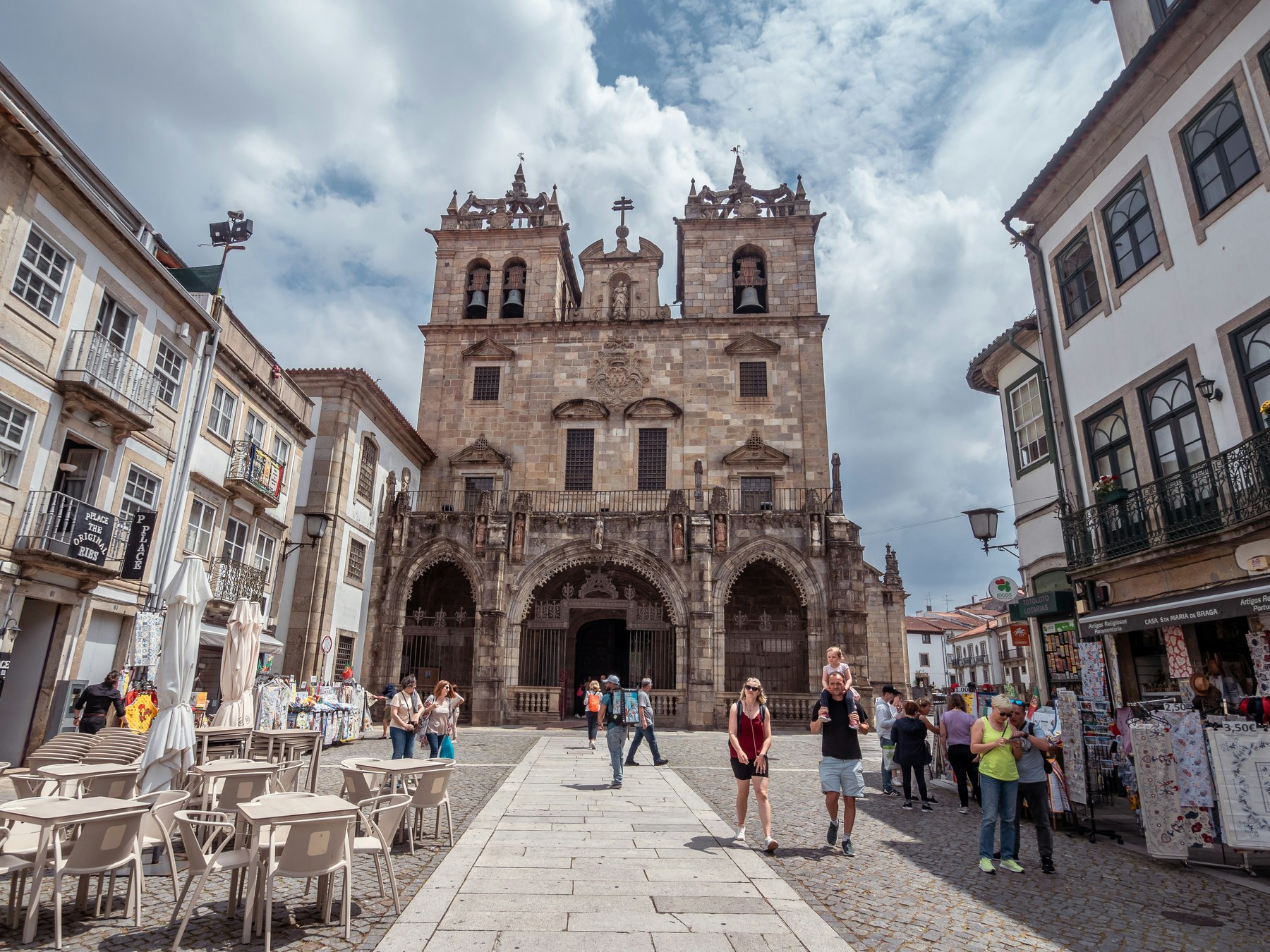
Sé de Braga

The cathedral is useful precisely because it doesn't belong neatly to one moment.

The present building began in the medieval period and was altered repeatedly afterwards. Different generations changed chapels, façades, interiors and adjoining spaces rather than preserving an original Romanesque building untouched.

Don't turn that into a style-identification exercise. Instead, notice accumulation. Older mass and later embellishment occupy the same complex because Braga's cathedral remained important enough for successive centuries to keep changing it. Walk around before entering. The exterior makes the additions easier to understand than one frontal view does.

Palácio do Raio and André Soares' Braga

Palácio do Raio is small enough to look properly.

Designed by Braga-born André Soares in the mid-eighteenth century, it combines a Baroque architectural structure with exuberant Rococo decoration. The façade pushes stone into curves, shells, garlands and movement rather than treating granite as inherently severe.

That's the useful lesson. Once you've seen it, start noticing how eighteenth-century Braga uses façades and urban composition theatrically elsewhere too. Soares mattered not just as the designer of one extravagant house but as a figure in Braga's wider eighteenth-century architectural transformation.

Look for: The tension between substantial masonry and decoration that seems determined to make the surface move.

Bom Jesus do Monte

The church at the top is only the final piece.

Bom Jesus developed over centuries as a sacred landscape on the slope of Mount Espinho. A Via Crucis climbs through chapels, monumental stairways, fountains, sculpture and formal gardens before reaching the church.

So start lower than your instincts tell you to. As you climb, architecture and landscape become difficult to separate. Retaining walls hold the terrain; stairs control movement; fountains interrupt the ascent; statues and chapels give the route a narrative. Then turn around. The view back towards Braga is part of what the architecture has been arranging for you.

Details to notice

The building starts at the bottom of the hill

This is why Bom Jesus doesn't need a conventional Wendelse architecture walk. It already contains one.

Begin below the monumental stairways and let the sanctuary control your movement. Climb. Stop. Turn. Look back. Continue. Chapels interrupt the route. Fountains give individual landings a subject. The stairs divide the ascent into episodes. The church remains above you until eventually it doesn't.

By the time you reach it, you've already spent a long time inside the architectural idea. Bom Jesus isn't a church with an impressive staircase. It is a designed sacred landscape in which the journey towards the church is inseparable from the monument itself.

Look closer

Granite doesn't have to behave severely

Braga gives you plenty of substantial stone architecture.

Then its eighteenth-century designers make the surfaces curve, swell and sprout ornament.

Look particularly at Palácio do Raio. The interest comes partly from the mismatch between the apparent weight of the material and the movement demanded from it.

Water is part of the route

At Bom Jesus, don't treat the fountains as decoration between flights of stairs.

Water belongs to the larger design of the sanctuary, alongside the hydraulic engineering needed to support the complex.

Stop at the fountains rather than simply passing them on the way uphill. The ascent has been paced deliberately.

Why Wendelse likes it

Getting around

Walk in the centre. For Bom Jesus, local bus/taxi and the historic funicular can be part of the experience; walking all the way from central Braga is not necessary to prove anything.

Rhythm and pacing

Do the centre and Bom Jesus as separate chapters. At Bom Jesus, consider taking the funicular one way and stairs the other if mobility and weather allow.

Don't overdo it

Don't let Bom Jesus erase the city. There's no need to force every Baroque church into the route.

Season and timing

Religious services can affect access. Heat/rain should influence whether you tackle the staircase up or down.

Birmingham · 6–9 November · 4 days

A suggested shape for your days.

Built around your dates and what you said you're in the mood for. The journey itself isn't checked until you choose dates in Results.

Friday · 6 November

Arrive & settle in

Arrival day

Afternoon
  • Arrive and check in.
  • Santa Bárbara Garden & civic centre walk — Slow the itinerary through gardens, arcades and decorated façades rather than adding another museum.
  • Braga Cathedral & historic core — Start with Portugal's oldest cathedral, then use surrounding lanes and squares to read Romanesque, Gothic and Baroque Braga together.

Nothing else planned. That's deliberate.

Saturday · 7 November

Your big exploring day

Weekend

Morning
  • Bom Jesus do Monte — Ride the historic water-powered funicular one way and walk the monumental stairway the other; the Baroque landscape is the experience.
Evening
  • Minho dinner and Vinho Verde — Try bacalhau à Braga/Narcisa or another Minho dish, then make Vinho Verde part of the evening rather than a generic Portuguese wine choice.

Keep the afternoon free — wander, sit somewhere, do nothing.

Sunday · 8 November

Take Braga at your own pace

Weekend

Afternoon
  • Roman Bracara Augusta — Use the archaeology museum and surviving Roman sites to see the city before its Baroque identity took over.

Nothing else planned. That's deliberate.

Monday · 9 November

One last morning

Departure day

Morning
  • Breakfast, then a last walk through town.
Afternoon
  • Lunch, then the journey home.

Leave gaps between plans — nothing here needs rushing.

Prototype itinerary. Activity availability is illustrative, not live opening hours.

Don't miss

Even if it's not what you came for.

Food & Drink

Taste Braga properly

Braga's Minho cooking is generous and deeply local: fried salt cod, pork-rich papas, custard-filled pastries, a convent pudding and Vinho Verde connect religious and rural tradition with a hearty northern Portuguese table.

  • Bacalhau à Braga / à Narcisa
  • Frigideiras de Braga
  • Pudim Abade de Priscos
Explore Food & Drink →

Art & Architecture

What makes Braga look like Braga

More than two millennia of Braga remain visible: Roman Bracara Augusta, Portugal's oldest cathedral, exuberant Baroque façades and the extraordinary sacred landscape of Bom Jesus.

  • Braga Cathedral
  • Bom Jesus do Monte
  • Sameiro Sanctuary
Explore Art & Architecture →

Getting there

Choose your dates and we'll check real flights and the journey from Birmingham.

Check a journey for your dates →

Traveller fit

Is Braga your kind of place?

Food
★★★★★5 out of 5
History
★★★★★5 out of 5
Architecture
★★★★★5 out of 5
Walkability
★★★★★5 out of 5
Outdoors
★★★☆☆3 out of 5
Atmosphere
★★★★★5 out of 5

Things worth doing

A first day that works

Cathedral and historic centre; Roman/civic layers; unhurried lunch; evening squares.

If you have a second day

Bom Jesus as the main outing; take time over the stairway and views; return for food and an easy evening.

An extra day, or bad weather

Another day can be slower Braga or a nearby Minho excursion instead of more churches.

Where to stay

Stay in the historic centre

Best for first-time visitors

A central base keeps the Cathedral, Roman remains, gardens and restaurants on foot; city buses/funicular handle Bom Jesus.

Ready to make it a trip?

Braga

4 days · History · Architecture · Food · Walkable · Culture

Prototype placeholders — nothing is connected to a booking service yet.

← Back to your Wendelse