Food & Drink
Taste Annecy properly
Annecy's food belongs to the Savoyard mountain world around it: Reblochon, charcuterie, diots, potato dishes and Alpine cheeses make hearty sense after lake and mountain time.
- Reblochon
- Tartiflette
- Diots
France
Don't over-plan this one.
Annecy works best when you stop treating the old town, canals and lake as separate attractions. The Thiou flows out of the lake through the historic centre and the town grew around that water.
Follow it, wander under the arcades, climb when you feel like a wider view, and leave enough time simply to be beside the lake.
4 days is ideal for Annecy.
Food & Drink
Do not eat as though Annecy is permanently in ski season. Reblochon is useful to recognise but does not need its own expedition. Tartiflette can be exactly right on a cold evening after being outdoors and completely wrong as a heavy lunch on a hot August day. The same applies to fondue: have it if you want it; skipping it is not failing Annecy. Diots are a useful less-obvious Savoyard choice. Ask for a local Savoie wine if that interests you. If the market is running, browse before lunch and let it fit naturally into the day.
Annecy's food belongs to the Savoyard mountain world around it: Reblochon, charcuterie, diots, potato dishes and Alpine cheeses make hearty sense after lake and mountain time.
Must try
A washed-rind cows'-milk cheese from the Aravis massif, soft under a thin orange rind, with a name that recalls a tax dodge.
Reblochon takes its name from "reblocher" — to pinch a cow's udder again — because farmers historically under-milked in front of the landowner's inspector, then finished milking properly afterwards for cheese that was technically off the books. It is made from raw or pasteurised milk, pressed into small discs and washed regularly during ageing, which gives it that thin, sticky orange-pink rind and a mild, nutty, slightly salty paste. AOC rules restrict production to the Aravis, Bauges and Val d'Arly.
A green casein label on the rind for farmhouse (fermier) Reblochon made from a single herd's milk, versus a red label for the laitier version blended from several dairies.
Sliced potatoes, lardons and onion baked under a whole halved Reblochon.
Despite feeling ancient, tartiflette is a 20th-century invention promoted by the Reblochon producers' trade body in the 1980s to sell more cheese outside winter. Potatoes are parboiled, layered with fried lardons and onion, then a whole Reblochon — rind and all — is halved and laid cut-side down over the top before baking until it collapses into the potatoes.
Wendelse tip: It is dense and filling; a green salad on the side is the usual, and sensible, accompaniment rather than a second course.
Small Savoyard pork sausages, traditionally simmered in white wine.
Diots are coarse pork sausages seasoned simply with salt and pepper, then poached or braised in Savoie white wine (often Roussette or Apremont) with onion, giving them a mild, wine-soured flavour rather than the fattier richness of tartiflette. They are usually served with crozets — small square buckwheat pasta local to Savoie — or polenta.
Melted mountain cheeses with white wine and a dash of kirsch, eaten with bread on long forks.
The classic Savoie blend mixes two or three of Beaufort, Comté and Emmental, melted with dry white wine, garlic and a little cornflour to keep it smooth, sometimes finished with kirsch. Bread cubes are speared and swirled in a figure-eight to stop the cheese catching; losing your bread in the pot traditionally means a round of drinks or a forfeit.
Wendelse tip: It is a shared, slow dish built for a whole evening rather than a quick lunch stop.
Thick potato-based savoury pancakes and cakes, the region's older, plainer answer to hunger.
Matefaim ("hunger-killer") is a thick batter pancake, sometimes with bacon or apple folded in, while farçon is a denser grated-potato cake baked with dried fruit and bacon together — a sweet-and-savoury combination that predates the tourist-facing cheese dishes. Both were everyday farmhouse food rather than restaurant specialities, so they turn up less often on menus geared to visitors.
Light, high-acid Alpine wines from grapes rarely grown outside the region.
The Savoie AOC covers small vineyards on steep slopes around the lake and Alpine valleys. Apremont and Abymes, both made from the local Jacquère grape, are crisp, pale and low in alcohol, built to cut through cheese and charcuterie rather than to be drunk alone. Mondeuse is the main red, peppery and light-bodied, distinct from anything grown further south in France.
By the glass alongside diots or a cheese plate rather than as a standalone tasting.
Annecy's largest weekly market fills the canals and old-town streets with Savoyard producers.
Held every Sunday morning (with a smaller Tuesday and Friday version) along Rue Sainte-Claire and the canal-side streets, the market brings in cheese-makers, charcutiers and farmers from the surrounding Haute-Savoie valleys, alongside general produce and flowers. It is a working market rather than a staged one, so what is on the stalls shifts with the season.
Wendelse tip: Go before midday; stalls close around lunchtime and the busiest browsing window is mid-morning.
Good to know
Art & Architecture
Annecy is easy to reduce to a postcard: coloured façades, flowers, canal, mountains. Look a little harder and the interesting part is how tightly everything fits together. The Thiou leaves the lake and threads through the old town. Buildings meet it directly. Bridges cross short distances between streets. Arcades borrow sheltered space beneath upper floors. Above all of it, the château occupies higher ground.
The result is a town where water, building and street rarely get much distance from one another.
Don't missStop looking for the prettiest canal view and notice how buildings actually meet the water.
Wendelse tipAnnecy's historic centre is compact. You don't need an architecture itinerary here; you need to wander slowly enough to see how it works.
Must see
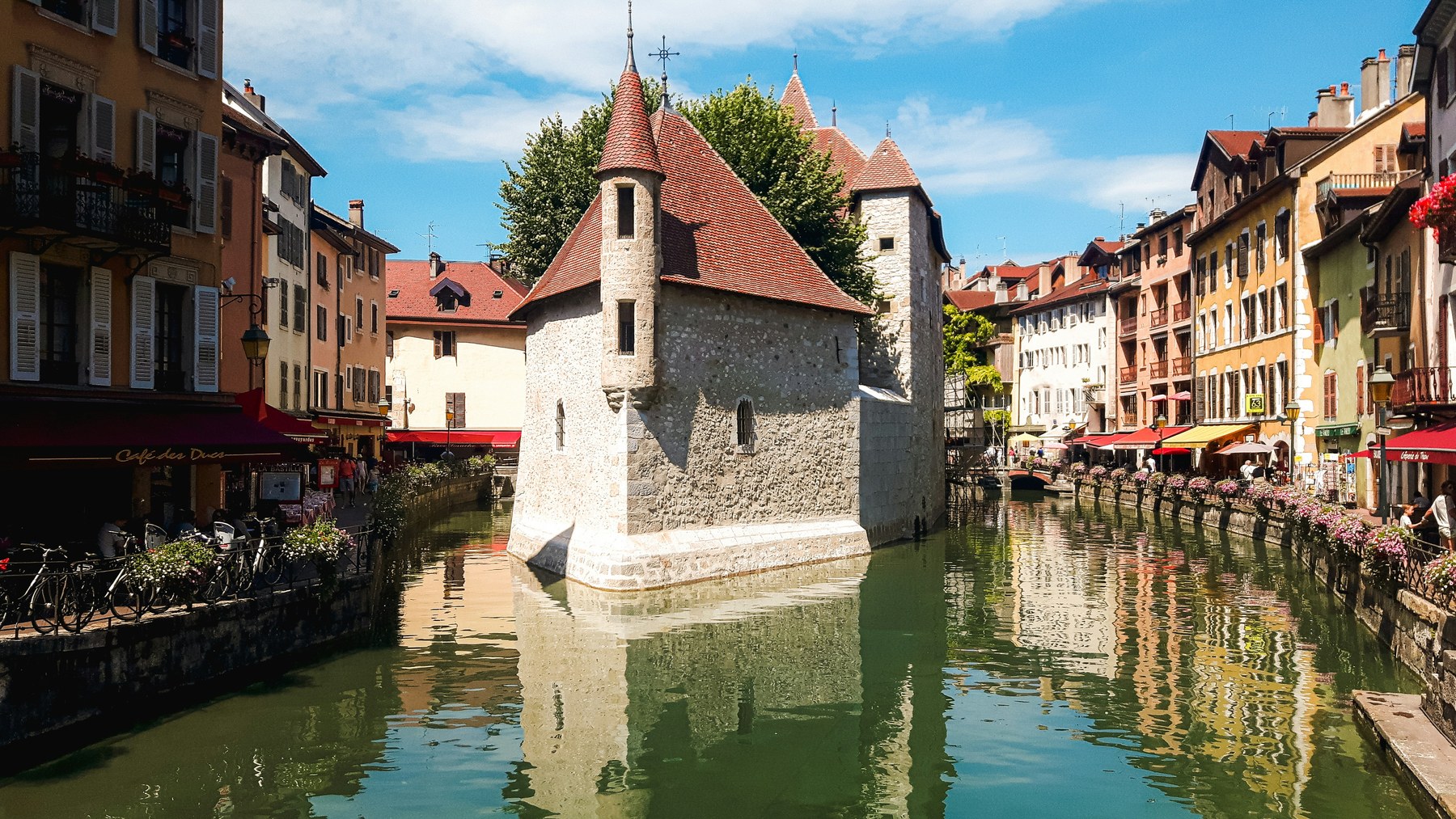
Yes, it is the photograph everybody takes.
But the Palais de l'Île is much stranger when you stop treating it as scenery. Its oldest parts date from the Middle Ages and the building sits on a natural rocky island in the Thiou. Across its long history it has served as stronghold, prison, courthouse, administrative building and even briefly faced demolition.
Stand on the bridge and look at its pointed downstream end, but then look sideways too. What matters isn't simply that a picturesque building sits in a canal. It is that the town has grown so tightly around the Thiou that the distinction between river edge and building line almost disappears.
Look for: Doors, walls and lower storeys meeting the water with very little intervening space.
The château looks coherent from below because distance simplifies it.
Up close, it isn't one building from one moment. The Counts of Geneva established their residence here in the Middle Ages, and the complex continued changing over several centuries. The massive Tour de la Reine belongs to its older defensive character; later residential ranges speak a different architectural language.
Walk around the courtyard before concentrating on museum displays. The useful thing is seeing a fortified high point gradually become a residence, then a building reused for entirely different purposes. And when you look back down towards the old town, the relationship between hill, water and settlement becomes much clearer.
Don't nominate one street as the sight. Walk beneath the arcades instead.
In parts of old Annecy, upper floors extend over sheltered pedestrian space, giving narrow streets another layer. Shops occupy the ground level, façades rise directly above you and the route repeatedly opens towards bridges or water.
This is modest architecture doing useful work. The arcades matter because they help the town fit everyday movement and commerce into an already tight urban fabric.
Details to notice
After you've seen the Palais de l'Île, don't immediately turn back towards the lake. Follow the Thiou downstream.
The famous view quickly becomes an ordinary working relationship between water, buildings, bridges and streets. The river narrows and widens, disappears behind structures and reappears; the old town gradually loses some of its theatrical prettiness.
That's useful. The Palais de l'Île is memorable because it concentrates Annecy's relationship with water into one extraordinary object. Following the Thiou shows you that the relationship belongs to the town.
Look closer
Annecy's arcades are easy to ignore because the shopfronts compete for attention.
Look instead at the supports, ceilings and changes in width. They turn parts of the street into sheltered space beneath the buildings themselves.
Why Wendelse likes it
Walk in the old town and along the lake. Cycling becomes genuinely useful if you want to cover more of the lakeside. Local transport can help with places farther around the lake, but for the central short-break experience the movement itself is part of the pleasure.
Annecy needs less itinerary than the database might suggest. Follow the water, climb through the old town, eat, then give the lake the best part of the weather. If the sun is shining, stop sightseeing and go to the lake.
Do not manufacture a checklist from every church, bridge and historic façade. Much of Annecy's value comes from the relationship between streets, water, mountains and lake rather than individual interiors.
Season changes Annecy substantially. Summer increases the value of the lake and cycling but also the crowds; colder weather makes Savoyard food and interiors more appealing. Boat and lakeside activities are seasonal, so check what is operating for the dates.
Birmingham · 6–9 November · 4 days
Built around your dates and what you said you're in the mood for. The journey itself isn't checked until you choose dates in Results.
Friday · 6 November
Arrival day
Nothing else planned. That's deliberate.
Saturday · 7 November
Weekend
Keep the afternoon free — wander, sit somewhere, do nothing.
Sunday · 8 November
Weekend
Nothing else planned. That's deliberate.
Monday · 9 November
Departure day
Leave gaps between plans — nothing here needs rushing.
Prototype itinerary. Activity availability is illustrative, not live opening hours.
Don't miss
Food & Drink
Annecy's food belongs to the Savoyard mountain world around it: Reblochon, charcuterie, diots, potato dishes and Alpine cheeses make hearty sense after lake and mountain time.
Art & Architecture
Annecy is less about monumental scale than the relationship between water and fabric: medieval lanes, Renaissance arcades, canals, bridges and the castle terrace create its distinctive urban character.
Choose your dates and we'll check real flights and the journey from Birmingham.
Check a journey for your dates →Traveller fit
Follow the Thiou through the old town, see Palais de l'Île, wander beneath the Rue Sainte-Claire arcades and climb towards the Château. Come back down by whichever smaller streets look interesting, have lunch, then spend the afternoon around the Pâquier and lakeside.
Let the weather decide. A good day belongs to the lake: walk or cycle farther, take a boat if it adds something, or simply spend longer outside. Use poorer weather for the Château, museums and slower old-town time.
Extra time is useful for going farther around the lake, not for inventing more central sights. Treat good weather as an opportunity and bad weather as permission to slow down.
Where to stay
Best for first-time visitors and no-car lake breaks
The old town keeps restaurants and heritage close; the lakefront and cycle routes begin within an easy walk.
Annecy
4 days · Walkable · Outdoors · Food · History · Architecture
Prototype placeholders — nothing is connected to a booking service yet.